
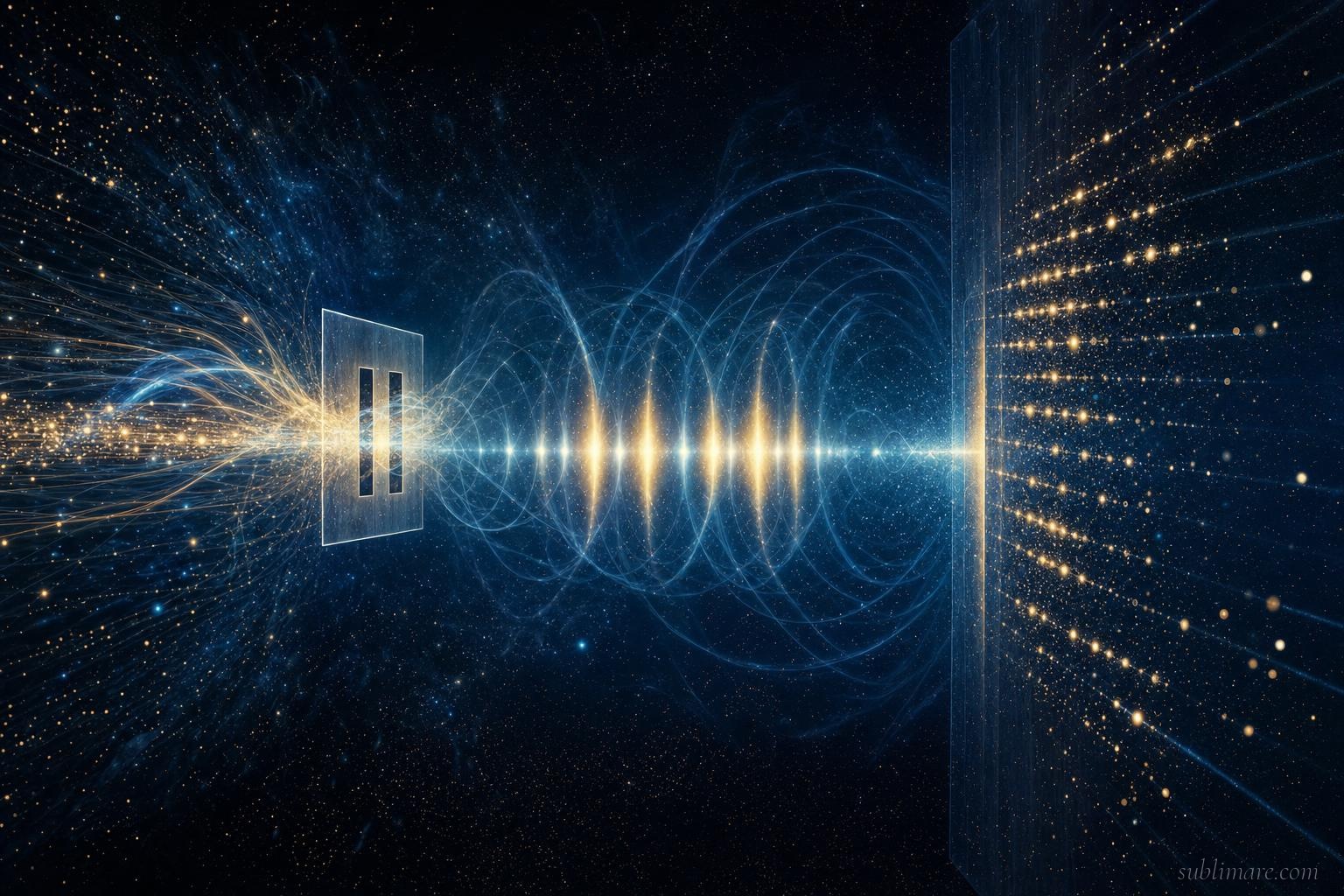
For most of human history, we assumed reality was simple: things exist, they have fixed properties, and they behave predictably whether or not anyone is watching.
Then quantum physics arrived — and changed everything.
What scientists discovered at the subatomic level is so strange, so counterintuitive, that even the physicists who study it full-time still argue about what it means. Richard Feynman, one of the greatest physicists of the 20th century, famously said: “If you think you understand quantum mechanics, you don’t understand quantum mechanics.”
This isn’t a post that will claim quantum physics “proves” spirituality is true. That would be an overreach — and intellectually dishonest. What it can do is show you what quantum physics genuinely reveals about the nature of reality — and why those findings are far more mysterious, and far more fascinating, than most of us were taught in school.
The Classical Worldview: A Reality of Solid Things
Before quantum physics, the dominant model of reality was Newtonian — built on the idea that the universe is essentially a giant machine. Particles are solid. Their positions and speeds can be measured precisely. The universe runs on predictable laws, like clockwork.
In this worldview, reality doesn’t depend on you. A tree in a forest makes a sound when it falls whether or not anyone is there to hear it. Matter exists independently of observation.
This model worked beautifully — and still does, at human scales. But when scientists started looking at the very small — atoms, electrons, photons — the clockwork stopped ticking the way anyone expected.
The Double-Slit Experiment: When Observation Changes Everything
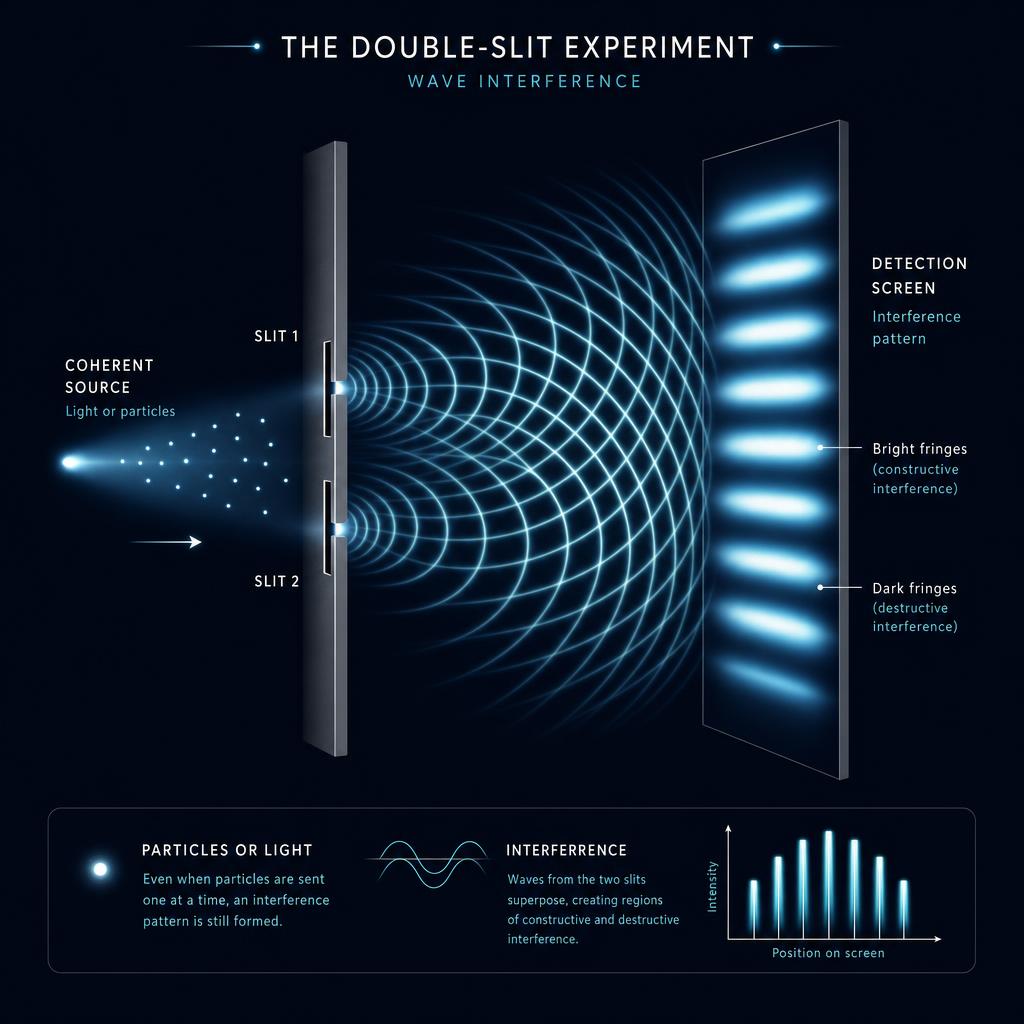
One of the most mind-bending experiments in the history of science is the double-slit experiment. Here’s the setup:
Fire particles — say, electrons — one at a time at a barrier with two slits. On the other side, a detector screen records where each particle lands.
What you’d expect: two clusters of dots on the screen, one behind each slit.
What actually happens: an interference pattern — the same rippled wave pattern you’d see if you dropped two stones in a pond. The electrons behave like waves, passing through both slits simultaneously and interfering with themselves.
But here’s where it gets stranger.
When scientists set up a detector to measure which slit each electron actually passes through — to observe the path — the interference pattern disappears. The electrons suddenly behave like particles again, forming two clusters.
The act of measurement changes the outcome.
This isn’t a measurement error or an instrument problem. It’s a fundamental feature of quantum reality. The electrons behave differently depending on whether they are being observed. Reality, at the quantum level, seems to respond to attention.
Wave-Particle Duality: Reality Is Both, Until It Isn’t
The double-slit experiment reveals something even deeper: quantum objects don’t have a fixed identity until they are measured.
An electron isn’t a wave or a particle — it exists in a superposition of both states simultaneously. Only when it’s observed does it “collapse” into a definite state. Before observation, it’s smeared across probability — a cloud of potential, not a fixed thing.
This is called wave-particle duality, and it’s one of the most experimentally confirmed facts in all of physics.
The philosophical question this raises is obvious: what does it mean for something to exist if its properties aren’t defined until they’re observed?
The Observer Effect: Does Consciousness Play a Role?

The “observer” in quantum mechanics doesn’t have to be a conscious being — technically, any interaction that constitutes a measurement counts. A photon hitting a detector is a “measurement.” The universe itself can be an observer.
But some of the most serious physicists in history — including Niels Bohr, Werner Heisenberg, John Wheeler, and Eugene Wigner — have taken seriously the idea that consciousness may play a special role in collapsing quantum states.
John Wheeler proposed the concept of a participatory universe: one in which observers are not passive bystanders but active participants in bringing reality into existence. In his view, the universe is not just “out there” — it is, in some sense, co-created by the act of observation.
This doesn’t mean your thoughts literally shape physical reality in the way some pop-spirituality claims suggest. But it does mean that the line between the observer and the observed is far blurrier than classical physics ever assumed.
Quantum Entanglement: The Universe Is Non-Local
Perhaps the strangest quantum phenomenon of all is entanglement.
When two particles interact in certain ways, they become “entangled” — their quantum states are correlated, no matter how far apart they become. Measure the state of one particle, and the state of the other is instantly determined — even if it’s on the other side of the galaxy.
Einstein called this “spooky action at a distance” and refused to believe it was real. But decades of experiments — most conclusively a series of tests known as Bell’s theorem experiments — have confirmed it beyond any reasonable doubt.
The implications are profound: the universe is non-local. Separation may be, in some deep sense, an illusion. Parts of reality that appear disconnected are entangled — fundamentally, inextricably linked.
Many spiritual traditions have said something like this for millennia. Quantum entanglement doesn’t validate those claims scientifically — the scales are different, the mechanisms uncertain. But the resonance is hard to ignore.
What This Means — and What It Doesn’t

Let’s be precise about what quantum physics does and doesn’t tell us.
What it does tell us:
- Reality at the quantum level is genuinely strange and non-classical
- The act of measurement has a physical effect on outcomes
- Particles don’t have fixed, defined properties before being observed
- The universe is non-local — entanglement is experimentally confirmed
- Our intuitions about solid, independent, objective reality are incomplete at best
What it doesn’t tell us:
- That your positive thoughts attract wealth or healing
- That consciousness directly controls physical reality at human scales
- That quantum mechanics validates any specific spiritual or religious tradition
- That science and spirituality are the same thing
The popular trend of using quantum physics to justify metaphysical claims — sometimes called “quantum mysticism” — often misapplies real science to make things sound more credible than they are. At Sublimare, we take the science seriously enough not to stretch it.
But here’s what is worth sitting with: the deepest scientific investigation of reality reveals a universe that is participatory, interconnected, probabilistic, and observer-sensitive. That is genuinely extraordinary.
Why It Matters Beyond the Lab
You don’t need to understand the mathematics of quantum field theory to feel the weight of these discoveries.
What quantum physics invites us to do is loosen our grip on certainty. It asks us to sit comfortably with the fact that reality — even at its most fundamental level — is not the simple, solid, predictable thing we thought it was.
If the building blocks of the universe exist in states of pure potential until observed… if entangled particles remain connected across cosmic distances… if the observer and the observed cannot be cleanly separated… then the universe is stranger, more alive, and more interconnected than the classical worldview ever allowed.
And that, at least, is something worth meditating on.
If this resonated, you might also enjoy: Science and Spirituality: Why They’re Not Opposites
Up next: Does Consciousness Create Reality? A Scientific Exploration
Related Posts