You’re thinking about someone you haven’t spoken to in years. Five minutes later they text you out of nowhere. You’re wrestling with a decision about your career and you open a book at random — the passage you land on speaks directly to your situation. You hear a word you’ve never noticed before, and then you encounter it three more times that same day.
These things happen to almost everyone. Most of us don’t know what to do with them. We dismiss them as coincidence and move on, or we quietly wonder if something larger is at work, then feel embarrassed for wondering. The tension between those two responses is exactly where Carl Jung started when he introduced the concept of synchronicity in the 1950s — and where the most interesting questions about consciousness, meaning, and reality still live today.
This is an honest attempt to trace that tension: what synchronicity actually means in Jung’s framework, what science has found when it looked at meaningful coincidences, and what remains genuinely unresolved in ways that should interest anyone paying close attention.

What Jung Actually Meant
Carl Jung introduced the term synchronicity formally in 1952, in a monograph titled Synchronicity: An Acausal Connecting Principle, co-published with Nobel Prize-winning physicist Wolfgang Pauli. But he had been developing the idea since the late 1920s, when he began noticing a pattern in his clinical work that his existing frameworks couldn’t explain.
Jung defined synchronicity precisely. He didn’t mean any coincidence, or even any striking coincidence. He meant the coincidence of an inner psychological event — a thought, a dream, an emotion, a premonition — with an outer event in the world, where the two are meaningfully related but causally unconnected. The key word is meaningfully. For Jung, the meaning wasn’t imposed on the coincidence after the fact. It was intrinsic to the experience itself.
He identified three criteria for a genuine synchronicity. First, there must be a subjective inner state — some psychological content with emotional charge. Second, there must be an objective outer event, something that happens in the world independent of the person’s will. Third, the two must be meaningfully connected in a way that cannot be explained by ordinary causality — and the meaning must be apparent to the person experiencing it, not constructed through reasoning afterward.
The most famous clinical example from Jung’s own practice is the scarab story. A patient was describing a dream in which she received a piece of jewelry in the shape of a golden scarab beetle. As she spoke, Jung heard a tapping at his window. He opened it and caught a golden-green scarabeid beetle — the closest thing Central Europe has to an Egyptian scarab — flying into the room. He handed it to his patient and said, “Here is your scarab.”
The timing mattered clinically. The patient had been stuck in therapy, overly rational, resistant to the emotional and symbolic dimensions of her experience. The beetle broke through. Something in the coincidence, in the sheer improbability of it timed to that exact moment, pierced her defenses. Jung considered it a turning point in her treatment.
What’s important to understand is that Jung was not claiming the universe sent a beetle to help his patient. He was pointing at something more subtle: that inner states and outer events can resonate with each other in ways that ordinary causality doesn’t account for, and that this resonance can carry meaning. His question was not “did that beetle appear on purpose?” His question was “what is the nature of the connection between psyche and world?”
The Pauli-Jung Conjecture
The collaboration between Jung and Pauli was one of the more unusual intellectual partnerships of the 20th century. Pauli, one of the founding figures of quantum mechanics and a rigorous scientist, came to Jung initially as a patient in 1930 following a personal crisis. Their relationship eventually evolved into a genuine intellectual exchange that lasted until Pauli’s death in 1958.
Pauli was troubled by the same question Jung was pursuing, approached from the opposite direction. Quantum mechanics had by then established that at the subatomic level, the act of observation affects what is observed. The sharp boundary between mind and matter, between the observer and the observed, had become philosophically untenable. Pauli was interested in whether physics and psychology might share a common foundation — whether the ordering principles that governed quantum phenomena and the ordering principles that governed the psyche might be aspects of the same underlying reality.
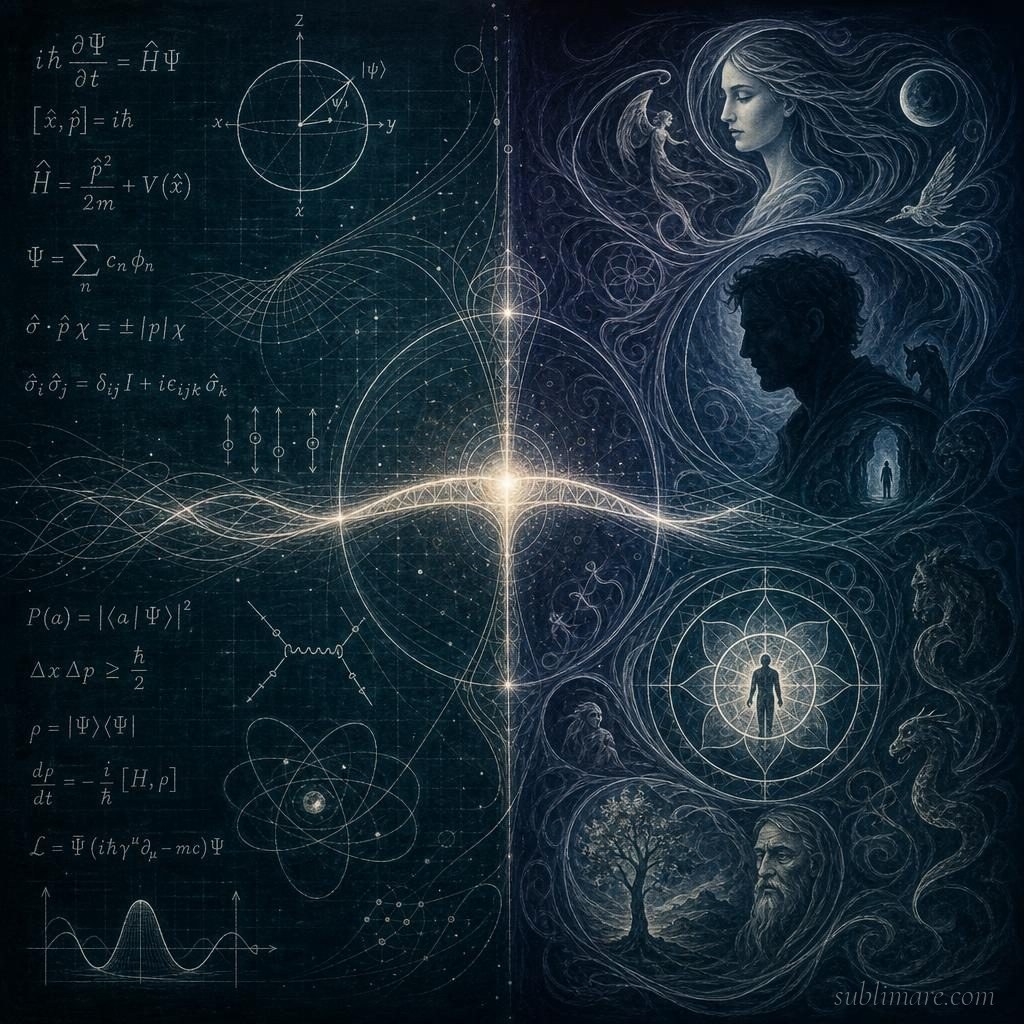
Their joint work proposed what became known as the Pauli-Jung conjecture: that reality has both a physical and a psychic aspect, and that both are governed by the same ordering principles — causal ones that science studies through normal means, and acausal ones that manifest as synchronicities. They weren’t claiming that mind causes physical events. They were proposing that mind and matter might share a deeper organizational layer that makes certain correspondences between them possible.
This remains speculative. Pauli and Jung said so themselves. But it’s worth noting that this speculation came from one of the most technically accomplished physicists of his era, not from someone dismissing rigorous science. Pauli took the question seriously precisely because the foundations of quantum mechanics had made certain easy dismissals impossible.
What the Skeptics Have Right
The standard scientific response to synchronicity is that it’s a product of well-documented cognitive biases, and this response has real substance worth taking seriously.
The most relevant concept is apophenia — the tendency to perceive meaningful connections between unrelated things. Psychiatrist Klaus Conrad coined the term in 1958 to describe a symptom he observed in schizophrenia: patients finding personal significance in random events. But apophenia in milder forms is a universal feature of human cognition, not a pathology. Our brains are pattern-recognition systems. They evolved to detect signal in noise, to infer intention behind events, to find structure in randomness. This was almost certainly adaptive. Detecting the pattern of a predator in ambiguous sensory data is worth it even if it produces false positives.
Confirmation bias compounds this. We notice and remember the times the phone rings just as we think of someone. We don’t notice or remember the far more numerous times we think of someone and nothing happens, or the times the phone rings when we weren’t thinking of the caller at all. The hits accumulate in memory; the misses fade. The result feels like a pattern even when it’s a statistical artifact.
The law of large numbers does the rest of the work. Given the sheer volume of experiences we have every day — thousands of thoughts, perceptions, and events — some meaningful-seeming coincidences are statistically inevitable. The birthday problem in statistics shows that in a room of just 23 people, there’s a 50% chance two of them share a birthday. This seems counterintuitive because we’re bad at grasping large possibility spaces. Our intuitions about probability evolved for small-scale, immediate situations. We’re not built to intuitively assess the odds across a lifetime of human interaction.
All of this is true and important. These mechanisms are real, well-documented, and they explain a great deal of what people experience as synchronicity. The skeptical position isn’t wrong to invoke them.
But there’s a version of the skeptical argument that overreaches — that assumes these mechanisms explain everything, that because we have a plausible cognitive story, the phenomenon is fully accounted for. This is the part that deserves scrutiny.
What the Research Actually Shows
There’s a growing body of empirical research on meaningful coincidences that produces some genuinely interesting results — results that don’t fit neatly into either the “it’s all cognitive bias” or “it’s cosmic communication” frameworks.
A 2024 study published in the journal Cognition and Emotion found that positive emotional states predict a higher frequency of meaningful coincidence experiences the following day. This matters because it cuts against the pure cognitive-bias explanation: if you were simply primed by confirmation bias, you’d notice more coincidences in negative states (heightened vigilance, scanning for threats) rather than positive ones. The relationship between emotional openness and meaningful coincidence perception suggests something more nuanced than random noise filtered through bias.
A 2024 study in PLOS ONE explored the relationship between meaningful coincidences and creativity across multiple empirical studies. It found that people who regularly experience meaningful coincidences engage in more creative activities — not because they’re more prone to magical thinking, but because coincidences seem to function as sources of meaning that catalyze creative engagement. The researchers were careful to note that openness to experience (the personality trait most associated with creativity) showed a weaker connection than expected, suggesting the relationship isn’t simply a personality confound.
Research by Bernard Beitman, a psychiatrist and former chair of psychiatry at the University of Missouri, has documented coincidence systematically over decades. His Weird Coincidence Survey, administered to thousands of respondents, found that the frequency of coincidence experiences correlates with what he calls “self-referential thinking” — the degree to which you notice your own mental states and their relationship to the world. This is interesting because self-referential thinking is not the same as magical thinking. It’s closer to mindfulness: attentiveness to one’s own inner state and its relationship to outer experience.
None of this proves that synchronicities are “real” in the sense of representing some external ordering force. But it does suggest that meaningful coincidence is a genuine psychological phenomenon with measurable correlates, and that reducing it entirely to cognitive bias is too simple.
The Philosophical Problem That Remains
Here’s the question that the cognitive-bias explanation can’t quite close: what is meaning, and where does it come from?
When we say that a coincidence is “merely” a product of pattern-recognition bias, we’re implicitly saying that the meaning a person finds in it is illusory — a story the brain tells, not a feature of reality. But this assumes we already know what reality is like at its most fundamental level, and that meaning is not among its contents. This is a philosophical assumption, not a scientific finding.
Consciousness researchers, including those working in the most rigorous scientific contexts, have not solved what philosopher David Chalmers calls the “hard problem of consciousness” — why there is subjective experience at all, why physical processes give rise to the felt sense of being someone. The relationship between mind and world remains philosophically unresolved at a deep level. That’s directly relevant to synchronicity, because synchronicity is precisely about the relationship between inner experience and outer event.
If you’ve read about what consciousness science actually knows (and doesn’t know) about this problem, you’ll recognize that the frontier of that inquiry opens directly onto questions like the ones Pauli and Jung were asking. If you haven’t, the post on what consciousness actually is covers why these questions are so much harder than they appear.
The honest position is: we don’t know enough about the nature of mind and its relationship to reality to confidently dismiss synchronicity as purely illusory. We also don’t know enough to confirm it as a cosmic ordering principle. What we have is a genuine phenomenon — one that virtually everyone experiences, that correlates with meaningful psychological states, that has resisted easy explanation — and a set of open questions about the nature of consciousness that are directly relevant to it.

How to Work With Synchronicity Without Losing Your Footing
There’s a practical dimension here that doesn’t require resolving the metaphysical questions. However synchronicities arise — whether through the nature of mind and matter, or through the more ordinary mechanics of pattern recognition and attention — they tend to carry information worth examining.
The key distinction is between using synchronicity as a prompt for inquiry and using it as a source of certainty. The former is useful; the latter is where things go sideways.
Pay attention to the emotional charge. Jung consistently emphasized that genuine synchronicities carry numinosity — a quality of felt significance that is immediate, not reasoned into. If something strikes you as meaningful in that way, it’s worth asking: what is this touching in me? What is the inner state that’s being resonated with? The outer event is a mirror pointing inward.
Keep a synchronicity journal. Not to prove the phenomenon, but to track it. When you write down the coincidences you experience, you begin to notice patterns in what you were thinking, feeling, or grappling with when they occur. This is more like the kind of journaling that deepens self-knowledge than it is fortune-telling. The coincidences become data points about your inner life.
Don’t use coincidences as decision-making shortcuts. This is where synchronicity thinking becomes genuinely problematic. Making significant life decisions because “the universe sent a sign” bypasses the hard work of actual discernment. Synchronicities can open questions. They should not close them. If a coincidence points you toward a possibility, investigate that possibility on its own merits.
Notice the timing relative to psychological transitions. Many people report an increase in synchronicities during periods of significant inner change — grief, transformation, creative breakthroughs, periods of intensive inner work. Whether this reflects a real shift in the world or a shift in attention and receptivity, the correlation is worth noting. These are often the moments when the inner life most needs engagement.
Hold the meaning lightly. Jung’s own approach to synchronicity was exploratory rather than dogmatic. He didn’t claim to know exactly what they were. He claimed they were real phenomena worth taking seriously, that they carried meaning, and that dismissing them reflexively was as much an error as taking them as literal cosmic messages. That’s a reasonable epistemic position to hold: open without being credulous.
The Real Question Underneath
The fascination with synchronicity points at something deeper than the phenomenon itself. What people are really asking when they wonder about meaningful coincidences is: is meaning intrinsic to the universe, or do we project it onto a fundamentally indifferent reality? Is there some kind of intelligence or order in the fabric of things, or are we alone with our minds in an unresponsive cosmos?
These are not questions science has answered. They may not be questions science can answer in its current form. They’re philosophical and ultimately experiential — the kind of questions that get resolved, if at all, through a sustained engagement with your own inner life and its relationship to the world around you.
What synchronicity offers, at minimum, is a reason to pay attention. To notice the texture of your experience more carefully. To ask what your inner life is doing when the outer world seems to echo it. Whether that noticing leads you toward a metaphysics of interconnection or toward a deeper appreciation of your own mind’s creative meaning-making, the practice of attending to it carefully is unlikely to leave you worse off.
Jung spent the last decades of his life working on these questions and never claimed to have resolved them. He considered synchronicity one of the most important phenomena in his clinical and theoretical work, and one of the least understood. Sixty-some years later, that’s still roughly where things stand.
That, too, might be meaningful.
Frequently Asked Questions
What is synchronicity, according to Jung?
Carl Jung defined synchronicity as the meaningful coincidence of an inner psychological event — a thought, dream, feeling, or premonition — with an outer event in the world, where the two are related in meaning but not by cause and effect. He introduced the concept formally in 1952 and considered it evidence of an “acausal connecting principle” that operates alongside ordinary causality.
Is synchronicity the same as coincidence?
Not exactly. All synchronicities are coincidences, but not all coincidences are synchronicities. Jung’s definition requires three things: an inner psychological state, an outer event, and a meaningful connection between them that is felt immediately, not constructed after the fact. An ordinary coincidence can be surprising without being meaningful in this deeper sense.
What does science say about synchronicity?
Science offers several explanations for coincidence experiences: confirmation bias, apophenia (the tendency to perceive patterns in randomness), and the law of large numbers (which makes unlikely events statistically inevitable over time). Recent research also shows that meaningful coincidence experiences correlate with positive emotional states and creative engagement, suggesting the phenomenon is more psychologically complex than pure cognitive bias. The question of what, if anything, underlies the experience beyond cognition remains open.
Why do synchronicities seem to happen more during difficult times?
There are at least two possible explanations. One is attentional: during emotionally charged periods, we’re more alert and more likely to notice correspondences between inner and outer experience. The other is psychological: times of transition naturally heighten our search for meaning, making us more receptive to experiences that seem to carry it. Jung observed that synchronicities often cluster around moments of psychological intensity, which he considered significant regardless of their ultimate cause.
How can I tell if something is a genuine synchronicity or just a coincidence?
Jung suggested looking for numinosity — an immediate felt sense of significance that doesn’t require reasoning your way into it. If a coincidence requires you to construct a story about why it’s meaningful, it probably isn’t a synchronicity in Jung’s sense. If the significance hits before you’ve had a chance to think about it, that’s closer to what he was pointing at. Even then, he recommended holding the meaning with curiosity rather than certainty.