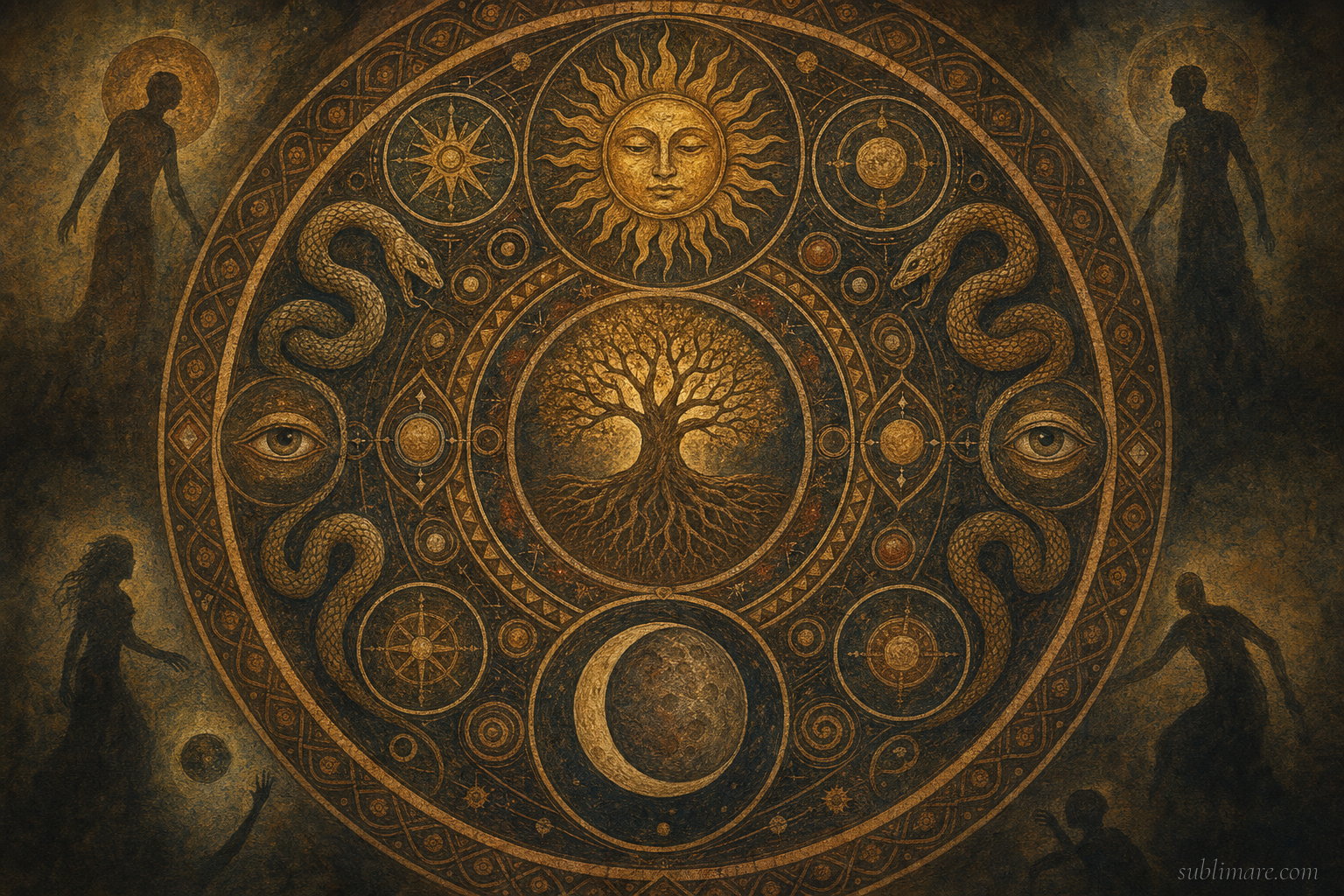
Here’s something that used to puzzle me: why do the same symbols keep appearing in myths from cultures that had no contact with each other?
The great flood story appears in ancient Mesopotamia, in Genesis, in Hindu texts, in Native American traditions, in ancient China. The hero’s journey — departure, initiation, return — shows up in Greek mythology, in African folklore, in stories from the Amazon. The wise old man, the trickster, the great mother — they’re everywhere.
Carl Jung had a theory about why.
Jung’s Model of the Psyche
Jung divided the unconscious into two layers. The personal unconscious is unique to you — it contains your repressed memories, forgotten experiences, and personal complexes. Standard Freudian territory.
But beneath that, Jung proposed something he called the collective unconscious. A layer of the psyche that isn’t personal at all. That’s shared across all human beings. That contains inherited patterns — not memories exactly, but predispositions to experience and respond to life in certain ways.
He called these patterns archetypes.
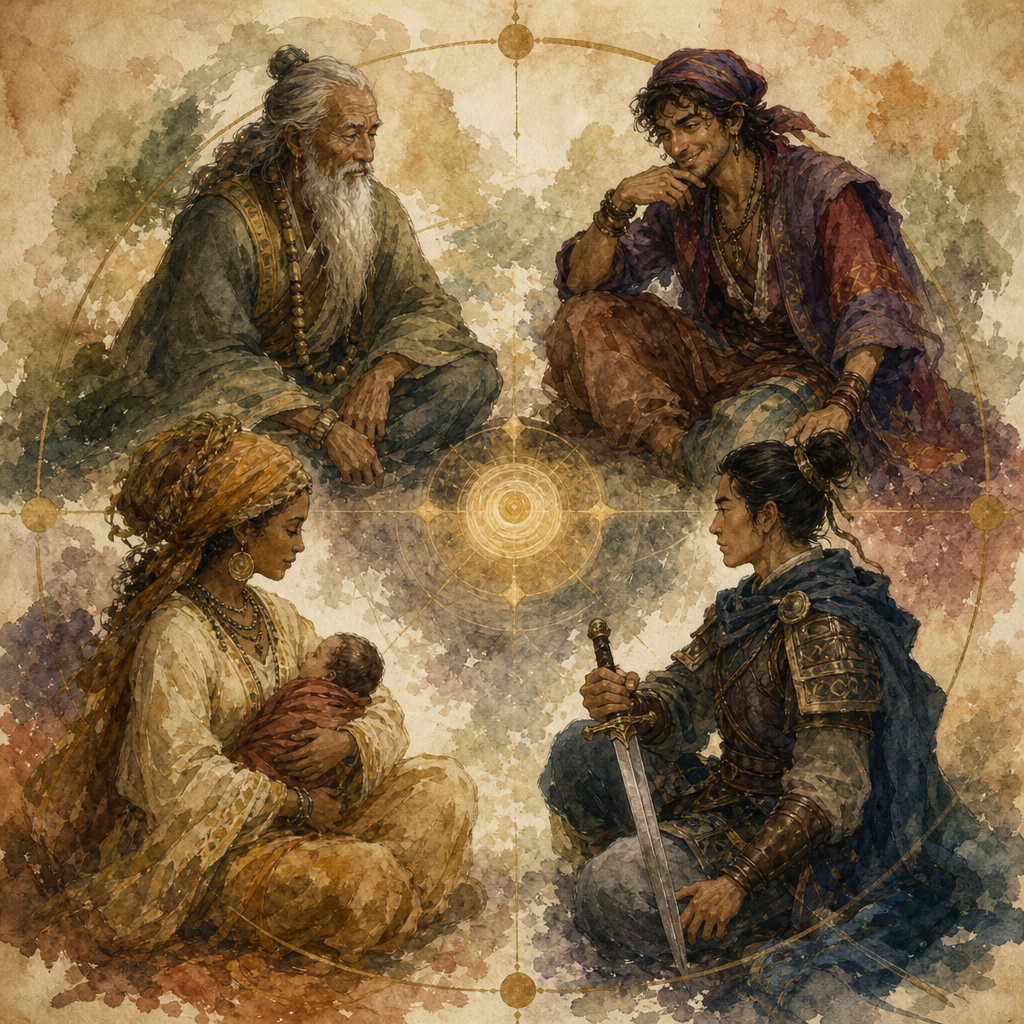
What Archetypes Are
Archetypes aren’t images or symbols themselves — they’re more like tendencies. Predispositions to form certain kinds of images and to have certain kinds of experiences.
The Mother archetype, for example, doesn’t look the same in every culture. But every culture has some version of it. A primal force of nurturing, creation, and sometimes consuming — appearing in myths as Isis, Kali, Mary, Gaia. The specific form changes. The underlying pattern doesn’t.
The Shadow — the parts of ourselves we reject and deny — is an archetype. So is the Self, the Hero, the Trickster, the Wise Old Man. Jung spent decades cataloguing these patterns across world mythology and his patients’ dreams.
Is It Literally Real?
This is where people get divided. Some take Jung’s framework as literally true — that there’s an actual shared psychic field connecting human beings. Others treat it as a useful metaphor for the fact that humans have common biology, common evolutionary history, and common existential challenges.
The metaphorical version is scientifically defensible. We’re all running similar hardware. Of course we produce similar software. The deeper question — whether there’s actual information shared across individual minds — is where it gets speculative.
Some researchers connect this to ideas like the Akashic Field or quantum theories of consciousness. I explored the Akashic Field angle in detail in this post if you want to go deeper there.
Where You Might Be Tapping Into It
Jung believed the collective unconscious speaks most clearly through dreams, through art, through religious and mythological imagery, and through what he called “big dreams” — dreams that feel archetypal and universal rather than personal and mundane.
If you’ve ever had a dream that felt like it came from somewhere larger than your own history — or been moved by a myth or a symbol in a way that felt disproportionate to the content — Jung would say you were touching something real. Something inherited rather than learned.
Why It Still Matters
Whatever you think of the metaphysics, Jung’s practical contribution is enormous. The idea that we’re not as separate as we think — that beneath our individual differences lies a shared human inheritance — has implications for how we understand creativity, culture, religion, and healing.
It also offers a different relationship to the symbolic and the mythic. Your dreams aren’t just noise. The stories you’re drawn to aren’t random. The archetypes that keep showing up in your life — the struggle with the shadow, the search for the Self — these might be less personal quirks and more universal chapters.
You’re not just living your life. You might be living a pattern as old as the species.