
There’s a particular kind of experience most people have had at least once, usually by accident. You’re deep into something — writing, painting, playing an instrument, running, coding, even washing dishes with unusual focus — and at some point you look up and an hour has vanished. You weren’t watching the clock. You weren’t thinking about yourself, your performance, or what came next. You were just doing the thing, completely absorbed, and it felt, paradoxically, both effortless and intensely alive.
Psychologist Mihaly Csikszentmihalyi gave this experience a name in 1975: flow. He spent decades studying it across cultures and professions — rock climbers, surgeons, chess players, assembly-line workers, composers — and found the same structural pattern showing up again and again, regardless of the activity’s content. Fifty years later, flow has become one of the most studied states in positive psychology, and in the last decade neuroscience has finally started to map what’s actually happening in the brain when it occurs.
This post covers what flow actually is, the neurochemistry and brain-network changes underlying it, and — most usefully — what the research says about how to invite it more reliably, rather than waiting for it to happen by accident.
What Csikszentmihalyi Actually Found
Csikszentmihalyi’s research method was itself distinctive. Rather than studying flow in a lab, he used what’s called the Experience Sampling Method — pagers (later smartphones) that would go off at random intervals throughout a person’s day, prompting them to record what they were doing and how they felt in that exact moment. This gave him thousands of snapshots of real lived experience rather than retrospective, potentially distorted self-reports.
Across an enormous range of activities and cultures, he identified a consistent set of characteristics present when people reported their most engaged, most satisfying moments. The core structural requirement, and the one that has held up most robustly in later research, is the challenge-skill balance: flow occurs when the difficulty of a task closely matches a person’s current skill level — challenging enough to require full engagement, but not so difficult that it produces anxiety, and not so easy that it produces boredom. Csikszentmihalyi visualized this as a channel: too much challenge relative to skill pushes you into anxiety; too little pushes you into boredom; the narrow band in between is where flow becomes possible.
Beyond the challenge-skill balance, he identified several other recurring conditions: clear goals (you know, moment to moment, what you’re trying to do), immediate feedback (you can tell, without delay, whether you’re succeeding), and — as a consequence of full engagement — several distinctive experiential features: intense concentration on the present moment, a merging of action and awareness where the activity feels automatic rather than deliberated, a loss of self-consciousness, a sense of personal control over the situation, a distortion of time perception (usually time speeding up, occasionally slowing down), and the activity becoming intrinsically rewarding — worth doing for its own sake, independent of any external outcome.
A 2024 Guardian feature on flow research summarized Csikszentmihalyi’s core finding well: flow isn’t primarily about the activity itself. It’s about the structure of attention during the activity. Almost any sufficiently complex task — physical, intellectual, creative, even manual labor — can produce flow if the challenge-skill balance and feedback conditions are right.
What’s Actually Happening in the Brain
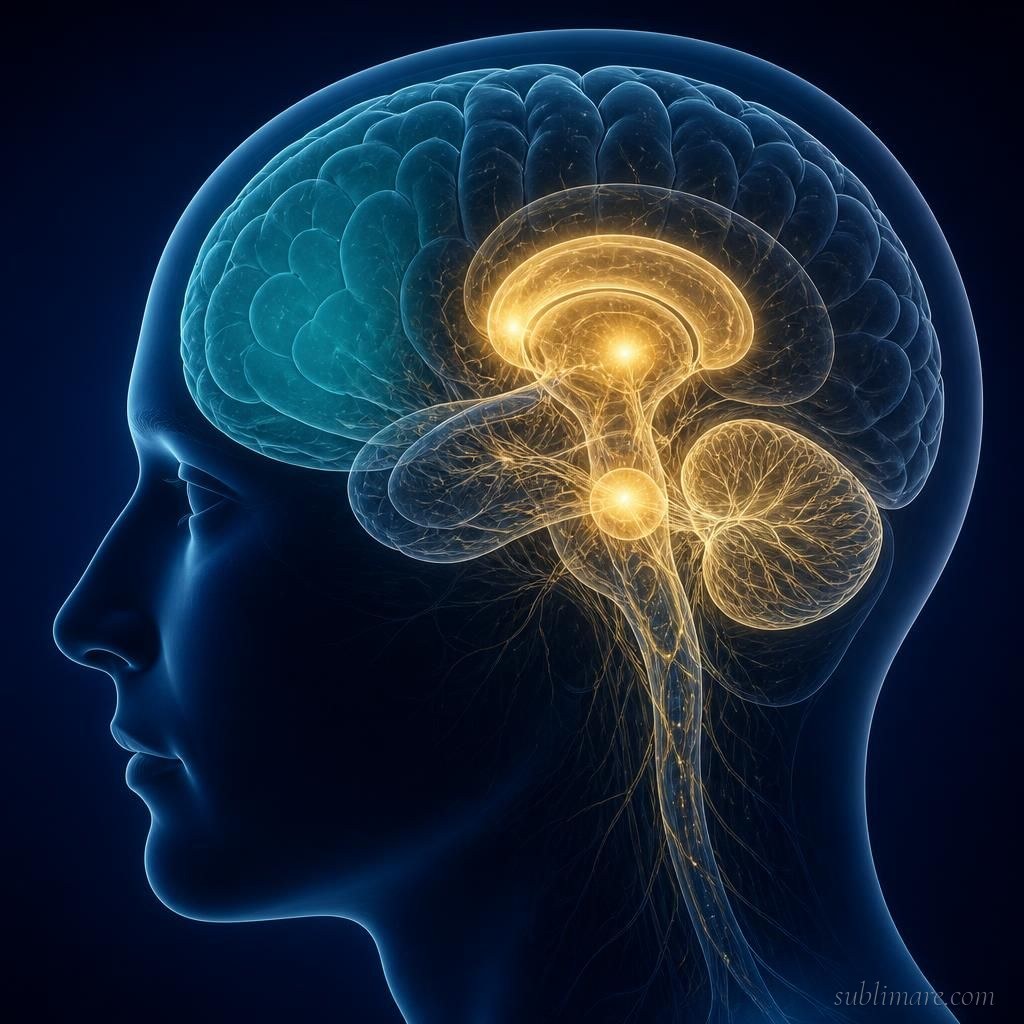
For most of flow’s research history, the phenomenon was described almost entirely in psychological and phenomenological terms — what it feels like, what conditions produce it — without a clear account of the underlying neuroscience. That’s changed substantially in the past decade, and the emerging picture is genuinely interesting.
Transient Hypofrontality
One of the most influential theories, proposed by psychologist Arne Dietrich, is called transient hypofrontality — the idea that during flow, activity in parts of the prefrontal cortex temporarily decreases. This sounds counterintuitive, since the prefrontal cortex is generally associated with higher cognitive functions: planning, self-monitoring, deliberate reasoning, and — crucially for this theory — the ongoing internal narration most people carry about themselves and their performance.
Dietrich’s theory holds that flow’s hallmark features — the loss of self-consciousness, the sense that action is happening automatically rather than being deliberately controlled, the quieting of the inner critic — result from a temporary downregulation of the specific prefrontal regions responsible for self-referential thought and explicit, effortful monitoring. With that internal chatter quieted, attention becomes fully available for the task itself, and well-practiced skills can execute through more automatic, implicit neural pathways rather than being consciously micromanaged step by step.
The theory has notable real-world resonance. Elite athletes — a frequently cited example is basketball player Stephen Curry — describe their best performances as feeling automatic, almost as though they’re watching themselves perform rather than consciously directing each movement. That subjective account matches what transient hypofrontality would predict: skilled, well-rehearsed action proceeding without the interference of explicit, effortful self-monitoring.
The theory isn’t without critics. Some researchers argue that certain flow-adjacent activities — particularly those requiring real-time creative judgment or complex decision-making — likely still require meaningful prefrontal engagement, and that a blanket “prefrontal shutdown” model oversimplifies what’s happening. The more careful current framing is that specific subregions of the prefrontal cortex, particularly those tied to self-referential processing, show reduced activity, rather than a wholesale shutdown of frontal lobe function.

The Neurochemical Signature
Flow research has identified a distinctive neurochemical profile involving several neurotransmitters and neuromodulators working together, rather than any single “flow chemical.”
Dopamine plays a central role in motivation and reward anticipation, and is elevated during flow states, contributing to sustained engagement and the sense that the activity itself is intrinsically rewarding — not just useful for some later payoff, but satisfying in the moment.
Norepinephrine, released by a brainstem structure called the locus coeruleus, has emerged as a particularly important piece of the puzzle. A 2021 mini-review in a peer-reviewed psychology journal proposed that the locus coeruleus-norepinephrine (LC-NE) system is central to flow’s onset, because this system directly regulates attention and the brain’s capacity to filter relevant information from distraction. The LC-NE system operates in different modes: a focused, “phasic” mode that sharpens attention on task-relevant stimuli, and a more diffuse, “tonic” mode associated with scanning and distractibility. Flow appears to correspond to a shift toward the phasic mode — tightly focused, high-fidelity attention on the task at hand, with distractions effectively filtered out before they reach conscious awareness. Researchers have even used pupil diameter, which correlates with LC-NE activity, as a physiological marker for how deeply someone is in a flow state.
Beyond dopamine and norepinephrine, research has also implicated endorphins (contributing to the pleasurable quality of flow and reduced perception of effort or discomfort), anandamide (an endocannabinoid associated with reduced anxiety and enhanced lateral thinking, sometimes linked to the mental ease characteristic of flow), and serotonin (contributing to overall mood elevation during and after flow experiences). The combined effect of this neurochemical cocktail is thought to explain why flow states are not just productive but subjectively pleasurable — a rare combination, since peak performance and peak enjoyment don’t usually coincide this cleanly in other contexts.
The Network-Level Picture
More recent theoretical work has moved beyond single regions or chemicals to describe flow as a coordinated shift across large-scale brain networks. A comprehensive 2021 review proposed that flow involves a specific interaction among three major networks: the Default Mode Network (DMN, associated with self-referential thought and mind-wandering, which quiets down during flow), the Central Executive Network (CEN, associated with focused, goal-directed cognitive control, which becomes more efficiently engaged), and the Salience Network (which helps determine what’s relevant and worth attending to, sharpening its filtering during flow to keep distractions out).
This network-level framing helps explain flow’s most distinctive subjective feature: the quieting of self-referential thought. The DMN is heavily implicated in the ongoing narrative of “me” — self-evaluation, rumination, the running commentary most people experience as background noise in ordinary waking life. Its reduced activity during flow corresponds directly to the felt sense of losing self-consciousness, of the boundary between “the one performing” and “the performance” dissolving.
The Performance Numbers
Flow’s effects on performance aren’t just subjectively pleasant — they’re measurable and, in some studies, dramatic. A widely cited peer-reviewed review on the neuroscience of flow in creativity and productivity reported productivity increases of up to 500 percent for individuals in flow states compared to their normal baseline performance, alongside significant improvements in learning rate and creative output.
This isn’t limited to elite performers in specialized domains. Research on flow in a wide range of settings — from online gaming (a 2024 study using response surface analysis on 528 participants found flow experiences were highest both when skill closely matched moderate challenge and when both skill and challenge were high simultaneously) to workplace productivity to neurorehabilitation for stroke and traumatic brain injury patients — consistently finds that structuring tasks around the challenge-skill balance measurably improves both engagement and outcomes.
Beyond raw performance, flow also has documented benefits for wellbeing independent of productivity: reduced anxiety, improved emotional regulation, and — notably — a protective effect against burnout. Because flow is intrinsically rewarding rather than dependent on external validation, cultivating more of it in daily work and creative life appears to build resilience against the chronic depletion that characterizes burnout, rather than simply producing more output at the same psychological cost.

How to Actually Invite Flow
Flow can’t be commanded directly — you can’t simply decide to enter it the way you might decide to stand up. But the research is clear that specific conditions dramatically increase the odds of it emerging, and you have meaningful control over most of them.
Calibrate the challenge deliberately. This is the single most consequential lever. If a task feels boring, you’ve likely miscalibrated it too easy relative to your current skill — find a way to raise the difficulty, add a constraint, or increase the stakes. If a task produces anxiety or overwhelm, it’s calibrated too hard — break it into a smaller, more achievable component. The goal is the narrow channel where the task genuinely stretches your current ability without exceeding it. This calibration needs to be revisited regularly, since skill improves with practice and yesterday’s appropriate challenge becomes today’s boredom.
Build in immediate feedback loops. Flow requires knowing, moment to moment, whether you’re succeeding. Activities with built-in, instant feedback (a musical note landing correctly or not, a climbing hold either working or failing, code either running or erroring) naturally support flow better than activities where feedback is delayed by days or weeks. If your work lacks natural immediate feedback, it’s worth engineering some — a visible progress tracker, a checklist, a smaller sub-goal you can verify as you go.
Set a single, specific goal for the session. Ambiguous intentions (“work on the project”) don’t give the attention system anything concrete to lock onto. A specific, achievable goal for the immediate session (“finish the outline for this section”) gives your Central Executive Network a clear target, which the research suggests is a precondition for the kind of focused engagement flow requires.
Eliminate the interruption sources in advance. Because flow depends partly on the Salience Network successfully filtering out distraction, and because the LC-NE system’s phasic focused mode is disrupted by frequent context-switching, removing notifications, closing unrelated tabs, and protecting an uninterrupted block of time isn’t just good practice — it’s addressing a specific, documented neurological requirement for the state to emerge.
Give it time to onset. Research on the “first few seconds” of flow onset suggests the state doesn’t arrive instantly — there’s typically a warm-up period during which attention gradually narrows and self-referential chatter gradually quiets. Expecting flow within the first two minutes of starting a task sets an unrealistic bar; most research suggests 15 to 20 minutes of sustained, undistracted engagement is a more realistic threshold before the deeper state has a chance to emerge.
Practice the skill enough that some of it becomes automatic. Because flow partly depends on well-rehearsed action executing through implicit, less consciously monitored pathways, a certain baseline of competence is a precondition. This is part of why flow tends to elude complete beginners at a task — there isn’t yet enough automaticity for the prefrontal quieting to happen without simply producing confusion instead. Flow tends to show up more reliably once you’ve moved past the earliest, most effortful stage of learning something.
Flow and Contemplative Practice
There’s a genuine kinship between flow and the states cultivated in meditative and contemplative traditions, even though they’re usually discussed in entirely separate literatures. Both involve a quieting of self-referential thought and rumination; both involve heightened, stable attention on a single object (whether that object is the breath, a mantra, or a demanding task); both are associated with reduced Default Mode Network activity in neuroimaging studies; and both are described by practitioners as producing a distinctive loss of the ordinary sense of a separate, effortfully controlling self.
The difference is mainly one of object and intention. Meditation typically cultivates this quality of attention deliberately and without an external task or goal; flow arises as a byproduct of pursuing a challenging external activity. But the underlying neurocognitive terrain — reduced self-referential processing, sustained focused attention, a felt sense of ease despite intense engagement — overlaps substantially. If you’ve read about the morning practices that support present-moment awareness, you’re already building some of the same attentional capacities that make flow states more accessible later in the day.
The Honest Bottom Line
Flow isn’t magic, and it isn’t reserved for elite athletes or virtuoso artists. It’s a well-documented psychological and neurological state with specific, identifiable preconditions — the challenge-skill balance above all, supported by clear goals, immediate feedback, and freedom from interruption. When those conditions are met, measurable shifts occur in brain network activity and neurochemistry that produce both dramatically enhanced performance and one of the more genuinely enjoyable states human consciousness is capable of.
The practical implication is worth taking seriously: if flow feels rare in your life, it’s likely not because you’re missing some special talent or personality trait. It’s more likely because the conditions that reliably produce it — well-calibrated challenge, clear goals, tight feedback loops, protected uninterrupted time — simply aren’t being deliberately built into your days. Those conditions are almost entirely within your control to construct.
Csikszentmihalyi’s central finding, after decades of research across every culture and profession he studied, was that this kind of complete absorption is one of the most reliable sources of genuine, sustainable happiness available to humans — more reliable, in many cases, than the external achievements flow states happen to produce. That’s a significant finding to sit with: the by-product may often matter less than the state of complete engagement that produced it.
Frequently Asked Questions
What is a flow state, exactly?
Flow, a term coined by psychologist Mihaly Csikszentmihalyi in 1975, is a state of complete absorption in an activity, characterized by intense focus, a merging of action and awareness, loss of self-consciousness, distorted time perception, and a sense that the activity is intrinsically rewarding. It occurs most reliably when a task’s difficulty closely matches a person’s skill level, alongside clear goals and immediate feedback.
What happens in the brain during flow?
Research points to several coordinated changes: reduced activity in prefrontal regions associated with self-referential thought (a theory called transient hypofrontality), elevated dopamine and norepinephrine supporting motivation and focused attention, and a shift in large-scale brain networks — reduced Default Mode Network activity (less self-focused rumination) alongside more efficient engagement of the Central Executive Network (goal-directed focus) and Salience Network (distraction filtering).
How do I get into a flow state more often?
The most important lever is calibrating task difficulty to closely match your current skill level — challenging enough to require full engagement, not so difficult it produces anxiety, not so easy it produces boredom. Beyond that, set a single specific goal for your session, build in immediate feedback where possible, eliminate interruptions and notifications in advance, and give the state time to develop — most research suggests 15 to 20 minutes of sustained, undistracted engagement before deeper flow tends to emerge.
Why can’t beginners easily enter flow?
Flow partly depends on well-practiced skills executing through more automatic, implicit neural pathways rather than requiring conscious, effortful monitoring of every step. Complete beginners at a task haven’t yet built that automaticity, so attention gets consumed by basic execution rather than freed up for the kind of effortless engagement flow requires. Flow tends to become more accessible once a baseline level of competence has been established.
Is flow the same thing as being in “the zone” or hyperfocus?
Flow and “being in the zone” are generally used interchangeably and describe the same underlying state. Hyperfocus, sometimes associated with ADHD, shares some surface features (intense absorption, lost track of time) but differs in an important way: flow is typically associated with feelings of control, enjoyment, and intentional engagement with well-matched challenge, whereas hyperfocus can be involuntary, difficult to disengage from, and sometimes unproductive or even distressing rather than intrinsically rewarding.
Related Posts