For roughly four decades, from the early 1970s until the early 2000s, serious scientific research into psychedelic compounds was almost entirely frozen. Regulatory classification as Schedule I substances — defined as having no accepted medical use and high potential for abuse — made human research nearly impossible to conduct, regardless of what earlier studies from the 1950s and 60s had suggested.
That has changed substantially. Since Johns Hopkins received regulatory approval to resume human psilocybin research in 2000, a growing number of universities — Johns Hopkins, NYU, Imperial College London, UCSF, and others — have built rigorous, well-funded research programs studying classic psychedelics (psilocybin, LSD) using the same double-blind, placebo-controlled methodology used elsewhere in medicine. The findings that have emerged are notable not just for their therapeutic implications, but for what they suggest about the relationship between subjective mystical experience and measurable psychological change — a question that sits squarely at the intersection of neuroscience and spirituality.
This post is a careful look at what the research actually shows: the clinical findings, the neuroscience of what’s happening in the brain, and the specific, well-replicated finding that the mystical or spiritual quality of the experience — not just the drug’s pharmacology — appears to predict therapeutic outcomes.
The Clinical Findings
The Johns Hopkins Center for Psychedelic and Consciousness Research, now the largest research center of its kind in the world with over $55 million in funding and more than 150 published studies, has produced some of the field’s most rigorous findings.
A landmark 2016 randomized, double-blind study published in the Journal of Psychopharmacology examined psilocybin’s effects on depression and anxiety in 51 patients with life-threatening cancer diagnoses — a population facing some of the most severe existential distress medicine encounters. Participants received either a very low dose (essentially an active placebo) or a high dose of psilocybin in a supportive, supervised setting, with a crossover design so every participant eventually received both conditions. The results were striking: significant reductions in depression and anxiety following the high-dose session, with more than 80 percent of participants showing sustained improvements at six-month follow-up. The high-dose session also produced lasting positive changes in participants’ reported quality of life, sense of meaning, optimism, and — notably — reduced anxiety specifically about death.
A more recent 2022 Johns Hopkins study, published via Johns Hopkins Medicine and involving 27 participants with long-term, treatment-resistant major depression, found that psilocybin combined with structured psychotherapy produced significant symptom reduction that remained largely durable at 12-month follow-up — a duration of effect that stands in notable contrast to conventional antidepressants, which typically require continuous daily dosing to maintain benefit and often show effects that fade if medication stops.
Beyond depression and end-of-life anxiety, active clinical trials are underway or completed investigating psilocybin for smoking cessation (with notably high success rates in early trials compared to standard cessation methods), alcohol use disorder, obsessive-compulsive disorder, and — in ongoing Johns Hopkins research — chronic pain conditions where the psychological experience of pain, not just its physical substrate, appears to respond to treatment. It’s worth being clear that this remains an active, evolving research area — sample sizes in many trials are still modest by pharmaceutical standards, and the FDA has not yet granted full approval for any psychedelic-assisted therapy, though several trials have received Breakthrough Therapy designation, which expedites the review process for treatments showing substantial promise over existing options.
The Central, Somewhat Startling Finding: Mystical Experience Predicts Outcome
Here is the finding that makes this research genuinely relevant to a conversation about science and spirituality, rather than simply another pharmaceutical development story: across multiple independent studies, researchers have found that the subjective intensity of a mystical or spiritually significant experience during the psychedelic session correlates strongly with the degree of therapeutic benefit — often more strongly than the dose administered or other measured variables.
This is measured using a validated research tool called the Mystical Experience Questionnaire (MEQ), developed by Johns Hopkins researchers and now used widely across the field. It assesses specific, well-defined dimensions of experience: a sense of unity or interconnectedness with all things, a noetic quality (the experience feels like it’s revealing a deeper truth rather than merely producing a subjective sensation), transcendence of ordinary time and space, deeply positive mood, and a sense of ineffability — that the experience exceeds what ordinary language can capture. These are, notably, close to the exact categories that contemplative and mystical traditions across history have used to describe profound spiritual experience — a convergence researchers have noted explicitly, since the questionnaire was partly built on the historical psychology-of-religion work of William James and later researcher Walter Pahnke.
Studies consistently find that participants who score higher on this mystical experience scale during their session show significantly better outcomes on measures of depression, anxiety, and general wellbeing at follow-up — not just immediately after, but months later. This is a genuinely unusual finding in psychiatric research. Most psychiatric treatments work through relatively straightforward, mechanistic processes: a drug binds a receptor, a neurotransmitter level changes, symptoms improve as a downstream biochemical consequence. Here, the strongest predictor of durable improvement is the subjective, first-person, spiritually flavored quality of a few hours of altered consciousness — something considerably harder to reduce to pure pharmacology.
This doesn’t mean the pharmacology is irrelevant — the drug is clearly necessary to produce the state in the first place, and set and setting (the psychological preparation and physical environment) are recognized by researchers as critical variables shaping whether a mystical-type experience occurs versus a difficult or even harmful one. But it does mean that whatever is happening isn’t reducible to “chemical goes in, symptom comes out.” The character and depth of the subjective experience itself appears to be doing real therapeutic work — a finding that sits uneasily with a purely mechanistic model of how psychiatric treatment operates, and comfortably with the idea that meaning, insight, and a felt sense of connection have their own causal weight in psychological healing.
What’s Happening in the Brain: The Default Mode Network
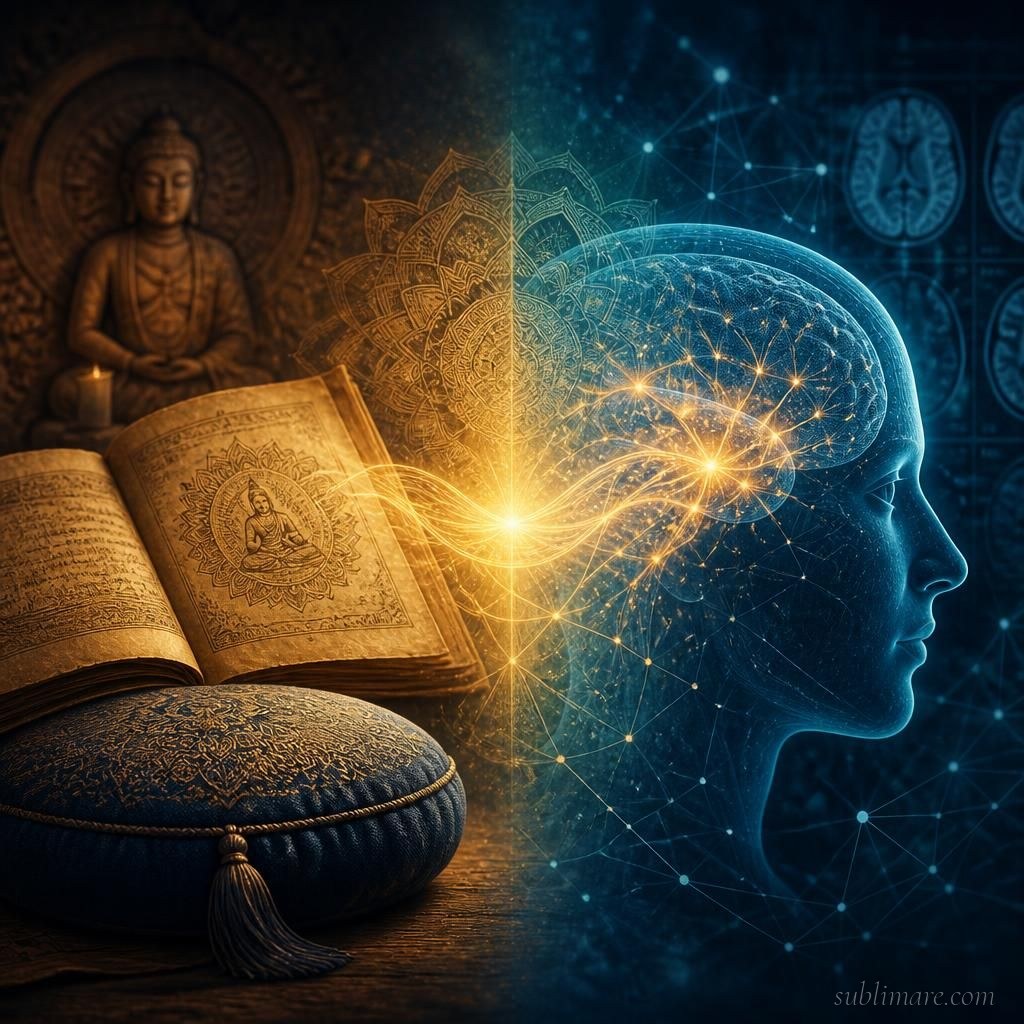
Neuroimaging research has converged on a consistent finding about what classic psychedelics — psilocybin, LSD, and the ayahuasca brew traditionally used in South American shamanic practice — do to brain activity: they substantially disrupt the Default Mode Network (DMN), the same brain network implicated in self-referential thought, mind-wandering, and rumination that appeared in our earlier coverage of flow states.
A 2023 systematic review in a peer-reviewed neuroscience journal, synthesizing neuroimaging studies across LSD, psilocybin, and ayahuasca, found a consistent pattern: acute disruption of the DMN’s normal resting-state connectivity, accompanied by increased functional connectivity between brain networks that don’t typically communicate as directly under ordinary conditions. In effect, the brain’s usual hierarchical organization — with the DMN acting as something like a coordinating hub that maintains a stable, consistent sense of self and habitual patterns of thought — temporarily flattens, allowing more free-flowing communication across regions that are normally more segregated.
This DMN disruption correlates closely with the subjective experience researchers call ego dissolution — a diminished sense of being a separate, bounded self, sometimes accompanied by a felt sense of merging with one’s surroundings or a broader sense of interconnectedness. The mechanistic story, at the receptor level, involves the drugs’ action as agonists at the serotonergic 5-HT2A receptor, which appears to alter synaptic efficacy and information processing in ways that increase what researchers call neural entropy — a less rigidly patterned, more flexible state of brain activity, sometimes described as increasing the brain’s overall “surprise” or novelty in how it processes information.
It’s worth being careful here, and researchers in the field increasingly are: the popular narrative — made famous by Michael Pollan’s influential book How to Change Your Mind — that psychedelics simply “turn off” the DMN and this straightforwardly produces ego death is a meaningful oversimplification. A thoughtful 2023 analysis from the MIND Foundation notes that the DMN’s relationship to the felt sense of self is real but more complex and interconnected with other brain regions and networks than a simple on/off switch implies. The honest current position in the field is that DMN disruption is clearly and consistently correlated with ego dissolution experiences, and increased neural flexibility appears related to the therapeutic and insight-generating qualities of the experience — but the full mechanistic story of exactly how altered brain connectivity produces a felt sense of unity, meaning, or self-transcendence remains an active area of research rather than a fully solved problem.
Ego Dissolution: Ancient Language, New Measurement
What’s genuinely interesting from a science-and-spirituality perspective is that “ego dissolution” as a phenomenon long predates modern neuroscience — it appears, described in strikingly similar terms, across contemplative traditions worldwide. Buddhist descriptions of anatta (non-self, covered in our earlier comparative look at the soul across traditions), the Hindu Vedantic dissolution of the individual self into Brahman, the Christian mystical tradition’s language of self-annihilation before the divine, and Sufi concepts of fana (the passing away of the individual ego) all describe a experiential territory that maps remarkably well onto what contemporary researchers are now measuring with brain scans and standardized questionnaires.
This convergence doesn’t prove any particular metaphysical claim about what’s “really” happening during these states — whether they represent contact with some deeper truth about reality, or simply a distinctive and profoundly meaningful configuration of ordinary brain activity, or some combination that resists that clean division. But it is a substantive data point: the phenomenology that contemplative traditions have described for millennia through meditation, fasting, prayer, and ritual practice appears to be reproducible, at least in its broad structural features, through a specific pharmacological intervention — and this reproducibility is now measurable with standardized psychological instruments and neuroimaging, in a way that allows for genuine comparative research across traditions and methods.
Set, Setting, and the Non-Negotiable Role of Context
One of the most consistent and clinically important findings in modern psychedelic research is the outsized role of what researchers call “set and setting” — the psychological mindset a person brings to the experience, and the physical and social environment in which it occurs. This isn’t a minor variable; it’s one of the primary determinants of whether a session produces a mystical-type, insight-generating experience versus a frightening or destabilizing one, sometimes called a “bad trip.”
In the clinical research context, this translates into careful protocols: extensive preparatory sessions before dosing to build trust and set intention, a comfortable, controlled physical environment with supportive music and eye shades to encourage internal focus, trained facilitators present throughout the session to provide reassurance if difficult material arises, and structured integration sessions afterward to help process and make meaning from the experience. Studies have found that the same substance, at the same dose, produces meaningfully different outcomes depending on how thoroughly these contextual factors are attended to — which is precisely why researchers in the field are cautious about generalizing clinical trial results to unsupervised or recreational use, where these safeguards are typically absent.
This finding is itself philosophically interesting. It suggests that the “mystical” quality of these experiences isn’t purely a pharmacological given — it’s substantially shaped by intention, preparation, and container, much the way contemplative traditions have long insisted that spiritual practice requires proper preparation, guidance, and a supportive context to bear its intended fruit rather than simply producing confusion or harm.

What This Research Does and Doesn’t Establish
It’s worth being precise about what this body of research actually supports, given how easily psychedelic science gets swept into either uncritical evangelism or reflexive dismissal in popular discussion.
What’s well-supported: Classic psychedelics, administered in controlled clinical settings with proper screening and support, produce measurable and often durable improvements in depression, end-of-life anxiety, and certain other conditions in the populations studied so far. These effects correlate strongly with the subjective mystical quality of the experience. The drugs produce consistent, replicable disruption of the Default Mode Network alongside increased cross-network connectivity. Set and setting substantially influence outcomes.
What remains genuinely open: The full mechanistic explanation for how altered brain connectivity produces the specific felt quality of unity, meaning, and self-transcendence is still being worked out. Sample sizes in most trials remain modest, and longer-term outcomes beyond one to two years are less thoroughly studied. These substances carry real risks outside careful clinical contexts — including the potential for difficult or destabilizing experiences, contraindications for people with certain psychiatric conditions (particularly personal or family history of psychosis), and the legal status of these substances outside of approved clinical trials remains a serious consideration almost everywhere. This is genuinely a case where the careful clinical research context and unsupervised use are different enough in risk profile that findings from one shouldn’t be casually extrapolated to the other.
The Honest Bottom Line
What makes this research area genuinely significant for anyone interested in the relationship between science and spirituality is the specific shape of its central finding: a pharmacological intervention reliably produces an experience with the phenomenological signature of what contemplative traditions have called mystical or spiritual experience for millennia — unity, transcendence, noetic quality, ineffability — and the intensity of that specific quality, not simply the drug’s presence in the body, predicts durable psychological healing.
This doesn’t resolve the deeper metaphysical questions about what these experiences ultimately are or what they reveal about the nature of reality and consciousness — questions this research program was never designed to settle, and which remain as open as they’ve always been. But it does establish, with a rigor that earlier eras of psychedelic research and pure contemplative report couldn’t achieve on their own, that whatever is happening during these states is real, measurable, reproducible, and — under the right conditions — capable of producing meaningful, lasting change in how people relate to their lives, their mortality, and their sense of what matters.
That’s a genuinely rare kind of finding: a place where rigorous clinical science and the oldest contemplative traditions in human history are, apparently, describing overlapping territory — even if they’re using very different instruments to map it.
Frequently Asked Questions
What does psychedelic research actually show about mental health treatment?
Controlled clinical trials, primarily using psilocybin, have shown significant and often durable reductions in depression and anxiety, including in populations with treatment-resistant depression and end-of-life anxiety related to terminal illness. A 2016 Johns Hopkins study found over 80 percent of cancer patients with depression and anxiety showed sustained improvement six months after a single high-dose psilocybin session administered with psychological support. Ongoing research is examining applications for smoking cessation, alcohol use disorder, and chronic pain.
What is the Mystical Experience Questionnaire?
Developed by Johns Hopkins researchers, the Mystical Experience Questionnaire (MEQ) is a validated psychological instrument that measures specific dimensions of mystical-type experience: a sense of unity or interconnectedness, a noetic quality (feeling that the experience reveals deep truth), transcendence of time and space, deeply positive mood, and ineffability. Studies consistently find that higher scores on this questionnaire during a psychedelic session predict better therapeutic outcomes at follow-up.
What happens to the brain during a psychedelic experience?
Neuroimaging studies consistently find that classic psychedelics disrupt the Default Mode Network (DMN), a brain network associated with self-referential thought and habitual patterns of cognition, while increasing connectivity between brain regions that don’t typically communicate as directly. This disruption correlates with the experience of “ego dissolution” — a diminished sense of being a separate, bounded self. The mechanism involves the drugs’ action on serotonergic 5-HT2A receptors, though the full explanation for how this produces the felt quality of unity and meaning remains an active area of research.
Why does “set and setting” matter so much in this research?
Set (a person’s psychological mindset and intention) and setting (the physical and social environment) are among the strongest predictors of whether a psychedelic session produces a positive, mystical-type experience versus a difficult or destabilizing one. Clinical research protocols include extensive preparation, a controlled and comfortable environment, trained facilitators, and structured integration afterward specifically because these contextual factors substantially shape outcomes — which is also why researchers caution against generalizing clinical trial results to unsupervised or recreational settings, where these safeguards aren’t present.
Is psychedelic-assisted therapy legal and available?
As of this writing, psilocybin and other classic psychedelics remain Schedule I controlled substances in most jurisdictions, meaning they are illegal outside of approved clinical trials or specific limited regulatory pathways (such as Oregon and Colorado’s supervised psilocybin service programs in the United States). The FDA has granted Breakthrough Therapy designation to psilocybin research for certain conditions, which expedites review, but full regulatory approval for clinical use has not yet been granted. Access currently remains limited to research studies and a small number of legal supervised programs.