
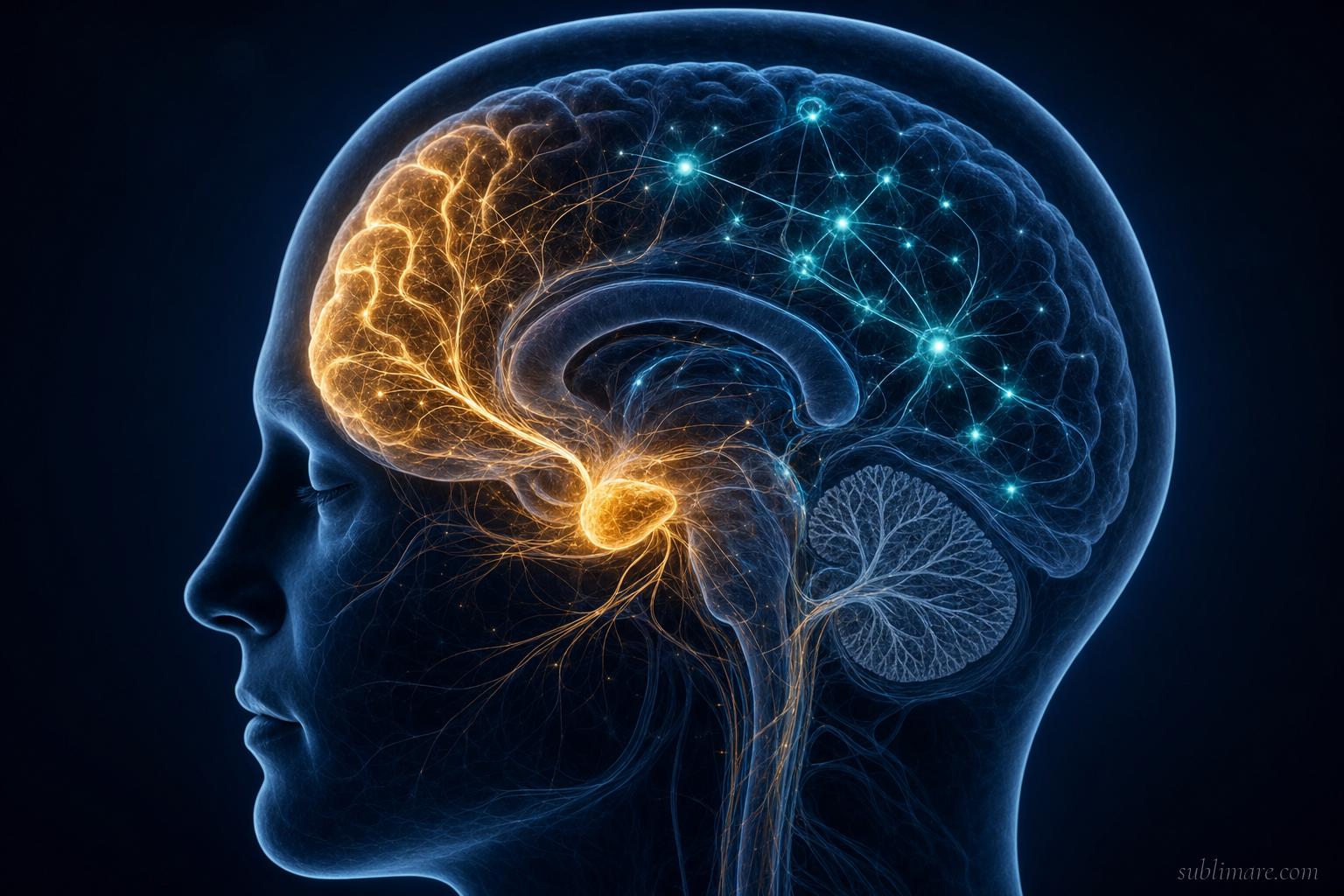
Meditation Was Once Considered Mysticism. Then Scientists Put People in Brain Scanners.
For thousands of years, meditators described inner experiences that defied easy explanation — a sense of expansion, of stillness, of a mind that had somehow become quieter and more spacious. Skeptics called it wishful thinking. Then neuroscientists started measuring it.
What they found surprised nearly everyone — including the researchers.
The brain doesn’t just reflect your mental states. It physically changes in response to how you use it. And meditation, it turns out, is one of the most consistent, well-documented ways to reshape the brain’s structure and function from the inside out.
This post explores what the science actually says — not the breathless headlines, but the studies, the findings, and what they mean for anyone who wants to understand what happens on a neurological level when you close your eyes and breathe.
The Brain Is More Plastic Than We Thought
Until the late 20th century, the dominant view in neuroscience was that the adult brain was fixed. You were born with a certain number of neurons, and from there, things only declined. The idea that a fully mature brain could grow, rewire, or structurally change was considered fringe at best.
Neuroplasticity changed all of that.
We now know that the brain is remarkably adaptable throughout life — that repeated experiences, skills, and yes, even thoughts and attention practices, can alter both the gray matter (neuron cell bodies) and white matter (connective pathways) of the brain. Meditation, practiced with consistency, appears to be one of the most powerful behavioral interventions we know of for prompting those changes.
What Research Shows: Key Findings
Increased Cortical Thickness in Key Regions
One of the landmark early findings came from a study comparing 46 experienced meditators with 46 non-meditating control subjects. Meditators showed greater cortical thickness in frontal and temporal brain regions — areas linked to attention, self-awareness, and emotional regulation — while showing thinning in some posterior regions associated with passive mental activity.
Cortical thickness is associated with cognitive function. The fact that it’s greater in meditators suggests that long-term practice may be structurally protective — even against age-related cognitive decline.
Changes to the Default Mode Network
The Default Mode Network (DMN) is a cluster of brain regions that activates when you’re not focused on anything in particular — when you’re daydreaming, ruminating, or mentally wandering. It’s the part of the brain that generates thoughts like I should have said something different and What will people think of me?
In most people, the DMN is chronically hyperactive. It’s the mental noise that makes it hard to simply rest.
Meditation changes this. Research published in Frontiers in Human Neuroscience found that experienced meditators showed reduced activity in the posterior cingulate cortex — a key hub of the DMN — and increased activity in frontal regions during meditation. A 2022 study in Scientific Reports found that just one month of mindfulness meditation training increased functional connectivity between the DMN, the salience network, and the central executive network. In other words, the brain becomes better at regulating its own internal noise.
Amygdala and Emotional Regulation
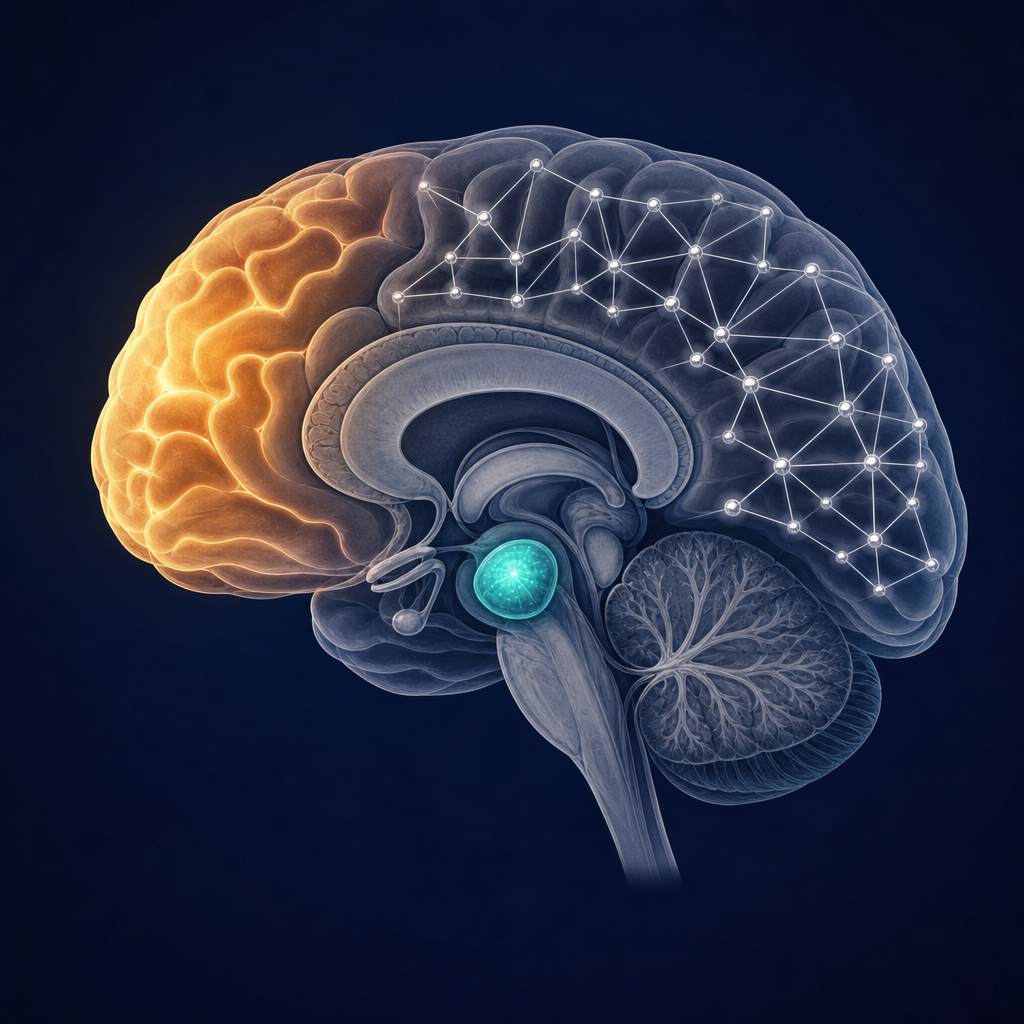
A 2025 study from the Icahn School of Medicine at Mount Sinai used intracranial EEG recordings from epilepsy patients to measure brain activity during loving-kindness meditation. Researchers found significant changes in the amygdala and hippocampus — structures tied to emotional processing, memory, and stress response — specifically in beta and gamma brain wave activity.
These findings add to a growing body of evidence suggesting that meditation physically modulates how the brain processes emotion — not by suppressing feeling, but by changing the neural architecture around it.
The Practice Shapes the Brain, but the Brain Also Shapes the Practice
One of the most interesting aspects of this research is the feedback loop it reveals. Long-term meditators often report that their practice deepens over time — that stillness becomes more accessible, that reactivity naturally decreases, that presence feels less like an effort and more like a default.
Neuroscience offers one reason why: the brain changes don’t just reflect the meditative state you enter during practice. They become structural. The meditative mind becomes, slowly, more of your ordinary mind.
As Frontiers research confirmed, longer meditation experience correlated with more pronounced changes in DMN microstate patterns — suggesting that these changes aren’t just a temporary shift but an enduring neurological transformation.
You Don’t Need Years to See Results
One of the persistent misconceptions about meditation is that meaningful change requires decades of devoted practice. The research doesn’t support this.
Studies show measurable neurological changes after as few as eight weeks of consistent practice, even at modest durations like 20 minutes per day. Changes in self-reported stress, attention, and emotional regulation often appear even earlier — sometimes within weeks of beginning a practice.
If you’re just starting out, the neuroscience suggests the most important thing isn’t the depth of your technique. It’s the consistency of your return to it.
For practical guidance on building a practice from the ground up, read our beginner’s guide: How to Start Meditating: A Beginner’s Guide for Restless Minds.
Beyond Stress Relief: What the Brain Changes Actually Mean
The popular framing of meditation as “stress relief” is accurate but incomplete. What the neuroscience points toward is something more profound: a practice that gradually rewires the relationship between your nervous system, your attention, and your sense of self. The anterior insula — a region associated with interoception, or awareness of the body’s internal states — thickens in long-term meditators. The amygdala becomes less trigger-happy. The default mode network quiets down.
What you’re left with is not a person who never has thoughts or feelings. It’s a person with a different relationship to them.
The Science and the Tradition, Finally Meeting
For many people, the neuroscience of meditation is validating. It offers a language — synapses, cortical thickness, functional connectivity — that makes something ancient feel legible to the modern mind.
But it’s worth remembering that contemplative traditions didn’t need neuroscience to teach the value of stillness. Buddhist monks, Christian mystics, Vedic sages, and Sufi masters have been mapping the inner landscape for millennia. The science isn’t discovering what they found. It’s learning to measure it.
If you’ve ever wondered whether science and spirituality can coexist, this intersection is a good place to start: Science and Spirituality: Why They’re Not Opposites.
And if you want to go deeper into what meditation actually is — beyond any particular technique — explore: What Is Meditation, Really? (No Mysticism Required).
A Final Thought
The most remarkable thing about the neuroscience of meditation may not be any single finding. It’s the cumulative picture — of a practice that, done consistently over time, doesn’t just calm you down but actually changes who you are at a neural level.
That’s not mysticism. That’s biology.
And biology, as it turns out, has room for the sacred.
Related Posts