
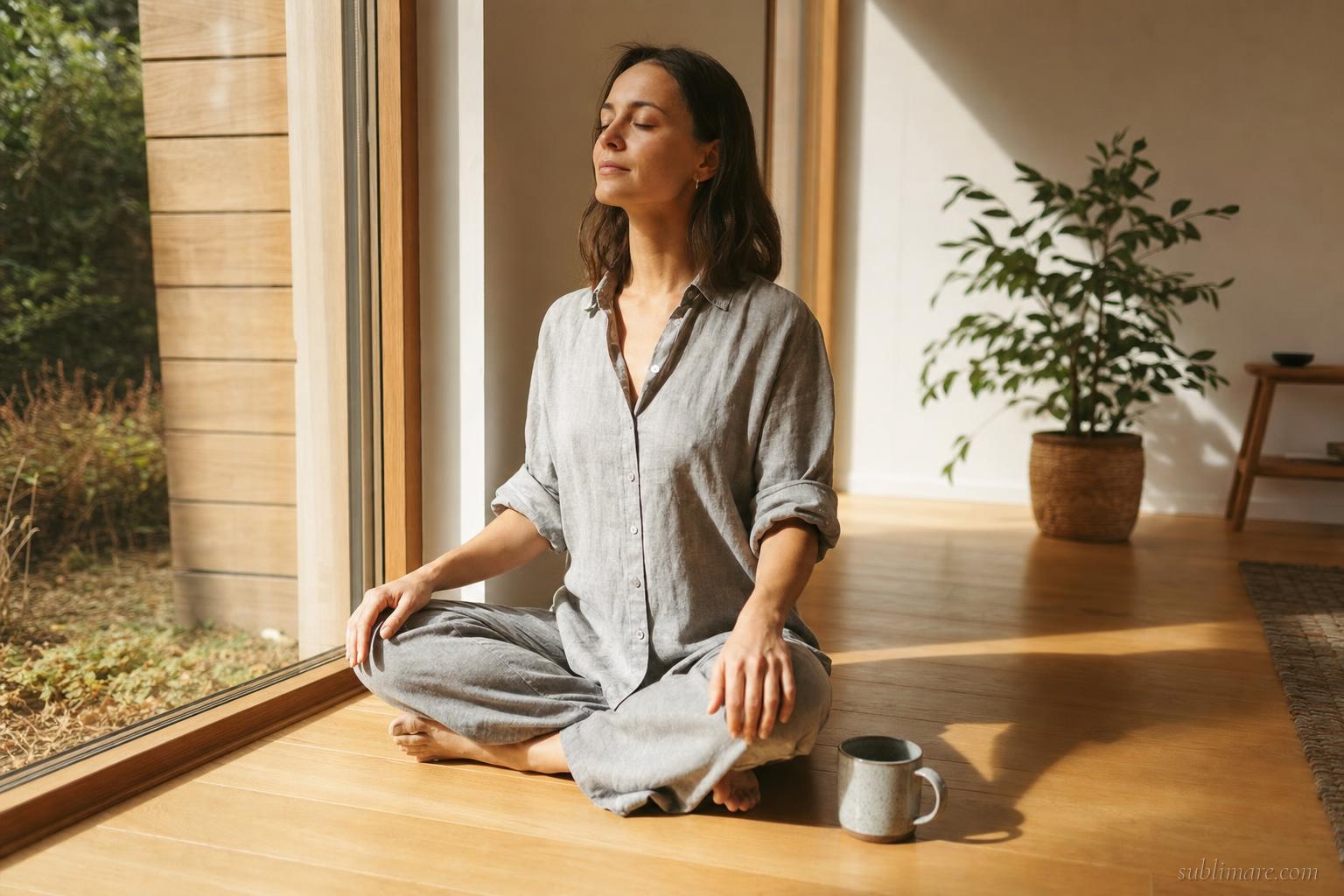
You don’t need a guru, a cushion, or a perfectly quiet mind. Just a few minutes and a willingness to pay attention.
The word “meditation” carries a lot of baggage.
For many people, it conjures images of monks in saffron robes, incense smoke curling toward the ceiling, and the expectation that you must somehow empty your mind completely — sitting in perfect silence while your to-do list screams at you from the other room.
No wonder most people have tried it once, found it impossible, and quietly given up.
But here’s the thing: that image of meditation — the exotic, mystical, effortful version — is not what meditation actually is. Or at least, it’s not what it has to be.
At its most essential, meditation is simply this: paying deliberate attention to what is happening in the present moment.
That’s it. Nothing mystical. Nothing religious. Nothing that requires you to be flexible, spiritually advanced, or living in an ashram. Just attention, on purpose, right now.
What Meditation Is Not
Before we talk about what meditation is, it helps to clear away what it isn’t.
Meditation is not emptying your mind. This is the most common misconception — and the one that stops most beginners before they’ve started. Thoughts will arise when you meditate. Lots of them. That is not failure. That is the human mind doing what it does. The practice is not to stop the thoughts from coming — it’s to notice when your attention has wandered, and gently bring it back.
Meditation is not a religion. While many traditions incorporate meditation — Buddhism, Hinduism, Sufism, Christian contemplation — the practice itself belongs to no tradition. You can be an atheist and meditate. You can be deeply Catholic and meditate. You can have no spiritual beliefs whatsoever and still benefit from what meditation does to your brain and nervous system.
Meditation is not about achieving a special state. You don’t need to feel blissful, calm, or transcendent for meditation to be working. Some sessions feel peaceful. Others feel like you spent fifteen minutes wrestling with your grocery list. Both are valid. The point is the practice, not the experience.
Meditation is not complicated. At its core, it requires nothing except a few minutes and a willingness to pay attention.
What Meditation Actually Is
Here is a definition that cuts through the noise:
Meditation is the practice of training your attention.
Just as you might train your body through exercise — strengthening muscles, building endurance, improving coordination — meditation trains your mind. Specifically, it trains your capacity to direct your attention where you want it, and to notice when it has gone somewhere else.
Think about how rarely you are actually here, in this moment. The mind is a time traveler by default. It lives mostly in the past (replaying conversations, reliving experiences) or in the future (planning, worrying, anticipating). Research suggests the human mind wanders away from what it is doing nearly 47% of the time.
Meditation is the practice of returning.
Not arriving at stillness permanently — but noticing you’ve wandered, and coming back. And then wandering, and coming back again. Over and over. That repetition is the practice. The moment of noticing is the moment that matters.
The Science Is Remarkably Clear

You don’t have to take anyone’s word for what meditation does. The neuroscience research from the last three decades is compelling.
Regular meditation practice has been shown to:
- Reduce activity in the amygdala — the brain’s threat-detection center — which means less automatic reactivity, less anxiety, more space between stimulus and response.
- Thicken the prefrontal cortex — the region associated with focus, decision-making, and self-awareness. The brain physically changes with consistent practice.
- Quiet the default mode network — the neural circuit responsible for mind-wandering, rumination, and self-referential thinking. The inner chatter literally decreases at the level of brain activity.
- Regulate the nervous system — shifting the body from the sympathetic “fight-or-flight” state toward the parasympathetic “rest-and-digest” state, reducing cortisol and calming the stress response.
These are not subtle effects. They are measurable, reproducible, and documented across hundreds of peer-reviewed studies. What contemplatives across traditions have been describing for thousands of years, neuroscience is now mapping in real time.
Three Ways to Think About What Meditation Is
Because meditation takes many forms, it helps to have a few different framings:
1. Meditation as attention training. The simplest framing. Every time you notice your mind has wandered and bring it back, you are doing a “rep” — like a bicep curl for your focus. The more you practice, the stronger your capacity for presence becomes.
2. Meditation as a relationship with your inner life. From a psychological perspective, meditation gives you something rare: a structured opportunity to observe the contents of your own mind without immediately reacting to them. You begin to see your thoughts as events that arise and pass — not as truth you must obey. This is one of the most liberating shifts a person can make.
3. Meditation as a coming home. For those drawn to the spiritual dimension: meditation is often described, across traditions, as a return to something that was never absent. A quieting of the noise that reveals a deeper stillness beneath. Not a destination you travel to — but a recognition of something already present.
You don’t have to believe in the third framing to benefit from the first two. But it’s worth knowing all three exist.
What Does a Meditation Session Actually Look Like?

In its most basic form, a session looks like this:
- Sit comfortably — on a chair, on the floor, wherever your back can be reasonably upright.
- Close your eyes, or soften your gaze downward toward the floor.
- Choose an anchor — most commonly, the sensation of breathing. Just the feeling of air moving in and out.
- When your attention drifts (and it will), notice that it has drifted, and gently return to the breath.
- Repeat — for however long you’ve chosen. Even five minutes is a complete practice.
That’s it. That is a meditation session.
There are many variations — open awareness, body scan, mantra, visualization, walking meditation — and we’ll explore all of them in this series. But the core of what makes something a meditation practice is that quality of intentional, gentle, returning attention.
Who Is Meditation For?
Everyone. But especially you, if any of these sound familiar:
- You feel like your mind is always “on” and you can’t switch it off.
- You know you should slow down, but you don’t know how.
- You’ve heard the benefits and been curious, but the idea felt too “woo” or too hard.
- You’ve tried it before and felt like you were doing it wrong.
- You’re drawn to the spiritual dimension of life but want a practice grounded in something real.
Meditation is not a cure for everything. It is not a replacement for therapy, medication, or the hard work of living. But it may be one of the most consistent, accessible things you can do — over time — to change your relationship with your own mind.
A Closing Thought
You already know how to breathe. You already know how to sit. You already know what it feels like, however briefly, to be fully present in a moment.
Meditation is simply the practice of making that more intentional. More frequent. More chosen.
You don’t need to do it perfectly. You don’t need to do it for long. You don’t need to believe in anything.
You just need to begin.
In the next post in this series, we’ll walk through exactly how to start — a step-by-step beginner’s guide for people whose minds never stop. But you have everything you need right now to take the first breath.
📚 Recommended Reading
If this post sparked something in you, these books go deeper — each one approaches meditation from a different angle, and all of them are worth your time.
The Miracle of Mindfulness — Thich Nhat Hanh
A gentle, profound introduction to mindfulness as a way of life — not just a sitting practice. Written as a letter to a friend, it’s one of the most accessible and human books ever written on the subject.
Wherever You Go, There You Are — Jon Kabat-Zinn
The book that brought mindfulness into mainstream Western culture. Short chapters, no fluff — perfect for skeptics and beginners who want the science and the practice without the mysticism.
Waking Up: A Guide to Spirituality Without Religion — Sam Harris
A neuroscientist and philosopher makes the case for meditation as a rational, secular practice. Honest, rigorous, and genuinely eye-opening — especially if you’ve ever felt caught between science and spirituality.
The Mind Illuminated — Culadasa (John Yates)
For those who want to go further. A detailed, stage-by-stage meditation guide that bridges neuroscience and Buddhist psychology. Considered one of the most complete meditation manuals available.
This post contains affiliate links. If you purchase through them, I earn a small commission at no extra cost to you — and it helps keep Sublimare going. Thank you.
Ready to go deeper? Subscribe to Sublimare for the rest of the meditation series — and share this with someone who has always been curious about meditation but never knew where to start.