
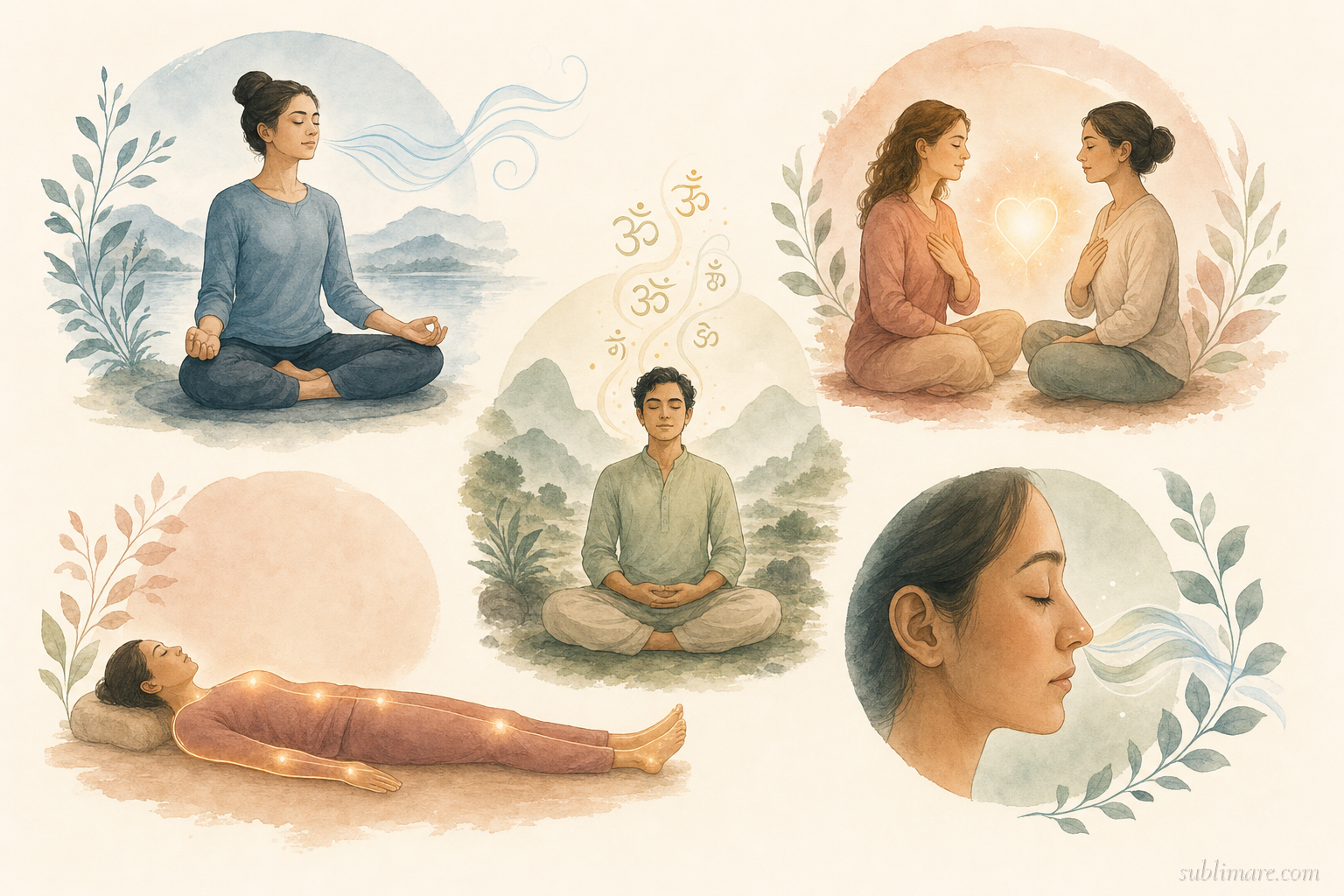
Not All Meditation Is the Same
If you’ve ever tried meditating and felt like you were doing it wrong — that your mind was too busy, the silence too uncomfortable, the technique unclear — it might not be that you’re bad at meditation. It might be that you’re using the wrong type for where you are right now.
Meditation is not a single practice. It’s a family of practices, each with a different mechanism, a different aim, and a different felt quality. Some train focused attention. Some open awareness. Some cultivate feeling. Some release tension held in the body. Understanding these differences is the first step toward finding what actually works for you.
Here are five of the most widely practiced and well-researched forms of meditation, what each one does, and how to know which might be your starting point.
1. Mindfulness Meditation
What it is
Mindfulness meditation is the practice of paying deliberate, non-judgmental attention to whatever is happening in your present-moment experience — breath, body sensations, sounds, thoughts. You don’t try to stop thinking or achieve any particular state. You simply notice what’s arising, without clinging or pushing away.
How to practice
Sit comfortably, close your eyes, and bring your attention to the sensation of breathing — the rise and fall of the chest, or the feeling of air at the nostrils. When your mind wanders (and it will), gently return. That return is the practice. Start with 5–10 minutes and build from there.
Best for
Stress reduction, managing anxiety, cultivating present-moment awareness, improving focus. Mindfulness-Based Stress Reduction (MBSR), developed by Jon Kabat-Zinn, is built on this foundation and is one of the most extensively studied therapeutic interventions in medicine.
Widely considered the best entry point for beginners.
2. Loving-Kindness Meditation (Metta)
What it is
Metta, or loving-kindness meditation, is a heart-centered practice rooted in the Theravada Buddhist tradition. Rather than focusing attention on sensations or thoughts, you cultivate specific emotional qualities — warmth, compassion, goodwill — and extend them outward, first toward yourself, then toward others.
How to practice
Settle into stillness and silently repeat phrases like: May I be happy. May I be well. May I be at peace. After several minutes, extend these wishes to a loved one, then to a neutral person, then to someone you find difficult, and finally to all beings. The practice trains the heart in the same way physical exercise trains the body.
Best for
Building compassion, softening reactivity, healing self-criticism and shame, improving relationship quality. Research from institutions like Mount Sinai has specifically found that loving-kindness meditation produces measurable changes in the brain’s amygdala and hippocampus — key centers for emotional processing. (Read more in The Neuroscience of Meditation.)
Particularly valuable if self-judgment is a pattern you’re working with.
3. Transcendental Meditation (TM)
What it is
Transcendental Meditation is a mantra-based technique, formally taught through a structured course by certified teachers. Each practitioner receives a personally assigned Sanskrit mantra and repeats it silently during practice to allow the mind to “transcend” ordinary thinking activity and settle into a state of restful alertness.
How to practice
TM is typically practiced twice daily for 20 minutes in a comfortable seated position. Unlike mindfulness, the goal isn’t to maintain attention on the mantra but to allow the mind to naturally become quieter as the mantra becomes subtler. Formal instruction is recommended because the technique is quite specific.
Best for
Deep rest, reducing deep-rooted stress, accessing a state of calm wakefulness, those who struggle with focus-based techniques. TM has a substantial body of research behind it, particularly in cardiovascular health, with studies showing reduced blood pressure and lower rates of heart disease in long-term practitioners.
A strong option for people who find focused-attention meditation frustrating or over-effortful.
4. Body Scan Meditation
What it is
Body scan meditation involves moving awareness slowly and deliberately through different parts of the body, noticing sensation without trying to change or fix anything. It’s a practice of embodied attention — bringing the mind into the body rather than allowing the body to disappear into abstract thought.
How to practice
Lie down or sit comfortably. Starting from the top of the head (or the soles of the feet), slowly move your attention through each region of the body: scalp, forehead, jaw, throat, shoulders, chest, belly, arms, hands, lower back, hips, legs, feet. Spend 20–30 seconds in each area, simply noticing. There’s no right way to feel.
Best for
Stress and tension held in the body, improving sleep, recovering from trauma (with appropriate support), those who have difficulty with purely mental forms of meditation, anyone wanting to reconnect with embodied experience. Body scan is a core component of MBSR and is widely used in chronic pain management.
Excellent for anyone who spends a lot of time “in their head.”
5. Breath Awareness Meditation (Anapanasati)
What it is
Breath awareness meditation is one of the oldest and most universally practiced forms of meditation across traditions. The Buddha described it as capable of bringing complete liberation if practiced fully. At its simplest, it’s just this: return, again and again, to the sensation of breathing.
Unlike mindfulness meditation (which observes anything that arises), breath awareness is a one-pointed practice. The breath is the object. Everything else is a distraction you return from.
How to practice
Choose a specific anchor — the feeling of air at the nostrils, the rise of the belly, the pause between breaths — and rest your attention there. When you wander, return. The quality of attention matters more than its duration. A committed five minutes is worth more than a distracted thirty.
Best for
Building concentration, calming the nervous system quickly, developing the capacity for sustained attention. Many advanced practices — visualization, insight meditation, loving-kindness — build on the foundation that breath awareness creates.
Simple, portable, and effective. Requires no equipment, no teacher, no special setting.
Which One Should You Start With?
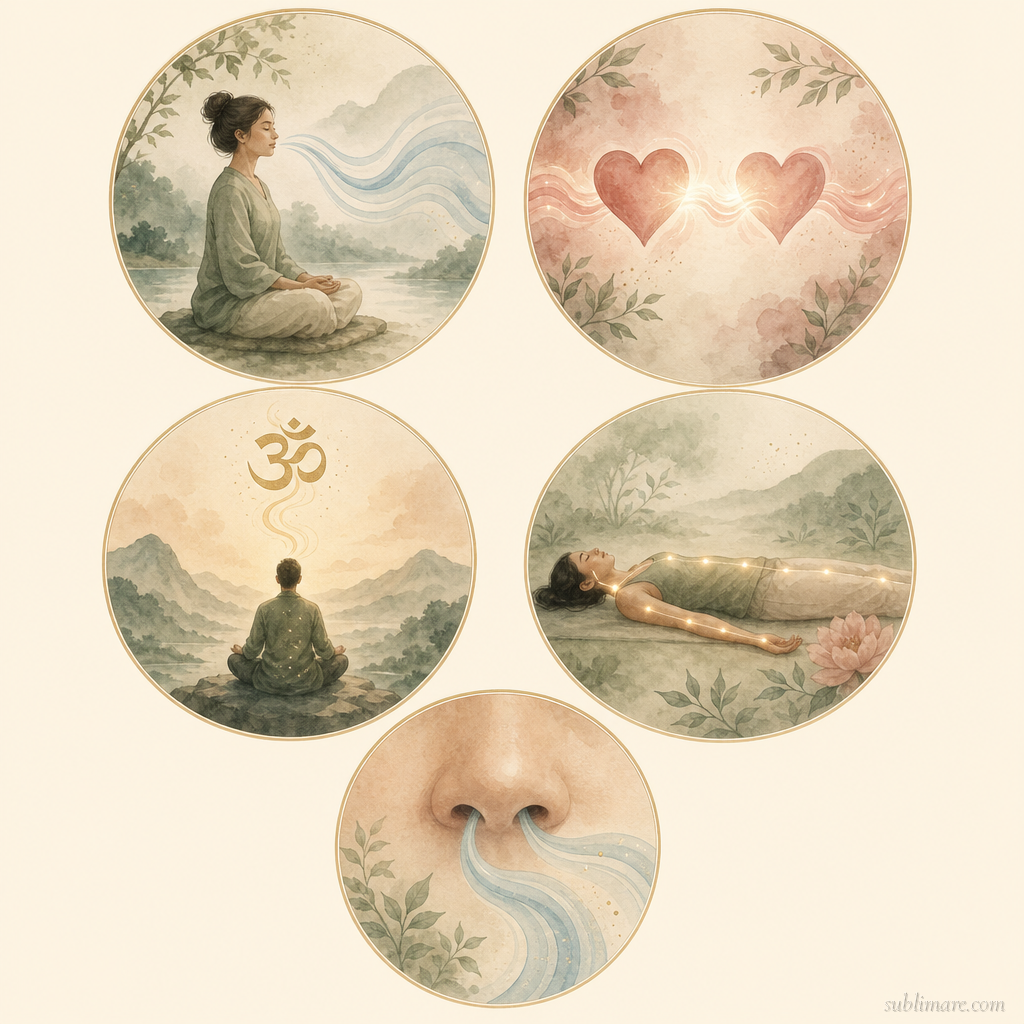
- If you’re new to meditation: Start with mindfulness or breath awareness. Both are accessible without instruction and build the foundational skill of returning attention.
- If your inner critic is loud: Add loving-kindness. It directly cultivates the warmth that self-judgment erodes.
- If you’re exhausted and over-extended: Try transcendental meditation or the body scan. Both prioritize rest over focus.
- If you feel disconnected from your body: The body scan is your doorway.
You don’t have to choose only one. Many practitioners move between types depending on what the day calls for. The goal isn’t to perfect a technique — it’s to cultivate a relationship with your own awareness.
If you haven’t started a meditation practice yet, our guide on how to begin without feeling overwhelmed is a good first step: How to Start Meditating: A Beginner’s Guide for Restless Minds.
The Practice That Changes You Isn’t the Perfect One
There’s a common trap in learning about meditation: spending more time researching which method is best than actually meditating. The truth is, any of these practices, done consistently over time, will change your relationship to your own mind.
The best practice is the one you’ll actually do.
Start there.
Related Posts