

Modern Spirituality Has an Ego Problem
Somewhere along the way, popular spirituality decided that the ego was the villain of the story. Dissolve it, transcend it, kill it. The goal, as it’s often framed, is to become egoless — free from the small self, merged with the infinite, beyond all personal identity.
It sounds appealing. It also doesn’t work. And more importantly, it misunderstands what the ego actually is.
Carl Jung — who spent decades mapping the structure of the human psyche — had a very different view. He saw the ego not as the enemy of growth, but as a necessary partner in it. The goal wasn’t ego dissolution. It was integration.
Here’s what he meant, and why it changes everything about how we approach inner work.
What the Ego Actually Is
In Jungian psychology, the ego is the center of conscious awareness. It’s the “I” that you experience yourself as — your identity, your memories, your values, your sense of continuity over time.
The ego is not the whole psyche. It’s more like the portion of an iceberg above water — the visible, navigable surface of a vast unconscious depth. Jung distinguished the ego (the conscious center of personality) from the Self — a deeper organizing principle that encompasses both conscious and unconscious, known and unknown.
Far from being a problem to get rid of, the ego has an essential function. It is the agent of adaptation. It lets you navigate the world, maintain relationships, form plans, hold values. Without a stable ego structure, there is no coherent experience at all — only fragmentation.
The issue isn’t having an ego. The issue is identifying with the ego as if it were the whole of who you are.
The Shadow: What the Ego Refuses to See
When the ego becomes too rigid, too defended, too certain of its own story, it begins to cut off access to the parts of the psyche it finds threatening. Jung called this rejected material the Shadow — not evil, but simply unlived, unexpressed, disowned.
The shadow contains everything we’ve been told isn’t acceptable: the anger we were taught to suppress, the vulnerability we learned to hide, the ambition we were shamed out of, the grief we never fully moved through. It also sometimes holds our own gifts — capacities that were dismissed or discouraged so early that we stopped recognizing them as ours.
What we disown, we project. The qualities we refuse in ourselves, we tend to see exaggerated in others. The person who makes you disproportionately angry often reflects something you’ve rejected in yourself. This isn’t a comfortable truth. It’s a profoundly useful one.
Shadow work — the deliberate practice of retrieving and integrating the disowned — is one of the most demanding forms of inner work there is. It’s also one of the most transformative. Our guide to starting that process: Shadow Work for Beginners: Meeting the Parts of Yourself You’ve Been Avoiding.
Ego Inflation: The Danger of Identifying Upward
Jung also warned about the opposite problem: ego inflation. This happens when the ego becomes oversized — when a person identifies not with the wound but with the grandiose image, absorbing archetypal energies they haven’t actually integrated.
In spiritual communities, this often appears as what psychologist John Welwood called spiritual bypassing: using spiritual language, practices, and frameworks to avoid the difficult emotional and relational work of becoming a full human being. The person who talks endlessly about transcending the ego while remaining unwilling to have a hard conversation. The teacher who speaks of oneness but treats certain people as less than.
The spiritual path, Jung understood, doesn’t lead around the ego. It leads through it — to a relationship with something deeper, but not by pretending the ego isn’t there.
Individuation: The Work of Becoming Whole
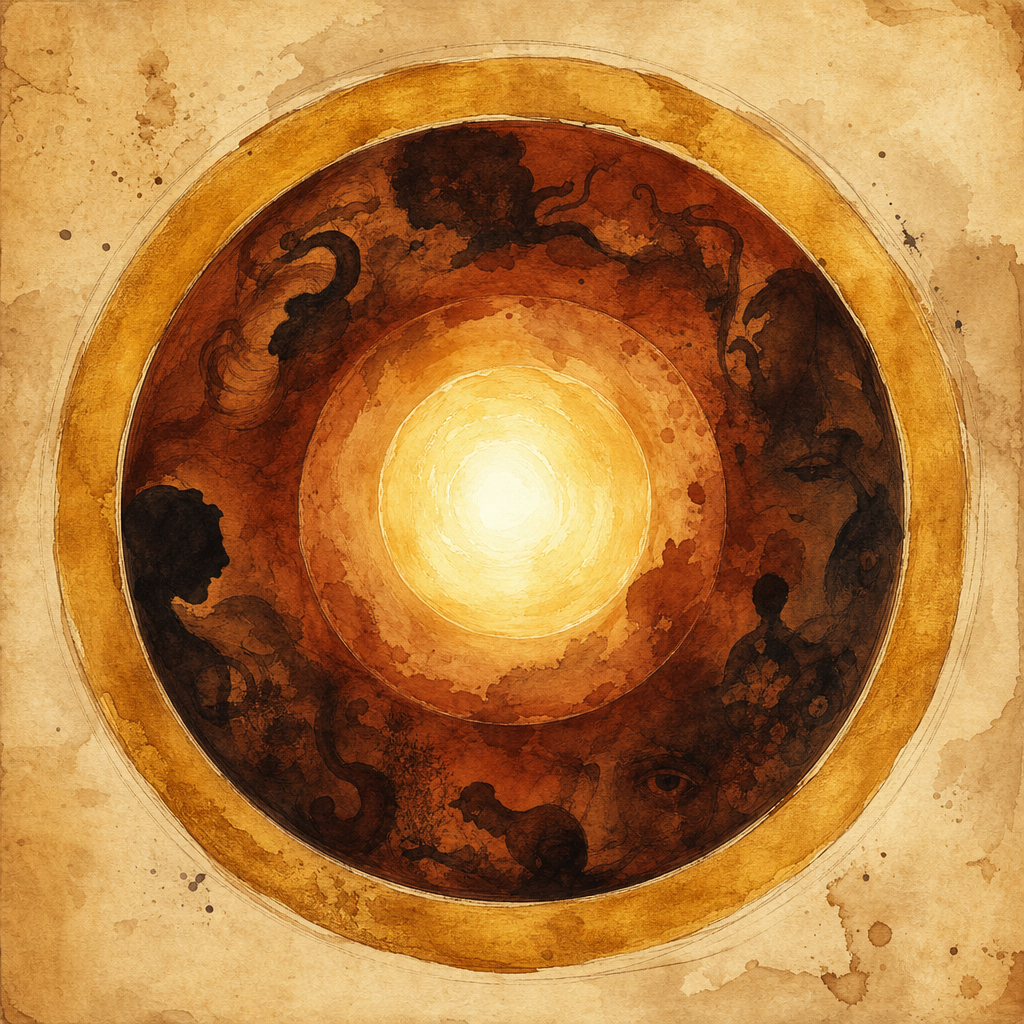
Jung’s model of psychological development centered on a process he called individuation — the gradual movement toward wholeness, in which the ego learns to relate honestly to the full spectrum of the psyche, including the shadow, the unconscious, and the deeper Self.
Individuation doesn’t destroy the ego. It relocates it — from the position of commander to the position of servant of something larger. A strong, flexible, self-aware ego is the vehicle of individuation. A weak or defended ego is the obstacle.
This is why genuine spiritual maturity tends to produce people who are more themselves, not less. More capable of feeling. More present in relationship. More clear about their own values and limits. Not emptied of personality, but deepened into it.
Three Signs You’re Working Against Your Ego Instead of With It
1. You use spiritual concepts to avoid emotional truth. If mindfulness becomes a way to intellectualize rather than feel, if compassion-talk replaces honest conflict, if “not taking things personally” becomes a way to dismiss real relational pain — that’s bypassing, not growth.
2. You’ve become allergic to the very traits you most need. Over-humility that makes you small. Over-detachment that keeps love at arm’s length. Over-surrender that hands your agency to someone else. These are shadow patterns wearing spiritual clothing.
3. You only feel valid when in a “higher” state. The spiritual ego can be just as rigid as any other. If ordinary moments of doubt, sadness, or confusion feel like failures rather than part of the landscape, the ego has simply moved its defenses to a new address.
The Work That Actually Transforms
Integration is not glamorous. It doesn’t look like sitting on a mountain. It often looks like recognizing a pattern in yourself that you’ve been projecting for years, or sitting with a feeling you’ve been avoiding, or telling someone a truth that scares you.
But it changes you at a depth that the ego-dissolution fantasy rarely reaches.
The ego isn’t your enemy. It’s more like a room you’ve been mistaking for the whole house. The work isn’t to burn the room down. It’s to open the door.
Related reading on the path of self-knowledge: What Does It Mean to “Know Thyself”? A Modern Take on an Ancient Idea.
Related Posts