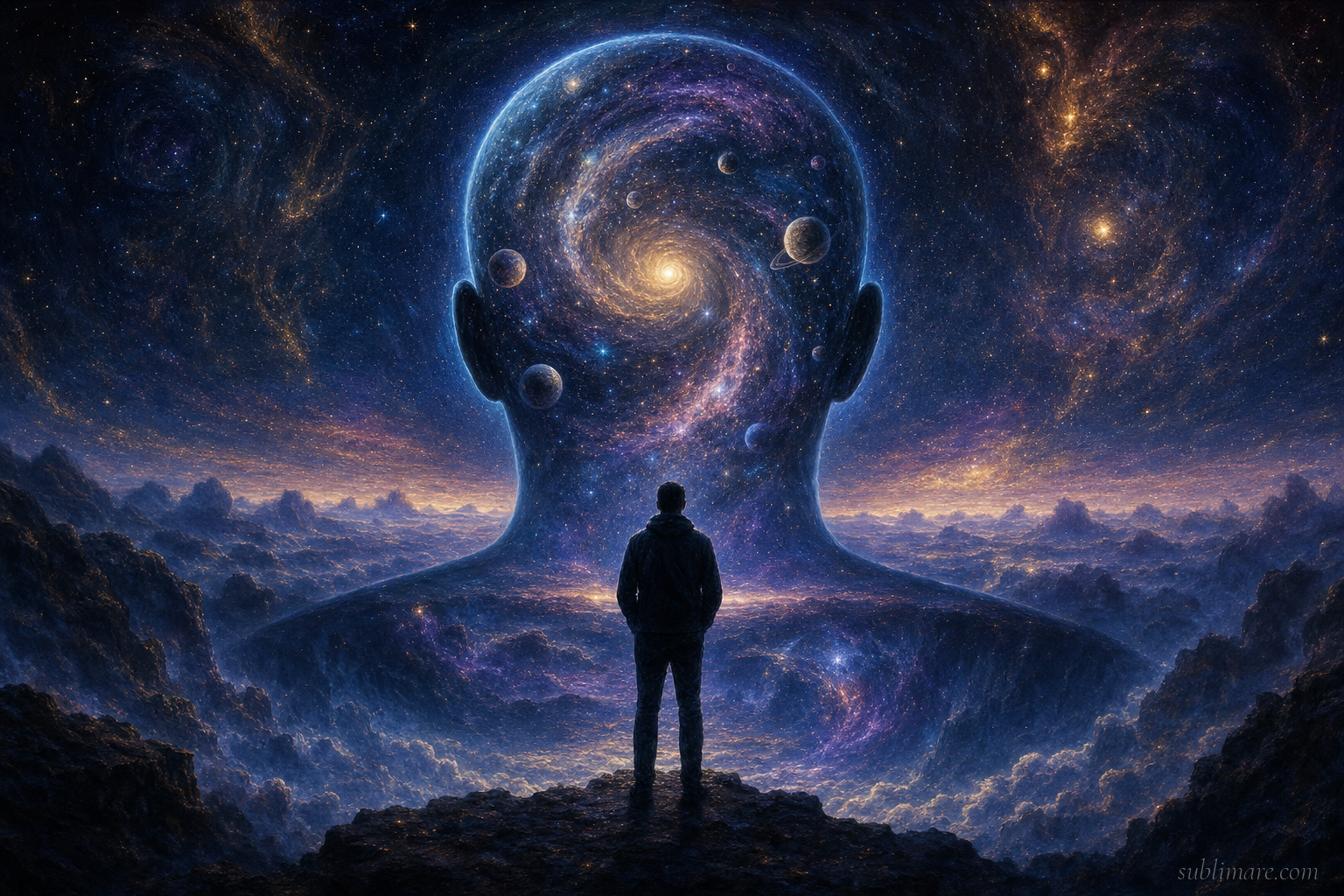
There Is a Question Science Cannot Answer — And It’s About You
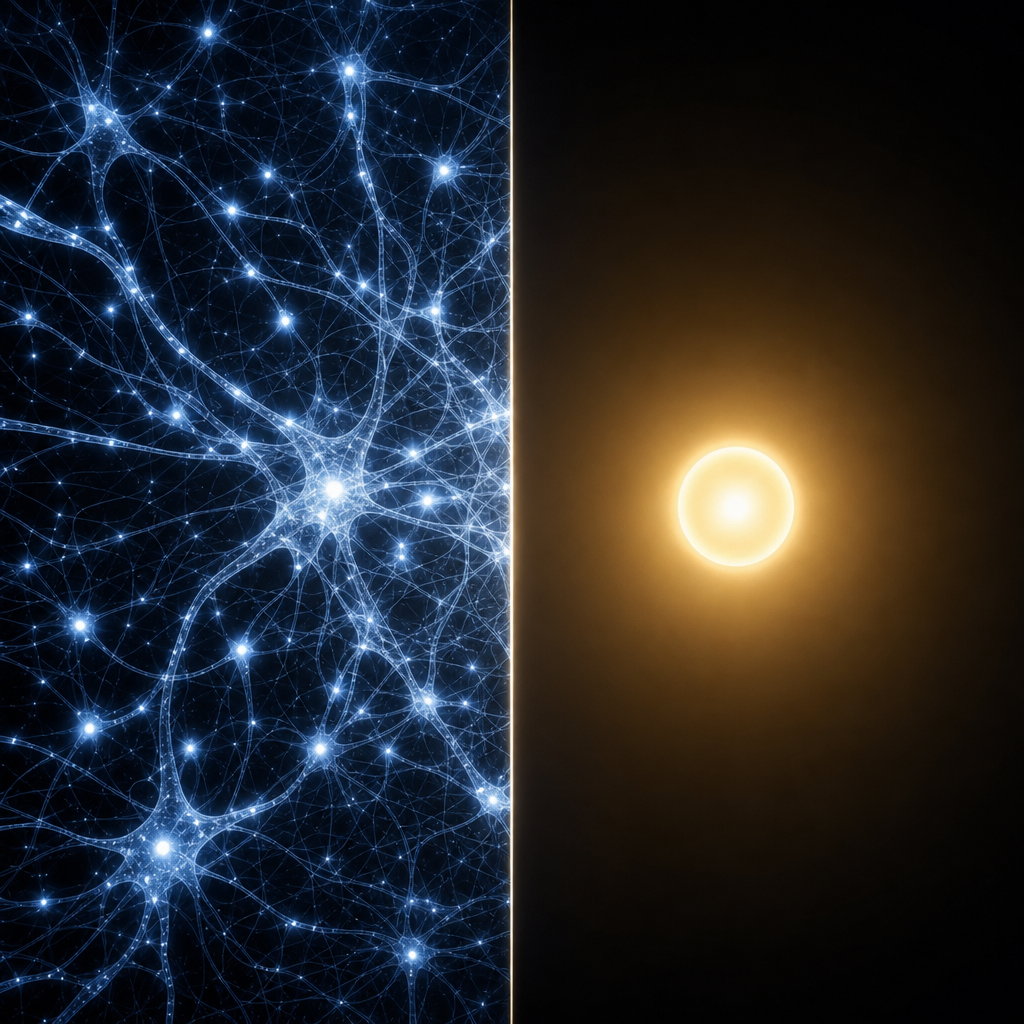
We can explain a lot about the brain. We can map which neurons fire when you see the color red. We can trace the electrochemical cascade that happens when your hand touches a hot surface. We can identify the brain regions that activate when you feel fear, joy, or grief.
What we cannot explain is this: Why does any of this feel like something?
Why is there an experience of redness, rather than just a signal being processed in darkness? Why does pain hurt, rather than simply triggering avoidance behavior without any accompanying feeling? Why is there something it is like to be you — right now, reading these words?
This is the hard problem of consciousness. And it’s one of the most profound open questions in all of human inquiry.
What Is the “Hard Problem,” Exactly?
The term was coined by philosopher David Chalmers in his 1994 paper “Facing Up to the Problem of Consciousness.” Chalmers drew a distinction between what he called the easy problems of consciousness and the hard problem.
The easy problems — and he meant easy only in the sense that we know how to approach them, not that they’re simple — include things like:
How does the brain integrate information?
How do we focus attention and direct behavior?
How do we distinguish sleep from wakefulness?
These are hard scientific questions. But they’re questions we can in principle answer by mapping brain processes, building models, running experiments. We’re making progress.
The hard problem is different. It asks: Why is there subjective experience at all? Why doesn’t all this information processing happen “in the dark” — efficiently, mechanically, without any inner light of awareness?
Even if we mapped every neuron in the brain perfectly, explained every functional process, built an exact computational replica — would we have explained why there is something it feels like to be conscious?
Qualia: The Atoms of Experience
Philosophers use the word qualia (singular: quale) to describe the intrinsic, subjective quality of conscious experience. The redness of red. The specific way coffee smells to you. The particular ache of missing someone you love.
These aren’t things you can point to from the outside. You can’t find qualia in a brain scan. You can only know them from the inside.
Thomas Nagel raised the question of qualia in a famous 1974 paper, “What Is It Like to Be a Bat?” A bat navigates the world through echolocation — it sends out sound pulses and builds a mental map from the returning echoes. We can describe this process neurologically and behaviorally. But what does it feel like to be a bat navigating that way?
Nagel’s point: there’s something it is like to be a bat that no amount of external observation will reveal. Consciousness is irreducibly first-person. And that’s exactly what makes it hard.
Why This Isn’t Just a Philosophical Puzzle
This matters enormously — in medicine, in AI, and in how we understand what we are.
We don’t have a good way to detect consciousness in patients who can’t respond — people under general anesthesia, those in minimally conscious states, patients with locked-in syndrome. Without understanding what consciousness is, we can’t reliably know when it’s present.
And whether an AI system could ever be genuinely conscious — not just intelligent, but actually experiencing — depends entirely on what consciousness is. We can’t answer that question without first answering the hard problem.
Most neuroscientists and many philosophers hold that consciousness is a physical process — that if we understood the brain well enough, we would understand experience. On this view, qualia are real but reducible to neural processes. The apparent gap between brain and experience is a conceptual illusion, not an ontological one.
Dualism
Descartes famously argued that mind and matter are fundamentally different kinds of stuff. Modern dualists don’t typically defend the Cartesian version, but some argue that consciousness is a distinct non-physical phenomenon that cannot be fully reduced to physics. The hard problem, on this view, is evidence that physicalism is incomplete.
Panpsychism
Perhaps the most provocative response is panpsychism — the view that consciousness (or proto-conscious experience) is a fundamental feature of reality, present to some degree in all physical matter. On this view, the hard problem isn’t unique to humans. Complexity simply organizes and amplifies something that was already present at the base level.
Panpsychism sounds strange, but it has serious defenders in contemporary philosophy, including Chalmers himself. It’s also deeply resonant with certain strands of Eastern philosophy — a convergence worth exploring in What Is Metaphysics? A Beginner’s Introduction to the Big Questions.
Where Spirituality and Philosophy Meet
What makes the hard problem so compelling isn’t just its intellectual difficulty. It’s that it points to something most contemplative traditions have known for millennia: experience itself is the ground of everything.
Before you have a world, before you have a brain, before you have a theory — you have the bare fact of awareness. The Vedantic traditions called it chit — consciousness as a fundamental property of existence. Zen Buddhism approached it through direct inquiry into the nature of mind. The Christian mystical tradition pointed to an inner ground of being that preceded all thought.
The hard problem, in this light, isn’t a dead end. It’s an invitation. A question pointing back toward the questioner.
What is it like to be you? You already know. You just can’t fully explain it.
That’s not a failure of science. That’s the frontier.
Contains information related to marketing campaigns of the user. These are shared with Google AdWords / Google Ads when the Google Ads and Google Analytics accounts are linked together.
90 days
__utma
ID used to identify users and sessions
2 years after last activity
__utmt
Used to monitor number of Google Analytics server requests
10 minutes
__utmb
Used to distinguish new sessions and visits. This cookie is set when the GA.js javascript library is loaded and there is no existing __utmb cookie. The cookie is updated every time data is sent to the Google Analytics server.
30 minutes after last activity
__utmc
Used only with old Urchin versions of Google Analytics and not with GA.js. Was used to distinguish between new sessions and visits at the end of a session.
End of session (browser)
__utmz
Contains information about the traffic source or campaign that directed user to the website. The cookie is set when the GA.js javascript is loaded and updated when data is sent to the Google Anaytics server
6 months after last activity
__utmv
Contains custom information set by the web developer via the _setCustomVar method in Google Analytics. This cookie is updated every time new data is sent to the Google Analytics server.
2 years after last activity
__utmx
Used to determine whether a user is included in an A / B or Multivariate test.
18 months
_ga
ID used to identify users
2 years
_gali
Used by Google Analytics to determine which links on a page are being clicked
30 seconds
_ga_
ID used to identify users
2 years
_gid
ID used to identify users for 24 hours after last activity
24 hours
_gat
Used to monitor number of Google Analytics server requests when using Google Tag Manager