What is real? Why is there something rather than nothing? Do we have free will? What is the nature of consciousness? These are not idle questions — they are the questions that shape how we live.
There is a branch of philosophy so foundational that everything else in human thought rests on it — often without anyone noticing.
It doesn’t deal with history, science, or psychology, at least not directly. It goes deeper than any of those disciplines, asking questions that come before them. Questions that most people have thought at least once, usually late at night, and then quietly set aside as unanswerable.
That branch is metaphysics.
So What Is Metaphysics, Exactly?
The word comes from Greek: meta (beyond or after) + physika (the physical). It was originally used to describe Aristotle’s works that came “after” his writings on physics — but it evolved into something far more precise.
Metaphysics is the study of the fundamental nature of reality. It asks:
- What exists? (ontology — the study of being)
- What is the nature of space and time?
- What is consciousness, and how does it relate to the physical world?
- Do we have free will, or are our choices determined by prior causes?
- Why is there something rather than nothing?
- What makes you the same person you were ten years ago?
These are not scientific questions — though science touches on some of them. They are questions about the structure of reality itself, the kind that science assumes answers to before it can even begin.
Why These Questions Matter More Than They Seem
Most people hear “metaphysics” and picture dusty lecture halls or abstract debates with no practical consequence. That’s a mistake.
Your metaphysical assumptions shape everything.
If you believe free will is an illusion, you approach personal responsibility — yours and others’ — differently. If you believe consciousness is nothing more than brain activity, you approach meaning, identity, and death differently. If you believe time is linear and absolute, you relate to memory, regret, and future planning differently than if you believe the present is all that truly exists.
Most people carry implicit metaphysical positions — inherited from culture, religion, science education — without ever having consciously chosen them. Metaphysics invites you to examine those assumptions. To hold them up to the light and ask: do I actually believe this? And does it hold together?
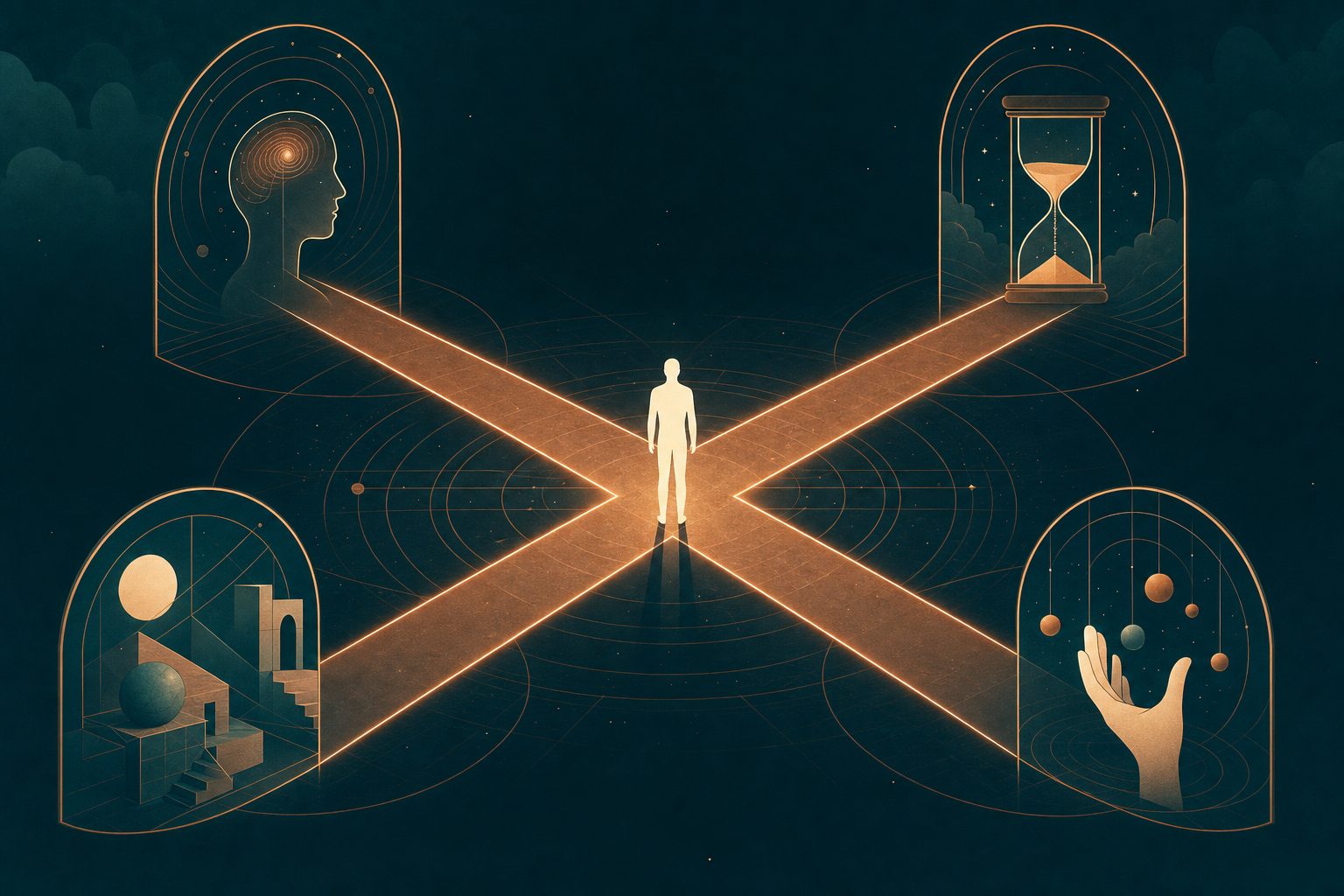
The Big Questions — A Brief Map
1. The Problem of Existence
Leibniz famously asked: “Why is there something rather than nothing?” It sounds almost childish until you sit with it. There could have been absolute nothing — no universe, no space, no time, no possibility. Yet here we are. Metaphysics asks what kind of explanation, if any, that demands.
2. The Mind-Body Problem
How does subjective experience arise from physical matter? Your brain is made of neurons — electrochemical signals. Yet from that mechanism emerges the felt quality of seeing red, tasting coffee, or feeling grief. How? This is perhaps the deepest unsolved problem in all of philosophy and science.
3. Free Will and Determinism
The laws of physics appear deterministic (or, at the quantum level, probabilistic). Every state of the universe seems to follow causally from the previous one. Where does that leave the intuition that you chose to read this sentence? Metaphysics explores the conceptual space between hard determinism, compatibilism, and libertarian free will.
4. The Nature of Time
Is the past still real? Does the future already exist? Is the present moment privileged, or is “now” just a subjective experience? Physics describes time as a dimension — but that doesn’t resolve what time is experientially or metaphysically.
5. Identity and Persistence
You are made of almost entirely different atoms than you were as a child. Your memories, beliefs, and personality have changed. What, exactly, makes you you? What is personal identity — and does it survive physical death? These questions sit at the intersection of metaphysics, ethics, and spirituality.
Metaphysics and the Spiritual Path
Here at Sublimare, we approach these questions from a particular angle: as part of inner inquiry and human transformation.
The great contemplative traditions — Buddhist philosophy, Vedanta, Stoicism, mystical Christianity, Sufi metaphysics — each developed sophisticated metaphysical frameworks. Not as abstract exercises, but as practical maps for understanding the nature of mind, self, and reality in ways that change how you live.
Modern science and secular philosophy are now grappling with the same questions, often arriving at strikingly similar conclusions through entirely different means.
The intersection of those two streams — ancient wisdom and rigorous inquiry — is exactly what Metaphysics & Consciousness explores.
You Don’t Need a Philosophy Degree
One of the great myths about metaphysics is that it’s inaccessible — that it requires specialized training to engage with meaningfully.
It doesn’t. What it requires is curiosity, a willingness to sit with uncertainty, and the intellectual honesty to follow a question wherever it leads — even when it challenges assumptions you’ve held for decades.
The questions metaphysics asks are, in a deep sense, the most human questions there are. Children ask them naturally. Adults tend to suppress them — life gets busy, certainties calcify, and the discomfort of not-knowing becomes something to avoid rather than explore.
But the people who keep asking — who never quite accept the easy answers — often discover something remarkable: that the inquiry itself is transformative. That living with a question, turning it over for years, changes the shape of how you see everything.
A Note on How We’ll Explore This
The Metaphysics & Consciousness category on Sublimare won’t offer you a definitive map of reality. No honest inquiry could.
What it will offer is a series of carefully examined questions, drawing on philosophy, neuroscience, quantum physics, contemplative practice, and lived experience — approached with intellectual rigor and an open mind.
We’ll explore consciousness, identity, the nature of time, the hard problem of mind, non-duality, and more. Not to arrive at comfortable conclusions, but to develop a more nuanced, examined, and ultimately more alive relationship with the mysteries at the heart of existence.
The Delphic oracle didn’t just say “know thyself.” In a different voice, it also said: know what you don’t know.
That’s where we start.
Related Posts