
There is a question so fundamental, so stubbornly unanswered, that philosophers and scientists have been wrestling with it for centuries — and still have no consensus.
What is consciousness?
Not “how does the brain produce thought” — neuroscience has made extraordinary progress on that. But something deeper: why does any of it feel like anything at all?
Why does the color red look the way it does? Why does music feel like something? Why is there an “inside” to your experience — a sense that you are here, present, aware — rather than just a body processing information in the dark?
Science doesn’t know. And that, once you really sit with it, is one of the most fascinating things about being alive.
What Is Consciousness, Exactly?
Before we can explore the mystery, we need to be clear about what we’re asking.
Consciousness, at its most basic, refers to subjective experience — the felt sense of being aware. Philosophers call this qualia: the redness of red, the pain of a headache, the particular quality of your favorite song. These are the raw, inner textures of experience.
There’s also a broader use of the word: “consciousness” as wakefulness, attention, or self-awareness. A person who is awake is conscious; one who is asleep or anesthetized is not. An animal may be conscious in some sense; a rock almost certainly is not. These distinctions matter, but they’re not quite the heart of the mystery.
The real puzzle isn’t whether consciousness exists — you know it does, because you’re having an experience right now. The puzzle is how and why it arises from physical matter.
The Hard Problem of Consciousness
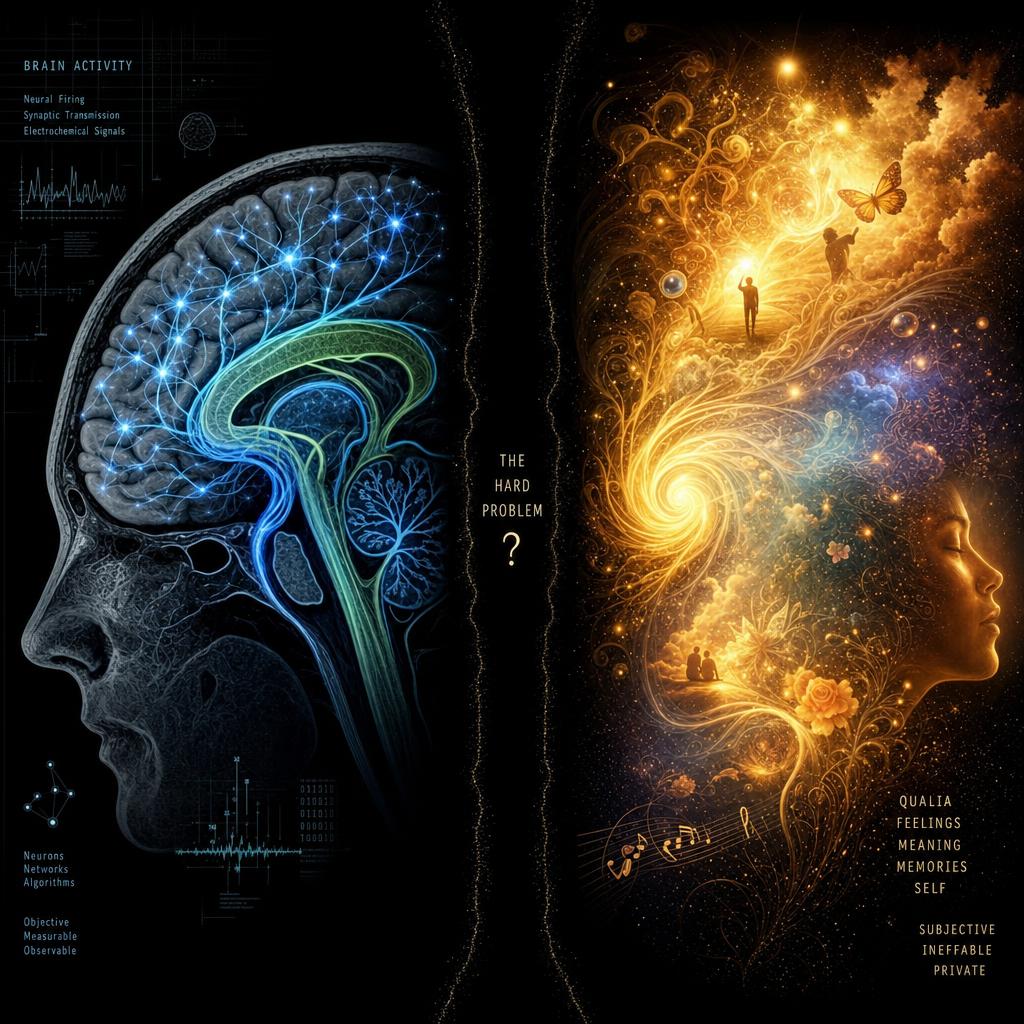
In 1995, philosopher David Chalmers made a distinction that changed the conversation. He separated what he called the “easy problems” of consciousness from the “hard problem.”
The easy problems are things like: How does the brain integrate information? How does it direct attention? How does it produce behavior? These are genuinely difficult scientific questions — but they’re tractable. We can imagine solving them with enough research. They involve explaining how the brain functions.
The hard problem is different. It asks: why does any of that neural activity feel like anything from the inside? Why isn’t it all just information processing happening in the dark, with no inner experience at all?
Imagine a complete neuroscientific account of what happens when you see red — every photon, every neuron, every signal. That account could be perfectly complete and yet still leave something unexplained: why does the experience of red feel the way it does? Why is there a “what it’s like” to seeing red at all?
That gap — between objective brain processes and subjective inner experience — is the hard problem. And it has resisted every attempt to close it.
What Neuroscience Can (and Can’t) Tell Us
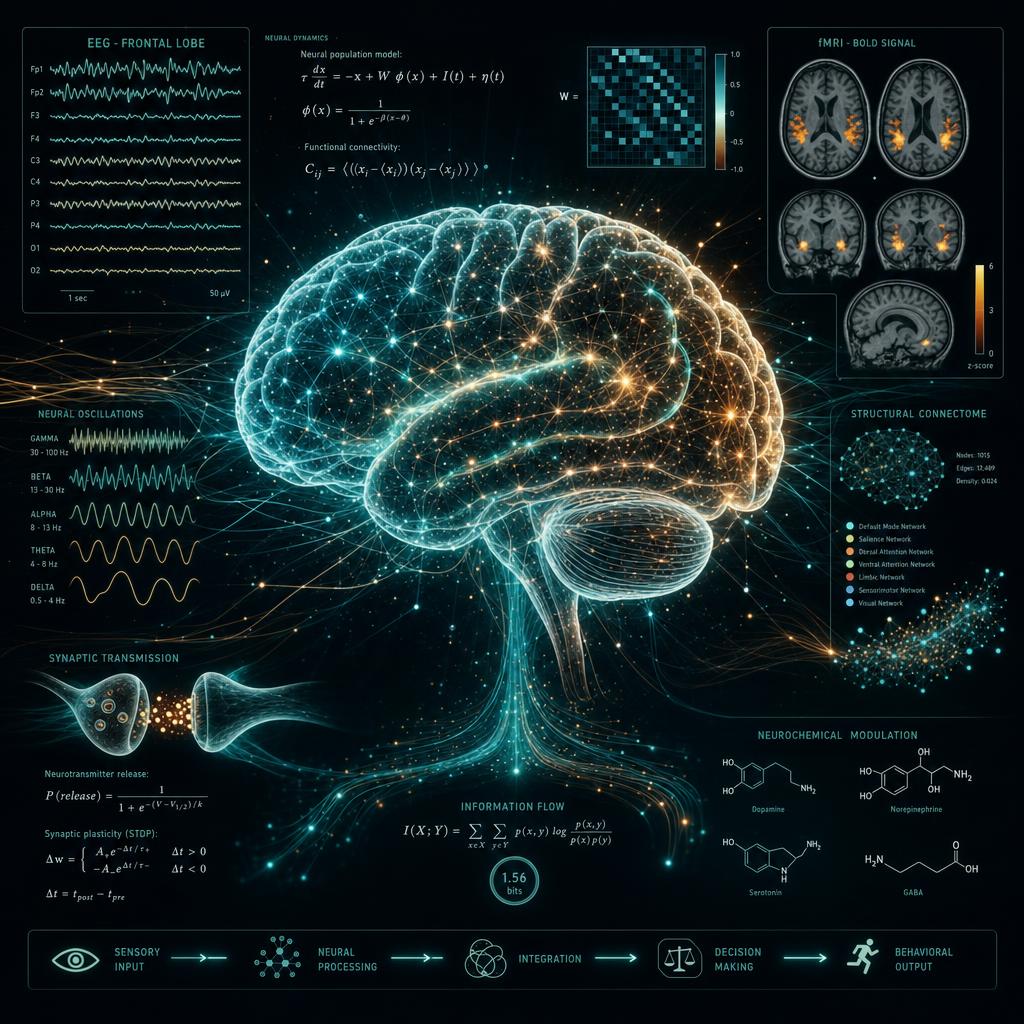
Modern neuroscience has revealed astonishing things about the brain. We can watch it in real time using fMRI scans. We can identify which regions activate when you feel fear, joy, or make a decision. We know that damage to specific areas erases specific abilities — language, memory, personality, the recognition of faces.
We’ve discovered that consciousness is not produced by a single brain region but seems to involve integrated activity across many areas. We know that anesthetics disrupt it by disrupting certain kinds of neural communication. We know that psychedelics alter it by flooding serotonin receptors and disrupting the brain’s default mode network.
All of this is genuinely extraordinary. Neuroscience has given us a detailed map of the brain’s machinery.
But the map is not the territory. Knowing which neurons fire when you experience awe doesn’t explain why there is an experience of awe at all. The hard problem remains untouched.
As neuroscientist Christof Koch — who has spent his career studying consciousness — has said: “The question of why and how physical processes in the brain are accompanied by conscious experience is arguably the most important unresolved problem in science.”
The Leading Theories — and Why None Are Settled
Scientists and philosophers haven’t given up. Several serious theories attempt to explain consciousness — and they differ radically in their assumptions.
Global Workspace Theory (Bernard Baars, Stanislas Dehaene) proposes that consciousness arises when information is “broadcast” widely across the brain, becoming available to multiple systems simultaneously. When something reaches this global workspace, you become conscious of it. This is influential in neuroscience, but critics say it explains the function of consciousness without explaining the experience.
Integrated Information Theory (Giulio Tononi) suggests that consciousness is identical to integrated information — represented by a measure called phi (Φ). The more a system integrates information in a way that can’t be reduced to its parts, the more conscious it is. Intriguingly, this theory suggests that consciousness might be a fundamental feature of certain physical systems — not just brains.
Orchestrated Objective Reduction (Roger Penrose and Stuart Hameroff) proposes that consciousness arises from quantum processes in microtubules inside neurons — and that it may be connected to fundamental features of spacetime. This is controversial and largely unverified, but it comes from two serious scientists and refuses to die.
Panpsychism — a view taken seriously by a growing number of philosophers — proposes that consciousness (or something like it) is a fundamental feature of reality, not an emergent product of complex brains. In this view, even simple physical entities have some minimal form of inner experience. Mind doesn’t arise from matter; it’s woven into it.
None of these theories has won the debate. Each has serious advocates and serious critics. The field is alive, contested, and genuinely open.
Why This Mystery Matters Beyond the Lab

You might wonder: why does it matter if scientists can’t explain consciousness? Your experience is real whether or not anyone can explain it.
But the implications run deep.
If consciousness is a fundamental feature of reality — not just a byproduct of complex neurons — then our entire picture of the universe changes. Matter is not the only fundamental thing. Mind, in some form, might be woven into the fabric of existence itself.
If the boundary between the observer and the observed is genuinely unclear — as both quantum physics and consciousness research suggest — then the sharp line we draw between “self” and “world” may be a useful fiction more than an ultimate truth.
And if we don’t fully understand what consciousness is, we can’t fully understand: What happens to it when we die? Could it persist beyond the brain? Could it exist in non-biological systems? Is it uniquely human, or does it extend to animals, plants, ecosystems?
These aren’t idle philosophical questions. They’re the kinds of questions that determine how we treat other beings, how we think about death, and how we understand our place in the cosmos.
The Question That Changes Everything
Here is something worth sitting with:
You are a physical system — neurons, atoms, chemistry — that is somehow aware of itself. You can step back and observe your own thoughts. You can wonder about your own existence. You can ask questions about the nature of consciousness while being conscious.
The philosopher Alan Watts called this “the universe examining itself.” The physicist John Wheeler said something similar: perhaps observers are not incidental to the universe but essential to it.
Whatever consciousness turns out to be — emergent, fundamental, quantum, or something we haven’t imagined yet — the fact that it exists at all is perhaps the most extraordinary thing in a universe full of extraordinary things.
Science still doesn’t know what it is. And that gap — that deep, honest unknowing — is not a failure. It is an invitation.
An invitation to stay curious. To resist easy answers. To keep asking the question that, by its very nature, reminds you that you are alive and aware and here.
📚 Recommended Reading
Consciousness is one of the deepest unsolved mysteries in science and philosophy. These books approach it from different angles — and each one will leave you thinking differently about your own mind.
Consciousness Explained — Daniel Dennett
The most influential materialist account of consciousness ever written. Dennett argues that the self and subjective experience are sophisticated illusions produced by the brain — challenging, provocative, and impossible to dismiss. Even if you disagree with his conclusions, this book will sharpen exactly what you’re thinking about when you think about consciousness.
The Conscious Mind — David Chalmers
Chalmers coined the term “the hard problem of consciousness” — and this is the book that introduced it to the world. A rigorous philosophical argument that subjective experience cannot be fully explained by neuroscience alone. Dense but rewarding, and one of the most important works in the philosophy of mind of the last thirty years.
Being No One — Thomas Metzinger
A landmark work in consciousness studies — Metzinger argues that the self is not a thing but a process: a model the brain generates to navigate the world. Dense and technical in places, but transformative for anyone willing to stay with it. His core insight — that no one has ever been or had a self — is one of the most unsettling and liberating ideas in modern philosophy.
Other Minds: The Octopus, the Sea, and the Deep Origins of Consciousness — Peter Godfrey-Smith
A philosopher and deep-sea diver explores consciousness through one of the most alien intelligent creatures on Earth — the octopus. Beautifully written and genuinely mind-expanding, this book asks what it means to have an inner life, and reminds us that consciousness may be far stranger and more widespread than we assume.
This post contains affiliate links. If you purchase through them, I earn a small commission at no extra cost to you — and it helps keep Sublimare going. Thank you.
Enjoyed this? You might also like: What Is Metaphysics? A Beginner’s Introduction to the Big Questions
Up next: The Hard Problem of Consciousness Explained Simply