Science and spirituality don’t have to be enemies. Discover how quantum physics, neuroscience, and ancient wisdom all point toward the same profound truth.
There is a story we have been told, quietly but persistently, for a long time.
It goes something like this: if you are a rational, scientific person, you cannot also be spiritual. And if you are spiritual, you must have abandoned reason. You must choose a side. Pick your camp. Draw your line.
But what if that story was never true?
What if science and spirituality are not two opposing worldviews fighting for the same territory — but two different languages attempting to describe the same breathtaking reality?
This is one of the central questions that Sublimare was created to explore. And the more you look into it — honestly, curiously, without an agenda — the more the false wall between science and spirit begins to dissolve.
Let’s start at the beginning.
The War That Never Should Have Started
The tension between science and religion has deep historical roots. In the 17th century, Galileo was condemned by the Church for insisting that the Earth moves around the Sun. In the 19th century, Darwin’s theory of evolution shook religious institutions to their core. For centuries, the two institutions clashed over authority — over who had the right to explain the nature of reality.
But somewhere along the way, that historical clash between institutional religion and scientific institutions became something different in the popular imagination. It became a war between reason and inner experience. Between data and meaning. Between the mind and the soul.
And that is where the story went wrong.
Because science, at its best, is not a belief system — it is a method. A way of asking questions, testing ideas, and remaining humble in the face of what we do not yet understand. And spirituality, at its best, is not blind faith — it is a direct inquiry into the nature of consciousness, existence, and the self.
Both, at their best, are forms of the same fundamental human drive: the desire to know what is real.
The conflict was never between science and spirituality. It was between dogma and openness — on both sides.
What Quantum Physics Is Quietly Telling Us
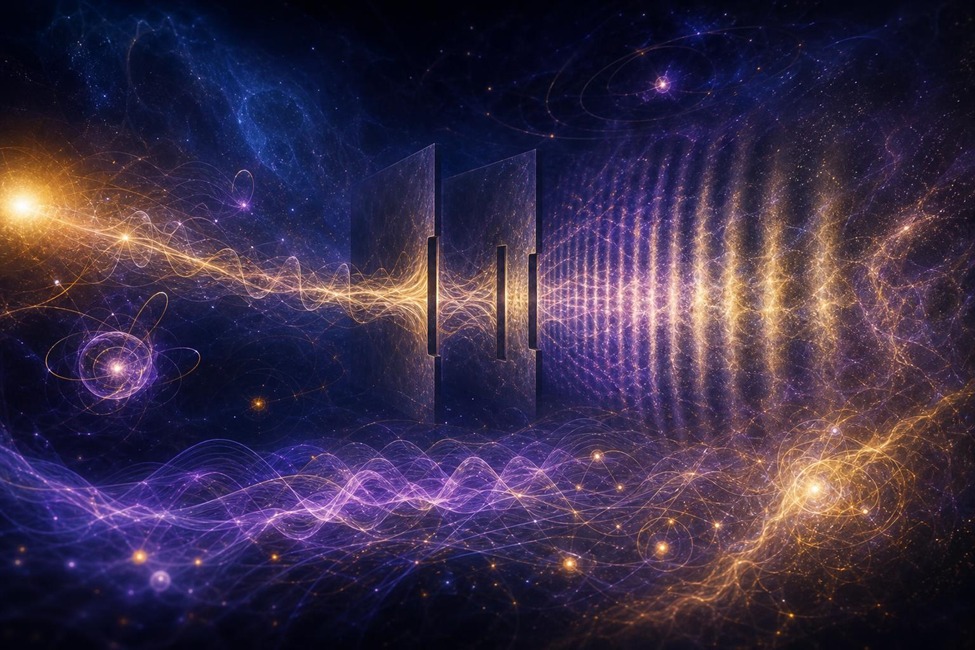
For most of human history, the scientific worldview was essentially mechanical. The universe was a giant clock, made of separate, solid objects, ticking forward in predictable ways. Matter was matter. Energy was energy. And the observer — the person looking — was irrelevant to what was being observed.
Then came quantum physics. And everything changed.
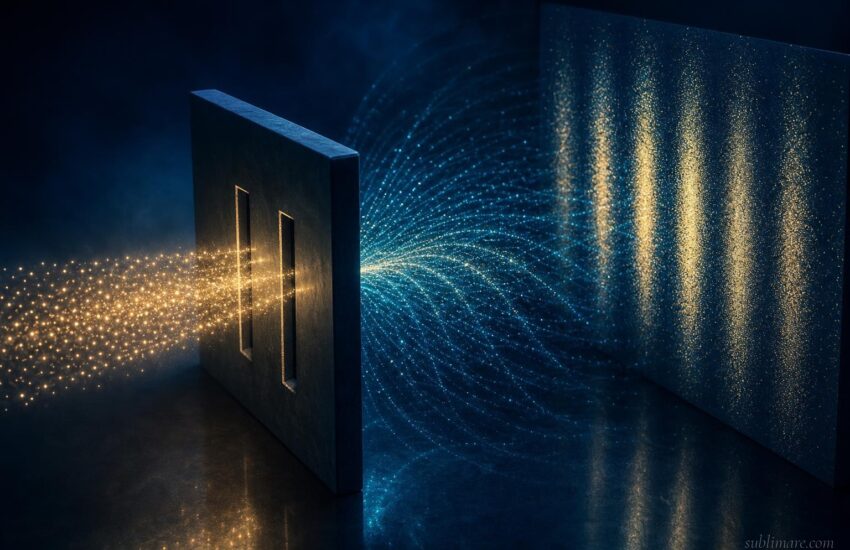
At the subatomic level, matter does not behave like a clock at all. Particles exist in states of probability rather than fixed locations. They appear to be influenced by the act of being observed — the famous double-slit experiment showed that a single particle, when not observed, behaves like a wave spreading across multiple possibilities; the moment it is measured, it “collapses” into a single definite position.
The observer, it turns out, is not irrelevant. The observer is part of the experiment.
This does not mean — as is sometimes oversimplified — that “you create your reality with your thoughts.” Quantum mechanics operates at a scale almost impossibly small compared to everyday life. But it does mean something profound: that at the most fundamental level of physical reality, the boundary between the observer and the observed is not as clear as we once assumed.
Physicists and philosophers are still debating what this means. But many of the greatest minds in quantum theory — Max Planck, Werner Heisenberg, Erwin Schrödinger — spoke openly about the philosophical and even spiritual implications of what they were discovering. Schrödinger himself wrote extensively about consciousness and its relationship to the material world, drawing on ancient Vedantic philosophy.
Science, when it goes deep enough, begins to sound like mysticism. Not because science becomes vague — but because reality, it seems, is stranger and more interconnected than our everyday experience suggests.
The Neuroscience of Inner Experience
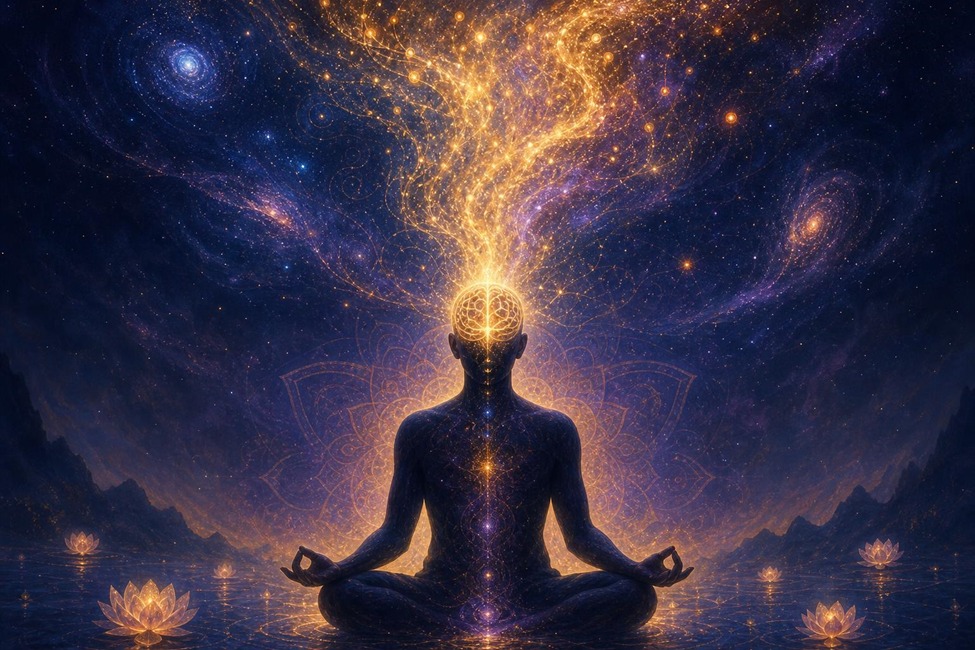
If quantum physics raises questions about the nature of reality, neuroscience raises questions about the nature of the self.
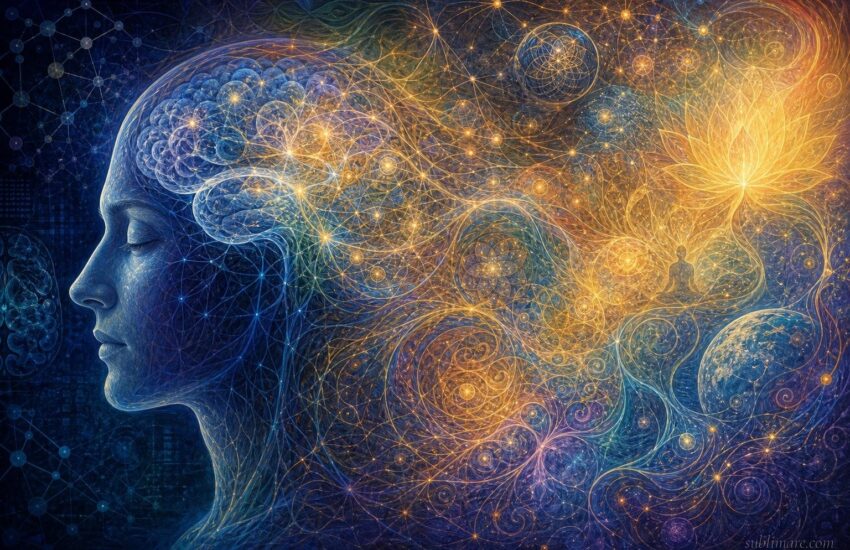
In the past three decades, the scientific study of meditation has produced findings that would have seemed extraordinary not long ago. Using fMRI brain scanners and EEG equipment, researchers have been able to observe, in real time, what happens inside the brain of someone who meditates regularly.
The results are striking:
- The prefrontal cortex — the region associated with focus, decision-making, and self-awareness — shows increased density in long-term meditators. The brain, in other words, physically changes with practice.
- The amygdala — the brain’s threat-detection and fear-response center — shows reduced activity in meditators, even outside of meditation sessions. Less reactivity. More inner space.
- The default mode network — the neural circuit that activates when we are lost in self-referential thought, rumination, and ego-narrative — becomes quieter during meditation. The “mental chatter” literally decreases at the level of the brain.
What contemplatives across traditions have been describing for thousands of years — the quieting of the mind, the expansion of awareness beyond the ego-self, the experience of a deeper, more stable inner presence — neuroscience is now mapping in real time.
The mystic and the neuroscientist are pointing at the same territory. One uses the language of inner experience. The other uses electrodes and data. But the map is converging.
Ancient Wisdom and Modern Science: Speaking the Same Language
Long before laboratories and scanning equipment, the great wisdom traditions of humanity were conducting their own investigations into the nature of mind and reality.
The ancient Vedic concept of Brahman — the underlying, indivisible consciousness that pervades all things — bears a striking resemblance to what physicist David Bohm called the implicate order: a deeper level of reality from which the observable universe unfolds, like a wave emerging from a hidden ocean.
The Buddhist concept of impermanence — the teaching that nothing is fixed, that all phenomena arise and pass away — is mirrored in the quantum understanding that subatomic particles are not solid objects but dynamic processes, constantly flickering in and out of states.
The Hermetic principle “as above, so below” — the idea that the patterns of the cosmos are reflected in the patterns of the self — echoes in fractal mathematics, in the self-similar structures found across scales of nature, from the spiral of a galaxy to the spiral of a seashell to the spiral of DNA.
These are not coincidences. They are convergences. Different cultures, working from different starting points, arriving at similar recognitions about the deep structure of reality.
Science gives us the precision. Wisdom traditions give us the depth. Together, they offer something more complete than either could provide alone.
Living at the Intersection
So what does this mean for how we actually live?
It means we do not have to choose. We do not have to be either a rational person or a spiritual person. We can hold both — and in that holding, find a richer, more textured way of being in the world.
It means that when we sit in meditation and feel something shift — when the noise quiets and something deeper surfaces — that experience does not contradict science. It is supported by it. The brain changes. The nervous system regulates. The default mode network quiets. Something real is happening, measurable and profound.
It means we can ask the big questions — Why are we here? What is consciousness? Is there something more? — with both intellectual rigor and genuine openness. Not forcing answers. Not settling for dogma. But exploring, curiously, with our whole selves.
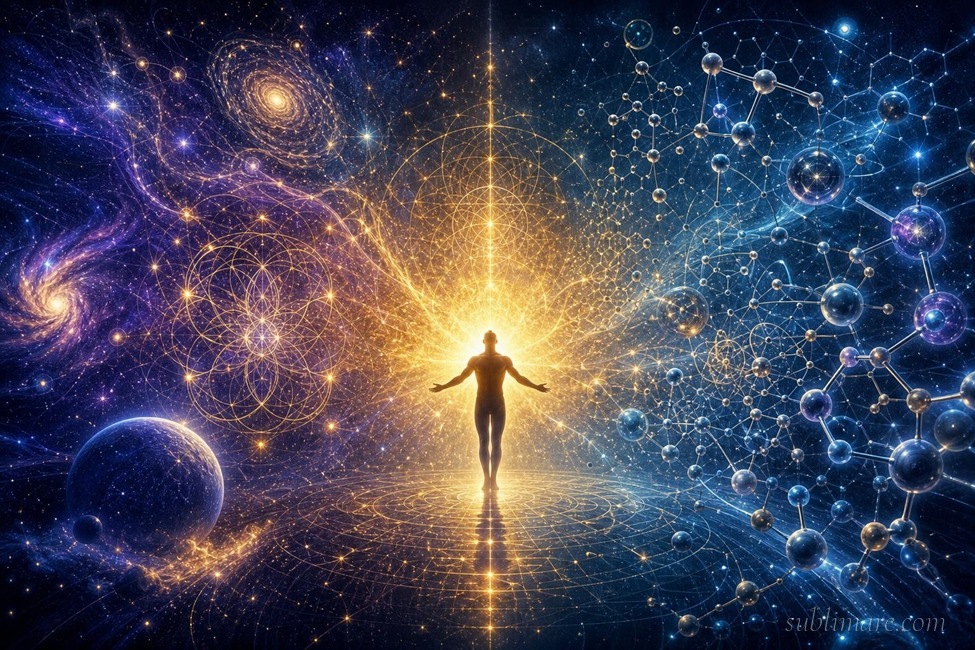
This is the spirit of Sublimare. Not to replace one belief system with another. But to stand at the intersection — where the telescope meets the meditation cushion, where the neuroscientist and the mystic can sit at the same table — and keep asking the questions that matter most.
A Closing Thought
The greatest scientists in history were, almost without exception, people of profound wonder. Einstein wrote about a “cosmic religious feeling” — a sense of awe at the mystery and order of the universe — as the deepest motivating force behind scientific inquiry. He did not see science as the enemy of that wonder. He saw it as its highest expression.
You are allowed to be both rigorous and reverent. Both curious and contemplative. Both scientific and spiritual.
In fact, the deeper you go in either direction, the more you will find the other waiting for you on the other side.
That is the intersection. That is Sublimare.
📚 Recommended Reading
If this post resonated with you, these books go further — each one explores the bridge between science and the deeper dimensions of reality in its own compelling way.
The Tao of Physics — Fritjof Capra
A landmark book that drew the first clear parallels between modern physics and Eastern mysticism. Capra shows how quantum theory and relativity echo ancient spiritual insights about the nature of reality — written for curious non-scientists.
Science and the Akashic Field — Ervin Laszlo
A systems scientist and philosopher proposes a unified field of information that underlies all of existence — bridging physics, biology, and consciousness in a framework that feels both scientifically grounded and spiritually alive.
The Hidden Life of Trees — Peter Wohlleben
Not a spirituality book — but one of the most quietly profound science books of the last decade. Wohlleben reveals that trees communicate, care for each other, and form communities. Nature as intelligence. A reminder that science itself keeps expanding what we thought was possible.
One Mind — Larry Dossey
A physician and researcher makes a rigorous case for a shared, universal consciousness — drawing on clinical evidence, near-death experiences, and quantum biology. Challenging, well-documented, and impossible to dismiss.
This post contains affiliate links. If you purchase through them, I earn a small commission at no extra cost to you — and it helps keep Sublimare going. Thank you.
Did this resonate with you? Subscribe to Sublimare so you never miss a new exploration — and share this with someone who is still choosing between their rational mind and their inner knowing. They don’t have to choose.
Related Posts