
The oldest instruction in philosophy turns out to be the most radical thing you can do in the modern world.
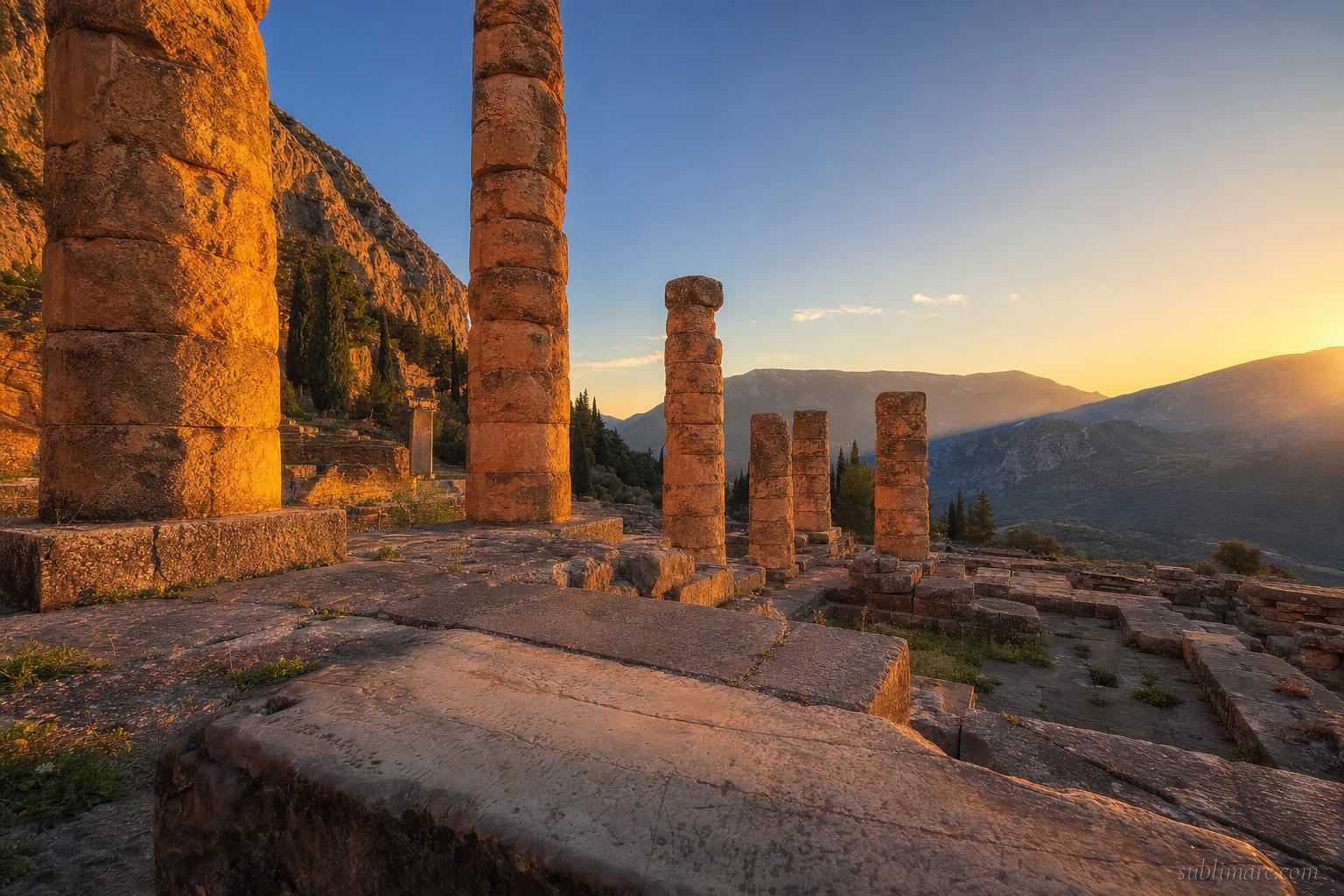
Two words. Carved in stone above the entrance to the Temple of Apollo at Delphi, one of the most sacred sites of the ancient world.
Gnothi seauton. Know thyself.
Pilgrims traveled for weeks to consult the Oracle there — kings, generals, philosophers, ordinary people — all seeking answers to the great questions of their lives. And before they even entered, they were greeted by this: not a prophecy, not a promise, but an instruction.
Know yourself.
It sounds simple. It is anything but.
More than two thousand years later, those two words remain arguably the most important challenge any human being can take on. And in a world designed to keep you distracted, defined by external metrics, and perpetually on the surface of yourself — the instruction hasn’t gotten easier. It’s gotten more urgent.
What the Ancients Actually Meant
The Delphic inscription has been interpreted many ways across history. For some ancient Greeks, it was a warning against hubris — a reminder to mortals not to overestimate themselves. Know your limits. Know your place.
But the Socratic tradition took it somewhere deeper. For Socrates — who famously claimed to know nothing, and yet spent his life in relentless inquiry — self-knowledge wasn’t about cataloguing your personality traits or understanding your habits. It was about something more fundamental: understanding the nature of the self that is doing the examining.
Who is the one who thinks? Who is the one who desires? Who is the one who suffers and celebrates and fears and loves?
The Delphic oracle wasn’t asking you to fill out a personality questionnaire. It was pointing at the deepest question available to a human being: What am I, really?
Why Most People Never Do It

Here’s what makes this so difficult in practice: most of us live almost entirely on the surface of ourselves.
We know our opinions. We know what we like and dislike, what we want and what we fear. We know our habits, our roles, our social identities.
But real self-knowledge goes deeper than any of that. It asks: Where did those opinions come from? Are those desires actually mine, or did I inherit them? Why do I react the way I do in certain situations? What am I afraid of beneath the fears I’ll admit to?
These questions are uncomfortable. Which is precisely why most people avoid them — not through deliberate choice, but through the quiet preference for busyness. When the phone is always in hand, the calendar always full, the noise always on — there is never quite enough silence for the deeper questions to surface.
Carl Jung called this the avoidance of the shadow — the parts of ourselves we don’t want to see, learned very early in life to push away. The anger we judge as unacceptable. The neediness we find shameful. The grief we haven’t let ourselves feel.
Those parts don’t disappear when we ignore them. They just operate from below, shaping our behavior, our relationships, our choices — without our awareness or consent.
This is the cost of not knowing yourself: you become a passenger in your own life.
What Modern Psychology Tells Us
Interestingly, contemporary psychology has a great deal to say about self-knowledge — and much of it confirms what the ancients intuited.
Research on metacognition — thinking about thinking — shows that people who develop the capacity to observe their own mental processes from a slight distance make better decisions, regulate their emotions more effectively, and are significantly less reactive under stress.
Studies on psychological flexibility — the ability to observe your inner experience without being dominated by it — are among the strongest predictors of mental health and life satisfaction across decades of research.
And work on values clarification — understanding what you actually care about, not what you’re supposed to care about — shows that people with a clear, conscious relationship with their values experience greater meaning, more resilience, and less of the low-grade anxiety that comes from living on autopilot.
The Oracle was right. Not just philosophically. Empirically.
What Self-Knowledge Actually Looks Like
Self-knowledge is not a destination. It’s a practice. And it’s more specific than the phrase suggests.
- Knowing your patterns. The emotional reactions that come up again and again. The way you respond to conflict, to criticism, to intimacy, to failure. Not judging these — simply seeing them clearly.
- Knowing your stories. The narratives you carry about who you are and what’s possible for you. “I’m not creative.” “I always end up alone.” These stories were formed, often in childhood, and they are not the truth — but they behave as truth until they’re examined.
- Knowing your values. Not the values you think you should have — but the ones that actually move you. What makes you feel most alive? What are you willing to sacrifice for? What, when you compromise it, leaves you feeling hollow?
- Knowing your edges. The places where growth is available — not as a project to complete, but as a lifelong orientation toward your own depth.
The Inner Observer: The Skill Beneath All Skills

At the heart of all self-knowledge is a capacity the contemplative traditions have always pointed to and modern psychology is now naming: the inner observer.
The ability to watch your own thoughts, feelings, and reactions without completely fusing with them. To be able to say: I notice I’m feeling anxious — rather than I am anxious. To see the story arising rather than simply being swept away by it.
This is the skill beneath all skills. And it is precisely what practices like meditation, journaling, and honest self-reflection train directly.
This is why self-knowledge and inner practice are inseparable. Reading about yourself can only take you so far. At some point, the inquiry has to become experiential. You have to sit with yourself long enough to actually see what’s there.
A journal is one of the simplest tools available. Not to write about your day — but to ask the harder questions and stay with them long enough to let something honest surface. What am I really feeling right now? What do I actually want? What am I avoiding?
The answers are always there. They’re just waiting for the silence to find them in.
A Closing Thought
The Temple of Apollo no longer stands at Delphi. But those two words have outlasted the building, the civilization, the gods for whom it was built.
They persist because they point at something that doesn’t age. The deepest, strangest, most inexhaustible subject available to any human being is the one who is doing the inquiring.
You will not reach the bottom of it. That’s not a discouragement — it’s an invitation.
The examined life is not a problem to solve. It is a way of being in the world. Curious. Honest with yourself about what you find. Committed to keeping the questions alive.
Gnothi seauton. Two words. A lifetime of work. The richest work there is.
If this kind of depth resonates with you, subscribe to Sublimare. We explore these questions regularly — and you never have to do it alone.
Related Posts