

“The observer affects reality” might be the most widely repeated line from quantum physics in spiritual and self-help spaces — used to justify everything from manifestation practices to claims that focused attention can literally reshape the physical world. It’s also one of the most consistently distorted findings in all of popular science communication. The actual physics is genuinely strange and worth understanding carefully. The popular version usually isn’t what physicists mean by it.
This is an attempt to lay out, as precisely as the subject allows, what the observer effect actually demonstrates, what the famous double-slit experiment does and doesn’t show, where the “consciousness causes collapse” idea actually comes from (it’s not where most people think), and what remains a genuinely open, unresolved question even among physicists who’ve spent careers on it.
The Double-Slit Experiment, Carefully Described
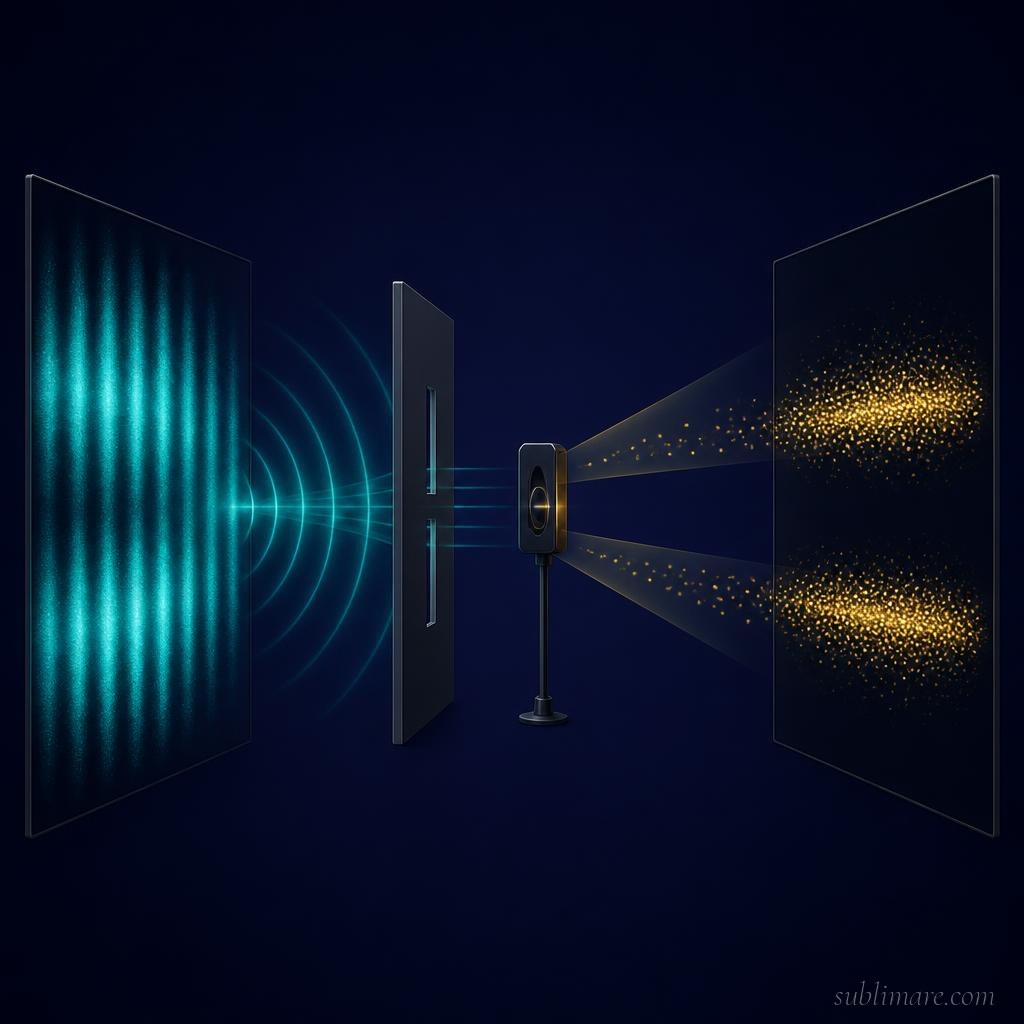
The experiment that anchors most discussion of the observer effect dates back to Thomas Young’s 1801 demonstration with light, later extended to individual particles like electrons and photons. The setup: a barrier with two narrow parallel slits, and a screen behind it that records where particles land.
When particles are fired at the barrier one at a time, with no attempt made to determine which slit each one passes through, the pattern that accumulates on the screen over time is an interference pattern — alternating bands of high and low particle density, the signature of wave behavior, as though each individual particle somehow passed through both slits simultaneously and interfered with itself. This is already strange: individual, discrete particles producing a pattern that only makes sense if something wave-like is happening.
Here’s the part that generates all the popular confusion: if you introduce a measuring device at the slits to determine which slit each particle actually travels through — gaining “which-path information” — the interference pattern vanishes. The particles now land in two simple clusters, as if they behaved like ordinary particles traveling through one slit or the other, not like a wave passing through both. The act of measuring which path the particle took appears to destroy the wave-like interference behavior.
This is real, extensively replicated, and one of the most important experimental results in the history of physics. The question is what it actually means — and this is exactly where the popular spiritual interpretation and the physics diverge sharply.
What Changes the Outcome: Measurement, Not Consciousness
The critical, well-established finding — confirmed across physics forums, textbooks, and peer discussion among working physicists — is that what destroys the interference pattern is the physical act of obtaining which-path information through some interaction with the particle, not the involvement of a conscious mind perceiving that information.
Detailed technical discussions on this point are unambiguous: introducing any detection apparatus that determines which slit a particle passes through destroys the interference pattern, regardless of whether a human being is aware of, or ever looks at, the measurement result. The pattern disappears whether the recorded information is written to a data file no one ever reads, captured by a fully automated detector with no human present, or deliberately hidden from the experimenter. What matters is that a physical interaction occurred that extracted path information from the system — not that a mind registered it.
The mechanism, as physicists understand it, involves the measuring device becoming physically entangled with the particle in a way that disturbs its quantum state and localizes it — essentially, the interaction required to detect which path the particle took necessarily disrupts the delicate superposition that produces interference. This is a physical interaction problem, analogous (though not identical) to the everyday observer effect in classical physics — the phenomenon where, say, inserting a thermometer into a small volume of liquid slightly changes its temperature just by the physical act of measuring it, or where checking a car tire’s pressure with a gauge releases a small amount of air. In all these cases, “observation” is a physical interaction with real, describable physical consequences — not synonymous with a conscious mind perceiving information.
Interestingly, there’s an even stranger confirmation of this physical-interaction framing: the “quantum eraser” experiments. In these setups, researchers can record which-path information (destroying the interference pattern, as expected) and then later erase that information before it’s ever observed by anyone — and when the information is erased, the interference pattern reappears in the correlated data, even retroactively in some experimental configurations. This result has sometimes been sensationalized as proof that “looking into the past changes it,” but the more careful physical description involves entanglement and correlation between particles across the whole experimental setup, not literal reality being altered by a later decision to look or not look. It’s genuinely strange physics — but its strangeness lies in entanglement and correlation structure, not in consciousness exerting retroactive causal power.

Where “Consciousness Causes Collapse” Actually Comes From
It’s worth being precise about this, because the idea that consciousness collapses the quantum wave function is often attributed entirely to New Age or wellness figures, when in fact it has a real, if marginal, pedigree within physics and philosophy of science itself.
The specific idea traces to the von Neumann–Wigner interpretation, named for mathematician John von Neumann and physicist Eugene Wigner, both serious, highly credentialed scientists. Von Neumann’s 1932 analysis of quantum measurement identified what’s sometimes called the “measurement problem” — the puzzle of why and how a quantum system described by a superposition of possible states (evolving smoothly according to the Schrödinger equation) appears to “collapse” into one definite, observed outcome upon measurement, a process the standard mathematics doesn’t fully explain on its own. Wigner later proposed, somewhat speculatively, that consciousness itself might be the thing that triggers this collapse — reasoning that since measuring devices are themselves physical systems that could in principle be described quantum mechanically too, there needed to be some non-physical endpoint (a conscious observer) where the regress of “measuring the measurer” finally stops.
This remains a minority position within physics and philosophy of mind, and it faces serious, specific objections. Critics on physics forums and in academic philosophy point out that the interpretation isn’t experimentally testable in any way that distinguishes it from competing interpretations of quantum mechanics (such as the many-worlds interpretation, objective collapse theories, or pilot-wave theory), that it relies on an undefined and scientifically unoperationalized concept of “consciousness,” and that practically all known experimental results are equally well explained without invoking consciousness at all — the physical interaction with any measuring apparatus, conscious or not, is sufficient to explain the collapse of the interference pattern. Some contemporary thinkers, writing in venues like Philosophy Now, have argued that advances in neuroscience could eventually make a more refined, testable version of a consciousness-linked interpretation possible, but this remains speculative and is not the mainstream position among working physicists.
The honest summary: a small number of serious physicists and philosophers have taken the “consciousness causes collapse” idea seriously as a genuine hypothesis about an unresolved foundational puzzle in physics. The overwhelming mainstream consensus is that it’s unnecessary to explain any known experimental result, is currently untestable, and shouldn’t be confused with the well-established, purely physical observer effect demonstrated in the double-slit experiment — which requires only a physical measuring interaction, nothing more exotic.
The Measurement Problem Is Still Genuinely Unsolved
Here’s what’s important to hold alongside the debunking above: dismissing the overreaching “consciousness creates reality” interpretation doesn’t mean quantum mechanics has a fully settled, agreed-upon explanation of what measurement actually is at a fundamental level. The measurement problem remains one of the genuinely open foundational questions in physics, nearly a century after von Neumann first formalized it.
Physicists have proposed multiple serious, competing interpretations, each internally consistent and each making the identical experimental predictions (which is precisely why choosing between them is so difficult): the Copenhagen interpretation (which treats wave function collapse as a fundamental, unexplained feature of nature triggered by measurement, without specifying exactly what counts as a “measurement” at a deep level); the many-worlds interpretation (which proposes that all possible outcomes actually occur, each in a separate, non-communicating branch of reality, with no collapse happening at all — only the appearance of collapse from within any one branch); objective collapse theories (which propose a genuine physical mechanism, independent of any observer, that spontaneously triggers collapse once a system reaches sufficient physical complexity); and pilot-wave theory (which proposes hidden variables guiding particle trajectories in a fully deterministic way, eliminating the need for collapse altogether).
What’s genuinely remarkable, and worth sitting with honestly, is that physics has not resolved which of these pictures of reality is correct — and some of the available options (particularly many-worlds) are themselves deeply strange and philosophically significant, even without any appeal to consciousness. The lesson isn’t “quantum mechanics proves mysticism is right.” It’s closer to the opposite and, in a way, more interesting: quantum mechanics is already strange enough, on its own well-tested terms, that it doesn’t need embellishment or mystical reinterpretation to be one of the most conceptually challenging discoveries in the history of science.
Why This Matters Beyond Physics
This isn’t just a technical correction for its own sake. The misapplication of the observer effect has real downstream consequences in how people think about their own agency and the nature of reality — showing up directly in claims examined in our earlier post on the science of manifestation, where appeals to quantum physics are frequently used to suggest that focused thought or attention can directly reshape external physical outcomes through some quantum mechanism. The actual physics doesn’t support this. The observer effect in quantum mechanics is a statement about microscopic particles and physical measuring interactions at extremely small scales; it says nothing about macroscopic thoughts or intentions influencing events at the scale of daily human life.
This matters for intellectual honesty within a spiritual or metaphysical worldview, not just for scientific accuracy. If a tradition or practice is going to draw on physics for support, it’s worth drawing on what physics actually demonstrates rather than a popularized distortion — both because misrepresenting established science undermines credibility unnecessarily, and because the actual, carefully described phenomenon is genuinely strange enough to inspire real wonder without needing to be stretched into something it isn’t. The honest version of quantum weirdness — genuine unresolved questions about the nature of measurement, multiple serious and mutually exclusive interpretations of reality still on the table, a measurement problem nearly a century old and still unsettled — is arguably more interesting than the simplified “your thoughts control reality” version, precisely because it’s real and still actively being worked out by serious people.
The Honest Bottom Line
The observer effect in quantum mechanics is real, well-replicated, and one of the strangest, most important findings in the history of physics. What it demonstrates is that physically interacting with a quantum system to extract information about it changes that system’s subsequent behavior — not that a conscious mind’s attention alters physical reality through some mystical channel. The interference pattern vanishes whether or not any human consciousness ever registers the measurement; what matters is the physical interaction itself.
The idea that consciousness specifically causes quantum collapse has a real, if minority, lineage within serious physics and philosophy (the von Neumann–Wigner interpretation), but it remains untestable, unnecessary to explain any known result, and is not the mainstream scientific position. What remains genuinely true and genuinely fascinating is that the measurement problem itself — what collapse actually is, and whether it happens at all in the way the Copenhagen interpretation suggests — is still an open question nearly a century after it was first identified, with multiple serious, internally consistent, and experimentally indistinguishable interpretations still competing for acceptance.
That unresolved strangeness, honestly described, doesn’t need any mystical amplification. Quantum mechanics, taken exactly as physicists actually understand it, is already one of the most genuinely mind-bending things humans have ever discovered about the structure of reality.
Frequently Asked Questions
Does the observer effect prove that consciousness creates reality?
No. The observer effect demonstrated in the double-slit experiment shows that a physical measuring interaction, which extracts “which-path” information about a particle, destroys the interference pattern associated with wave-like behavior. This happens whether or not any conscious being is aware of or ever examines the recorded information — the critical factor is the physical interaction with a measuring device, not conscious perception. This is a well-established and extensively replicated distinction in physics.
What does the double-slit experiment actually show?
When particles are fired one at a time through two slits without measuring which slit each one passes through, they produce an interference pattern characteristic of wave behavior. When a detector measures which slit each particle actually travels through, the interference pattern disappears, and particles behave as if they traveled through only one slit. This demonstrates that quantum systems behave differently depending on whether which-path information has been physically extracted, not depending on whether a human being is watching.
Is “consciousness causes collapse” a real scientific theory?
It has a real, if minority, origin within serious physics — specifically the von Neumann–Wigner interpretation, proposed by mathematician John von Neumann and physicist Eugene Wigner. However, it remains untestable (it makes no experimental predictions that differ from other interpretations of quantum mechanics), relies on an undefined concept of consciousness, and is not needed to explain any known experimental result. It is not the mainstream position in physics, though it continues to be discussed as one genuine, if speculative, response to the unresolved measurement problem.
What is the “measurement problem” in quantum mechanics?
The measurement problem refers to the puzzle of why a quantum system, described mathematically as existing in a superposition of multiple possible states, appears to “collapse” into one single, definite outcome upon measurement — a transition the standard mathematical framework of quantum mechanics doesn’t fully explain. Physicists have proposed several competing interpretations (Copenhagen, many-worlds, objective collapse theories, pilot-wave theory) that make identical experimental predictions but offer fundamentally different pictures of what’s actually happening, and the question of which, if any, is correct remains genuinely unresolved.
Can focused thought or intention affect physical outcomes through quantum mechanics?
There is no established physical mechanism by which ordinary human thought or intention directly influences physical outcomes through quantum effects. The observer effect operates on individual microscopic particles under tightly controlled experimental conditions through physical measuring interactions, not through consciousness exerting influence at a distance. Claims that quantum physics validates manifestation or similar practices through this mechanism are not supported by mainstream physics, as discussed in more detail in our piece on the science of manifestation.