
You’ve probably tried to meditate before.
Maybe you sat down, closed your eyes, and within thirty seconds your mind was running through your grocery list, replaying an awkward conversation from three years ago, and wondering if you were doing it wrong.
You probably concluded: meditation is not for me. My mind is too busy.
Here’s what no one told you: that busy, restless, wandering mind? That’s not a sign you’re bad at meditating. That’s just what minds do. And learning to work with it — not fight it — is literally the entire practice.
This guide is for people who have tried and given up, for beginners who don’t know where to start, and for anyone who suspects their mind might be too restless to sit still. Especially for you.
The First Thing to Understand: Your Wandering Mind Is Not the Problem
Most people believe the goal of meditation is to stop thinking. Empty the mind. Achieve silence.
This misunderstanding is responsible for more people quitting meditation than anything else.
The mind thinks. That is its job. Asking it to stop is like asking your heart to stop beating so you can relax. The thoughts will keep coming — during your first session, your hundredth session, and probably your thousandth.
What changes with practice isn’t the number of thoughts. It’s your relationship to them.
A beginner gets pulled into every thought — carried away, lost in the current. A more experienced meditator notices the thought arising, lets it pass, and gently returns attention to the breath. That noticing and returning? That is the practice. Every single time you catch yourself lost in thought and bring your attention back, you’ve done exactly what meditation is supposed to do.
The restless mind isn’t your obstacle. It’s your training ground.
What You Actually Need to Start
Almost nothing.
You don’t need a meditation app (though they can help). You don’t need a cushion, a candle, a mantra, or a teacher. You don’t need to sit cross-legged on the floor if that’s uncomfortable. You don’t need silence, a special room, or a particularly spiritual disposition.
Here’s what you actually need:
- 5 minutes — that’s enough to start. More is better, but 5 consistent minutes beats 30 occasional ones.
- A relatively quiet place — not silent, just not chaotic. A parked car works. A bathroom works. Wherever you can close your eyes for a few minutes.
- A timer — so you’re not peeking at the clock every 30 seconds.
- A willingness to feel uncomfortable — because sitting still and doing nothing is genuinely unfamiliar for most modern people. That discomfort fades.
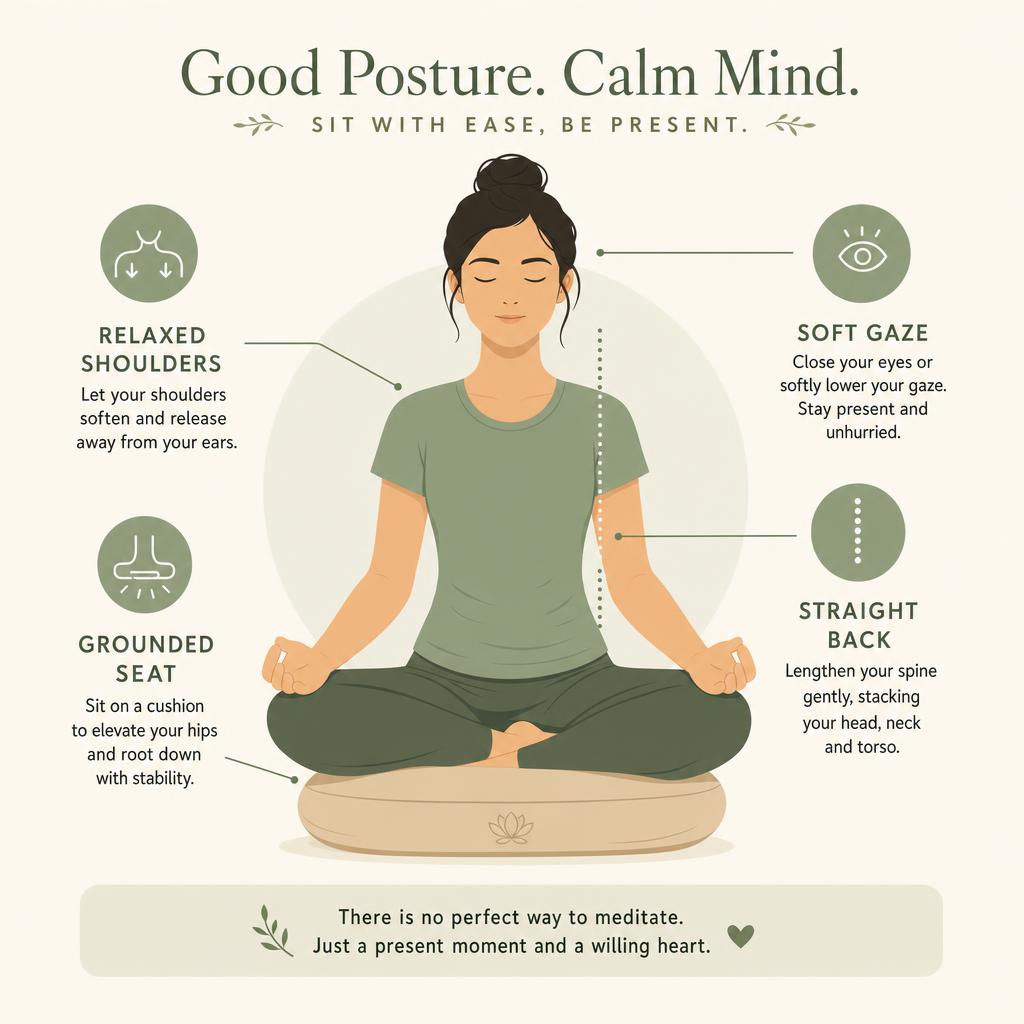
How to Sit: Posture Without the Pretension
Posture matters — but not in the rigid, uncomfortable way you might imagine.
The principle is simple: upright but relaxed. You want your spine to be relatively straight so you don’t fall asleep, but you don’t need to be rigid or tense. Think “dignified” rather than “stiff.”
- On a chair — feet flat on the floor, back gently upright, hands on your thighs. This is the easiest starting point for most people.
- On a cushion — cross-legged or kneeling, whatever is comfortable for your hips and knees.
- On the floor — back against a wall if you need support. No shame in that.
Eyes can be closed or softly open with a downward gaze — whatever helps you stay alert without getting distracted. Hands rest naturally on your knees or in your lap.
That’s it. You’re ready.
A Simple 5-Minute Practice to Start Today

This is the most basic, effective, and well-researched meditation practice in the world. It’s called breath awareness, and it’s been taught in some form across virtually every contemplative tradition for thousands of years.
Here’s how to do it:
- Set a timer for 5 minutes. Put your phone face-down so you’re not tempted to check it.
- Sit comfortably in your chosen posture. Take one or two deeper breaths to arrive.
- Let your breathing return to normal. Don’t try to control it. Just breathe naturally.
- Place your attention on the physical sensation of breathing. Feel the air entering through your nostrils, the rise and fall of your chest or belly, the slight pause at the top and bottom of each breath.
- When your mind wanders — and it will — gently bring your attention back to the breath. No frustration, no judgment. Just: oh, I wandered. Back to the breath.
- Repeat until the timer goes off.
That’s the entire practice. It sounds almost embarrassingly simple. And yet — done consistently, this simple act of returning attention to the present moment is one of the most powerful mental training tools that exists.
The Most Common Obstacles — and How to Handle Them
“My mind won’t stop.”
It’s not supposed to. Just notice the thoughts and return. Every return counts.
“I keep falling asleep.”
Try meditating at a different time of day, sitting upright instead of lying down, or meditating with eyes slightly open.
“I feel anxious or restless when I sit still.”
That’s very common — and it usually passes within the first few weeks. The restlessness is often just stored tension being released. Stick with it.
“I don’t know if I’m doing it right.”
If you sat down, closed your eyes, and tried to pay attention to your breath — you did it right. There is no perfect meditation session.
“I missed a day (or a week).”
Start again. Consistency over time matters more than perfection. The practice is always here waiting for you.
What to Expect in Your First 30 Days

Week 1: It feels strange. Your mind is relentlessly busy. You may wonder why anyone does this voluntarily. That’s normal.
Week 2: Something small shifts. You catch yourself mid-thought a little sooner. You notice moments of quiet in between the noise. The timer going off comes as a mild surprise rather than a relief.
Week 3: You start noticing the effects off the cushion. A moment of patience where you’d usually snap. A breath before a difficult conversation. A little more space between stimulus and reaction.
Week 4: It starts to feel less like a discipline and more like something you want to do. Not every day, but enough days that you notice when you skip it.
The Real Goal of Meditation (It’s Not What You Think)
People come to meditation looking for calm. And they find it — eventually. But that’s almost a side effect.
The deeper goal of meditation — at least in its classical forms — is awareness. The capacity to know what’s actually happening in your own mind, moment to moment, without being completely swept away by it.
That awareness is quietly revolutionary. It’s the difference between being angry and noticing that you’re angry. Between being anxious about the future and recognizing a pattern of anxious thought. That small gap — the noticing — changes everything.
You don’t need to meditate for years to start experiencing this. Five minutes a day, done consistently, starts building that awareness faster than most people expect.
You don’t need a quiet mind to begin. You just need to begin.
Want to go deeper? Read: What Is Meditation, Really? (No Mysticism Required)
Up next: 5 Types of Meditation and How to Choose the Right One for You
Related Posts