
The word “chakra” shows up everywhere now. On yoga mats, in wellness apps, on the labels of $40 supplements. Most of the time when it gets used it sounds like vague spiritual decoration, the kind of thing you nod at politely and don’t ask too many questions about.
But here’s what I find genuinely interesting: the chakra system is ancient, complex, and internally consistent in ways that most introductions completely miss. It’s also one of those concepts that looks different the closer you examine it. Not simpler. Actually more interesting.
This is an honest walkthrough of the whole thing. Where chakras came from, what the traditional system actually describes, what the science has found when it looked, and what I think is worth taking seriously even if you’re the kind of person who rolls your eyes at the crystal aisle.
Where the Concept Came From
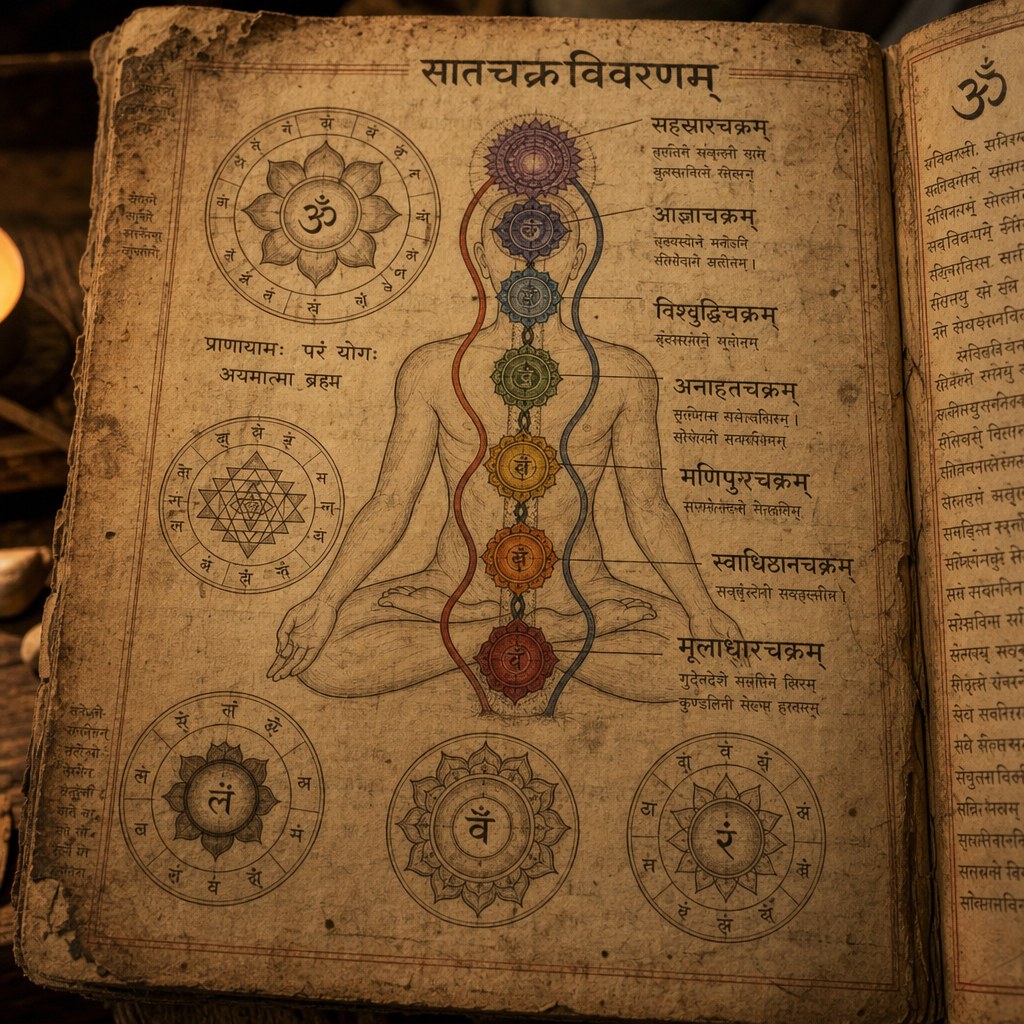
The chakra system has roots in the earliest written texts of Indian civilization. The Rigveda, one of the oldest texts in any language, dates to around 1500 BCE and contains early references to the concept of vital energy moving through the body. But the chakra system as most people recognize it today comes primarily from the Upanishads (around 600 to 800 BCE) and later from the tantric yoga traditions that developed between 500 and 1000 CE.
The word “chakra” is Sanskrit for wheel or circle. The traditional model describes a series of energy centers arranged along the spine, each one associated with specific physical, emotional, and spiritual functions. In the original framework, these centers were understood as part of a subtle body, a network of energy channels called nadis that run parallel to the physical nervous system.
This isn’t a single unified system that stayed consistent for 2,500 years. Different schools of Hinduism, tantra, and yoga developed different models: some describe five chakras, some seven, some twelve or more. The seven-chakra framework most familiar in the West was largely standardized in medieval Indian texts and then brought to Western audiences primarily through the work of Sir John Woodroffe (Arthur Avalon) in the early 20th century.
That context matters. What we call “the chakra system” is actually one version of a much larger and more varied tradition. The seven-chakra model is a coherent, well-developed framework, but it’s worth knowing it’s a distillation rather than a direct transcript of some single ancient authority.
The Seven Chakras: What They Actually Describe
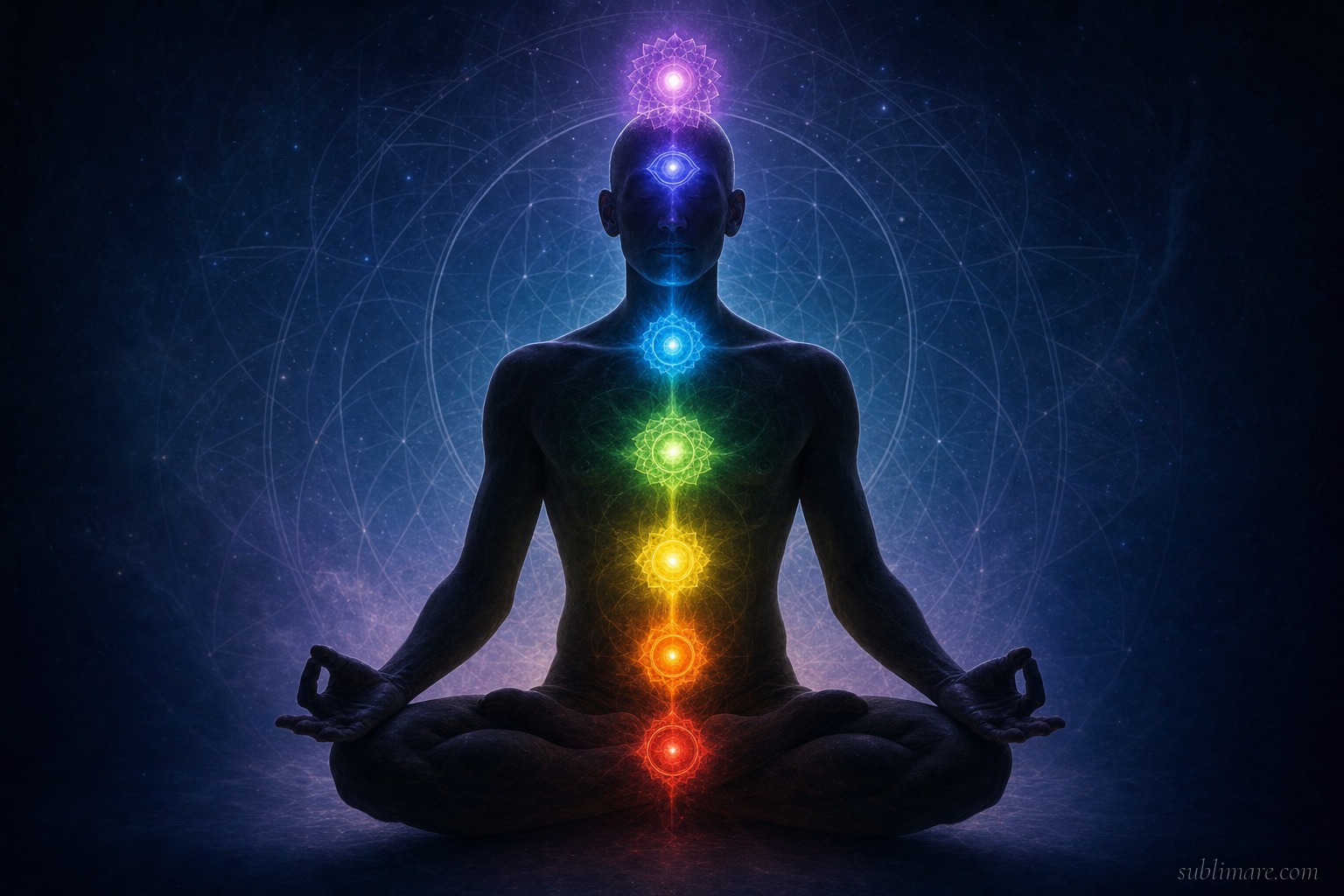
Each chakra in the traditional model is associated with a location on the spine, a color, an element, a sound, and a domain of human experience. The associations aren’t arbitrary. They map onto a fairly coherent theory of how consciousness develops from basic survival instincts up through transcendence.
1. Muladhara (Root Chakra)
Located at the base of the spine. Associated with the color red and the earth element. This is the chakra of survival, grounding, and physical safety. The traditional teaching is that when it’s balanced, you feel stable, rooted, and secure in your basic existence. When it’s dysregulated, you experience chronic fear, financial anxiety, or a persistent sense of being unsafe in the world.
2. Svadhisthana (Sacral Chakra)
Located in the lower abdomen, just below the navel. Associated with orange and the water element. This is the chakra of creativity, pleasure, and emotional flow. In traditional yoga psychology, this center governs your capacity for joy, desire, and intimacy. Dysregulation here shows up as emotional rigidity, repressed creativity, or a compulsive relationship with pleasure.
3. Manipura (Solar Plexus Chakra)
Located in the upper abdomen, at the solar plexus. Associated with yellow and fire. This is the chakra of will, personal power, and self-esteem. It governs your capacity to take action, set boundaries, and exercise agency in the world. When it’s weak, you feel powerless, passive, and easily controlled. When it’s overdeveloped, it tips into domination and control.
4. Anahata (Heart Chakra)
Located at the center of the chest. Associated with green and the air element. This is widely considered the pivotal chakra, the bridge between the lower three (survival and ego) and the upper three (expression and transcendence). It governs love, compassion, grief, and the capacity to give and receive care. The word “anahata” means unstruck in Sanskrit, referring to a sound that exists without being caused, which in this tradition points to a love that exists independent of conditions.
5. Vishuddha (Throat Chakra)
Located at the throat. Associated with blue. This is the chakra of authentic expression, communication, and truth-telling. It governs your ability to say what you actually mean, to speak your truth without filtering it through fear of disapproval. In the traditional model, blockages here manifest as chronic throat tension, difficulty with direct communication, or saying what others want to hear rather than what you actually believe.
6. Ajna (Third Eye Chakra)
Located at the center of the forehead, between the eyebrows. Associated with indigo. This is the chakra of perception, intuition, and insight. It governs the capacity to see clearly beyond surface appearances, to perceive patterns, and to access inner knowing. In many traditions, this corresponds to the pineal gland, a small endocrine structure deep in the brain that produces melatonin and was called “the seat of the soul” by Descartes.
7. Sahasrara (Crown Chakra)
Located at the top of the head. Associated with violet or white. This is the chakra of pure consciousness, transcendence, and connection to something beyond the individual self. In the traditional framework it’s not really a center of human experience so much as a gateway beyond the personal. It corresponds to what many spiritual traditions call enlightenment, liberation, or union.
Reading these descriptions, even skeptically, you can see that this is a coherent map of human psychological development. The movement from root to crown traces an arc from animal survival up through selfhood, relationship, expression, perception, and finally transcendence. Whether or not energy wheels actually spin in your spine, this is a thoughtful framework for understanding the layers of human experience.
What Science Has Actually Found
Here’s where it gets genuinely interesting, and also where I want to be careful about the difference between what the evidence shows and what people sometimes claim it shows.
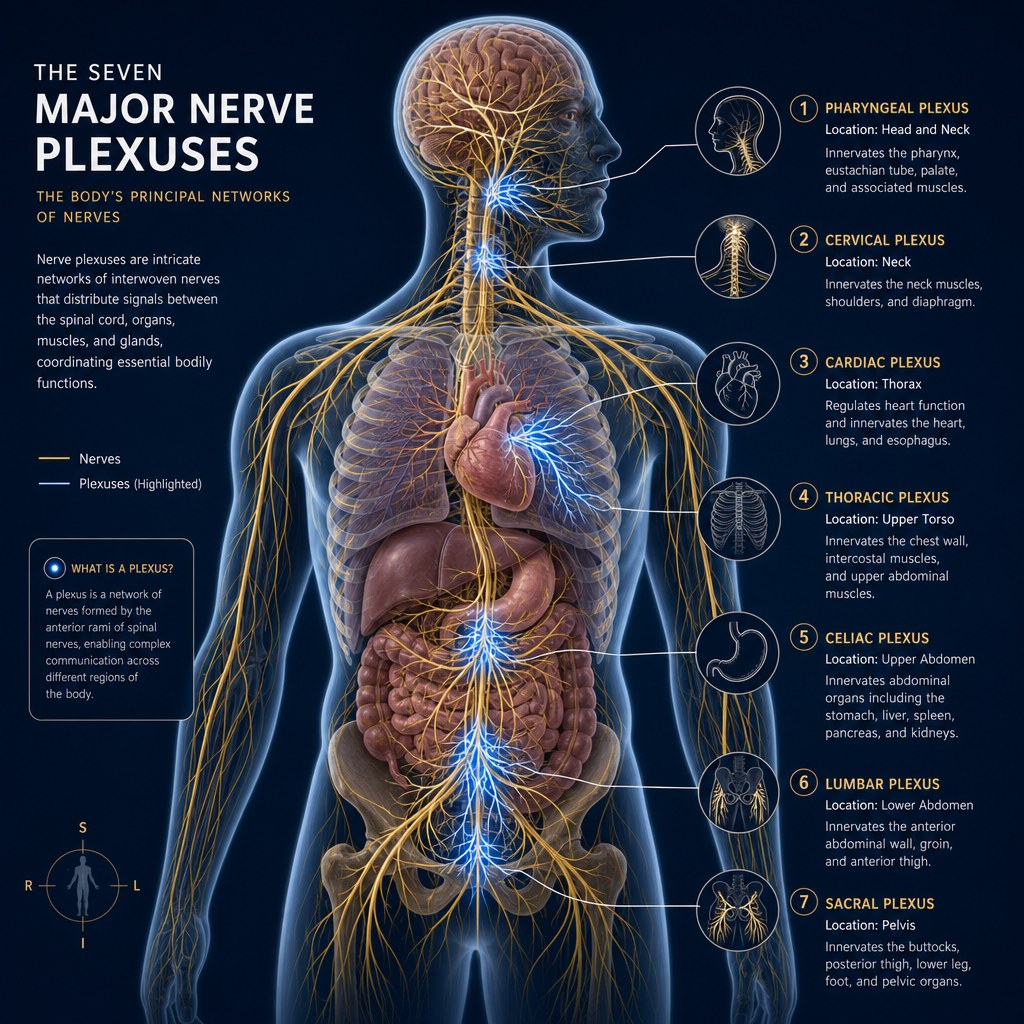
The most compelling scientific observation about chakras is the anatomical correspondence between the seven chakra locations and the major nerve plexuses of the human body.
A nerve plexus is a dense network of intersecting nerve fibers, essentially a junction point in the nervous system where large numbers of signals converge and get distributed. There are several major plexuses running along the spine and torso, and their locations map onto the chakra system with striking precision.
The solar plexus chakra (Manipura) corresponds to the celiac plexus, the largest autonomic nerve plexus in the body, located in the upper abdomen exactly where the solar plexus chakra is said to sit. The celiac plexus is sometimes called the “abdominal brain” because of its density and its role in regulating digestion, stress response, and what we now recognize as gut feelings. The connection to personal power and agency suddenly seems less metaphorical when you know that this nerve network is a primary player in your body’s fear and stress response.
The heart chakra (Anahata) corresponds to the cardiac plexus, a dense network of nerves surrounding the heart. The throat chakra (Vishuddha) corresponds to the pharyngeal plexus. The sacral chakra (Svadhisthana) corresponds to the sacral plexus, which controls the organs of reproduction and elimination. The root chakra maps to the coccygeal plexus at the base of the spine. The third eye chakra corresponds to the nasociliary plexus and its proximity to the brain’s own regulatory centers.
This correspondence doesn’t prove that chakras are “real” in the traditional sense of spinning energy vortices. But it does raise a legitimate question: how did ancient Indian practitioners, working without modern anatomical knowledge, develop a model that maps so precisely onto the actual neural architecture of the human torso?
One honest answer is careful phenomenological observation over centuries. Yogis spent extraordinary amounts of time in meditative awareness of their bodies. You don’t need an anatomy textbook to notice that intense fear produces a distinctive physical sensation in the solar plexus region, or that grief lives in the chest, or that authentic self-expression involves the throat. The chakra map may be less a metaphysical discovery than a careful record of what embodied human experience actually feels like from the inside.
The Biofield Research
Beyond the anatomical correspondence, there’s a smaller body of research that goes further. The National Institutes of Health has funded research into what it calls “biofield science,” studying whether living organisms generate measurable electromagnetic fields and whether those fields play a functional role in health.
The human body does generate electromagnetic fields. Your heart produces a measurable electrical field that can be detected several feet away from the body, which is the basis of electrocardiography. Your brain generates fields detectable with EEG. The nervous system runs on electrochemical signals. None of that is controversial.
What’s less established is whether the specific locations identified in the chakra system show distinct electromagnetic properties. Some studies, notably research by Dr. Valerie Hunt at UCLA in the 1970s and 1980s, reported higher electrical activity at chakra locations during meditation and energy healing sessions. This research has been criticized for methodological issues and hasn’t been widely replicated.
More recent work by researchers like Dr. James Oschman, author of “Energy Medicine: The Scientific Basis,” makes a detailed case that the connective tissue matrix of the body, the fascia and crystalline structures that run throughout every organ, could function as a communication network that operates differently from the nervous system but is no less real. This is speculative, but it’s serious science raising serious questions.
The honest summary: there’s intriguing preliminary evidence, real anatomical correspondence, and plenty of legitimate scientific questions still open. There isn’t yet the kind of rigorous, replicated evidence that would satisfy a hard skeptic. But the question hasn’t been definitively closed, either.
What’s Actually Useful About This Framework
Whether or not the energetic claims turn out to be physically verifiable, the chakra system works as a remarkably useful psychological map.
When therapists, somatic practitioners, and body-centered yoga teachers use chakra language, they’re often pointing at something real: the way emotional experience lives in the body. Chronic stress really does show up as tension in the solar plexus. Grief really does create tightness in the chest. People who’ve experienced trauma often report numbness or disconnection in the lower body, exactly where the root and sacral chakras sit.
This is consistent with what contemporary neuroscience and somatic therapy have found independently. The body keeps a record of emotional experience. Stress hormones change the tissue of the body. Trauma can reorganize the nervous system in ways that produce exactly the kinds of symptoms the chakra system associates with dysregulation in specific centers.
If you’ve read about the vagus nerve and how it connects the brain to the organs of the body, you’ll recognize that what modern neuroscience calls the autonomic nervous system and what ancient Indian medicine called the subtle body are mapping some of the same territory. Different instruments. Similar terrain.

How to Work With the Chakra System Without Losing Your Mind
You don’t have to decide whether chakras are literally spinning wheels of light to find the framework useful. What you’re really working with, when you do chakra-based practices, is a structured way of paying attention to the body and the emotional patterns stored there.
A few approaches that have actual evidence behind them or at least a coherent mechanism:
Body scan meditation. This is the secular version of chakra awareness practice. You move your attention systematically through the body, noticing sensation, tension, and aliveness in each region. It’s one of the most evidence-backed forms of mindfulness for reducing anxiety and increasing body awareness. If you do this with the chakra map in mind, you’re essentially doing the same practice with a richer vocabulary for what you notice.
Breathwork. Every major chakra system uses breath as the primary tool for working with the energy centers. Modern breathwork practices, from diaphragmatic breathing to pranayama to Wim Hof, work directly on the autonomic nervous system through the vagus nerve. The solar plexus, the heart, the throat: these areas of the body are directly affected by how you breathe. This isn’t metaphysics. This is physiology. If you want a full breakdown of how breathing actually changes your state, the post on breathwork for beginners covers the mechanisms in detail.
Yoga and movement. Every traditional yoga pose was designed, among other things, to affect specific chakra centers. Hip openers target the sacral and root chakras. Backbends open the heart and throat. Inversions affect the crown. Whether or not energy is flowing differently after these poses, the mechanical and physiological effects on the nervous system are real and well-documented.
Journaling with the map. Using the seven chakras as a structured reflection framework is genuinely useful regardless of your metaphysical commitments. Where am I feeling stuck? Is it in security and survival, in relationships and pleasure, in agency and self-expression? The chakra system gives you a vocabulary for locating the quality of your current experience and asking focused questions about it.
The Honest Bottom Line
The chakra system is one of the oldest and most sophisticated frameworks in human history for understanding the relationship between body, emotion, and consciousness. It’s not pseudoscience: it predates the category entirely. It’s also not yet verified science in the narrow sense of having been rigorously tested and replicated by modern methods.
What it is, at minimum, is a detailed phenomenological map created by careful observers over centuries. And at its core, it’s describing something you can verify in your own body right now: emotional experience is physically located. Feeling safe feels different in your body than feeling threatened. Love feels different from grief. Authentic expression feels different from suppression.
The chakra system gives you a map for that territory. Whether the map is literally accurate or metaphorically powerful, using it tends to produce more body awareness, more emotional clarity, and more insight into patterns you’ve been carrying without noticing.
That seems worth exploring, whatever your metaphysics happen to be.
If the consciousness angle interests you, the post on what consciousness actually is gets into why these questions about inner experience are so hard to answer from the outside, and why they matter.
Frequently Asked Questions
Are chakras real?
It depends on what you mean by real. As anatomical structures you can see on a scan, no, they haven’t been verified. As a framework that maps onto the nervous system’s major plexuses and describes genuine patterns in how humans experience emotion, there’s real substance here. The honest answer is that the question is still open, and the system is useful regardless of how that question eventually resolves.
What are the 7 chakras and their meanings?
The seven chakras are: Root (Muladhara, survival and grounding), Sacral (Svadhisthana, creativity and pleasure), Solar Plexus (Manipura, will and power), Heart (Anahata, love and compassion), Throat (Vishuddha, expression and truth), Third Eye (Ajna, intuition and perception), and Crown (Sahasrara, consciousness and transcendence). Each corresponds to a location on the spine from the base to the top of the head.
How do I know if a chakra is blocked?
In the traditional system, chakra “blocks” manifest as recurring emotional patterns or physical tension in the corresponding body region. Persistent anxiety and a sense of being unsafe can point to the root chakra. Difficulty expressing yourself or chronic throat tension might relate to the throat chakra. The most useful approach is to treat these as starting points for inquiry rather than diagnoses.
What does science say about chakras?
Science has found striking anatomical correspondence between the seven chakra locations and the major nerve plexuses of the human torso. There’s also preliminary research on biofield science and electromagnetic activity at chakra sites during meditation, though this work hasn’t been broadly replicated. The scientific case is intriguing but not yet conclusive.
Do I need to believe in chakras for chakra practices to work?
No. The practices associated with chakras, body scan meditation, breathwork, yoga, and structured self-reflection, have documented benefits independent of the metaphysical framework. You can use the chakra system as a map for body awareness and emotional inquiry without committing to any particular belief about what chakras are at a fundamental level.
Related Posts