

There’s an entire industry built around morning routines. Five-AM wake-ups. Hour-long journaling sessions. Cold plunges before sunrise. Gratitude lists before coffee. The advice keeps proliferating, and most of it is either so demanding it’s unsustainable, or so vague it’s impossible to evaluate.
What’s missing from most of this conversation is the actual biology. There are specific things that happen inside your body and brain in the first 90 minutes after waking — hormonal cascades, neurochemical shifts, circadian calibrations — and understanding them makes it much easier to figure out which habits are worth doing and which are just productivity theater.
This post is about what the research actually shows: what’s happening in your body when you wake up, why the morning window is genuinely distinct from the rest of the day, and which specific practices have real evidence behind them. It’s also about the deeper question underneath all the biohacking: what kind of morning sets you up not just to perform, but to feel like yourself.
What’s Actually Happening When You Wake Up
The moment you wake up, your body initiates a cascade of physiological events that establish the hormonal and neurochemical baseline for your entire day. Understanding two of these — the Cortisol Awakening Response and sleep inertia — changes the logic of morning habits completely.
The Cortisol Awakening Response
Cortisol gets a bad reputation because of its association with chronic stress. But cortisol is not inherently bad. It’s a steroid hormone your body uses as a primary activating signal — it mobilizes energy, sharpens alertness, and prepares your immune system and metabolism for the demands of the day.
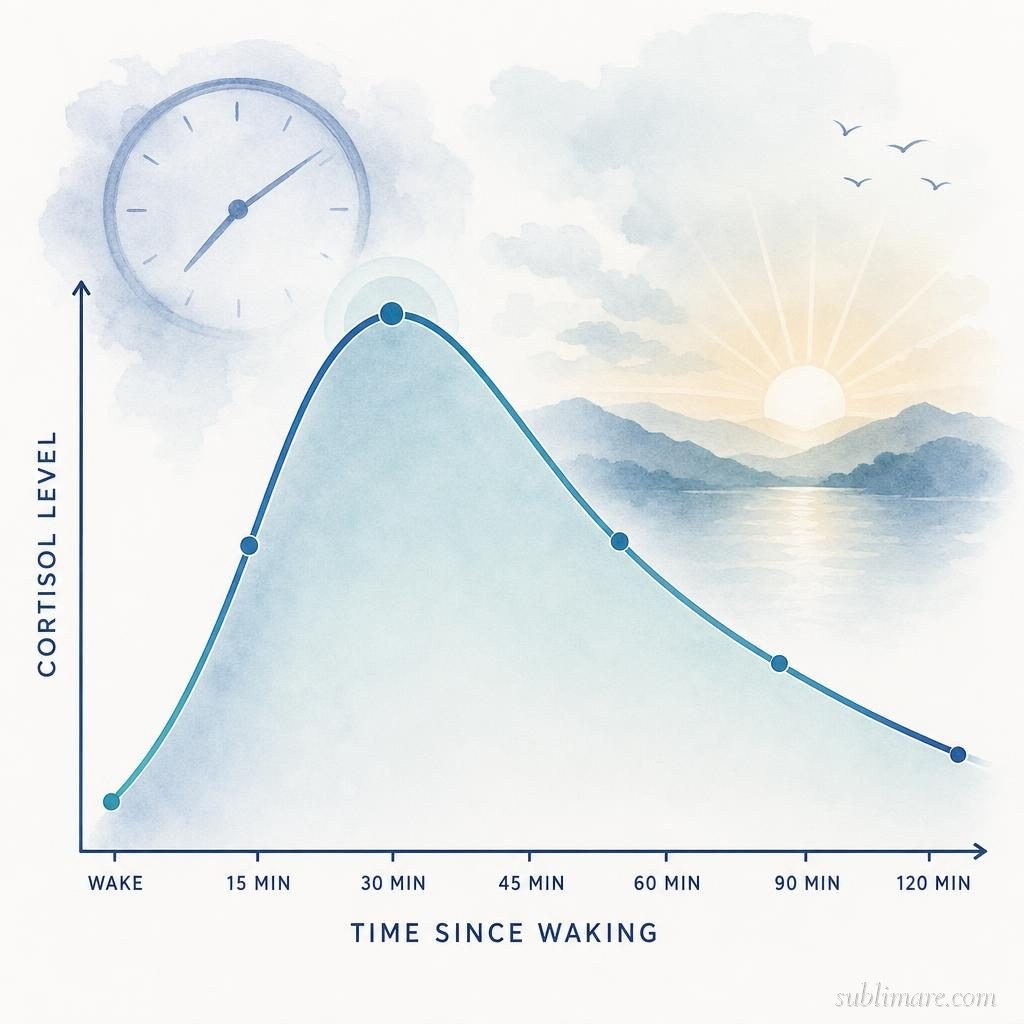
Within minutes of waking, your cortisol levels spike sharply — typically increasing by 50 to 100 percent above the baseline you had during sleep, peaking around 30 to 45 minutes after you open your eyes. This is the Cortisol Awakening Response (CAR), and research from ScienceDirect’s clinical review database shows it’s present in roughly 73 to 77 percent of healthy individuals. It’s your body’s built-in morning alarm — a natural, timed surge designed to get you operational.
Here’s the problem: when you pick up your phone within minutes of waking, you’re injecting external stressors — emails, news, social media — into a brain that is already in a heightened arousal state from the CAR. The result is not alertness; it’s anxiety. Your stress-response system gets triggered before it’s had a chance to complete its natural activation arc. Research consistently shows that early-morning phone use correlates with higher levels of reported stress, lower mood ratings through the day, and a subjective sense of being reactive rather than proactive.
The CAR is also a diagnostic marker for the health of your stress-response system overall. A blunted CAR — where cortisol doesn’t rise much after waking — is associated with chronic stress, burnout, and certain mood disorders. An exaggerated CAR is linked to anxiety and hypervigilance. The shape of your morning cortisol curve is telling you something about the state of your nervous system.
Sleep Inertia: The 20-Minute Window
There’s a second biological phenomenon that matters even more in the first minutes after waking: sleep inertia. When you come out of sleep, particularly out of deep slow-wave sleep, your brain doesn’t come fully online immediately. There’s a transitional period — typically 15 to 30 minutes — during which decision-making capacity, reaction time, and cognitive performance are measurably impaired. Research cited by Dr. Paul McCarthy’s neuroscience review shows that complex decision-making can be reduced by as much as 20 percent during this window.
This has two practical implications. First, the decisions and inputs you receive during this window have disproportionate influence on your emotional state, because your prefrontal cortex — the part of your brain responsible for rational appraisal and emotional regulation — is the last thing to come fully online. Your limbic system (emotional, reactive) leads. The thinking brain follows. Whatever emotional tone you set or receive in those first 20 minutes tends to anchor the day’s mood more strongly than inputs that arrive later.
Second, it means the first major decision of your day should probably not be made while you’re still in sleep inertia. This is one of the reasons spiritual and contemplative traditions have historically structured the early morning around ritual, repetition, and receptive practices rather than active problem-solving.
The Five Elements That Actually Work
With that biology as backdrop, here are the morning practices with the strongest evidence behind them — not the most glamorous, necessarily, but the ones that produce measurable changes in how you feel and function.
1. Morning Light Within the First Hour
This is the single most evidence-supported morning habit in the literature, and the most underrated. Light is the primary signal your circadian system uses to set its daily clock. When light-sensitive cells in your retina detect bright light — particularly the blue-spectrum wavelengths dominant in morning sunlight — they send a direct signal to your suprachiasmatic nucleus, the brain’s master timekeeper, which then synchronizes every cell clock in your body.
A 2023 study involving over 85,000 participants found that morning light exposure significantly reduced the risk of depression and improved general wellbeing markers. A UCLA Health review found that people who get regular morning light exposure show lower anxiety levels, better mood ratings, more stable sleep, and improved cognitive function through the day. The mechanism runs through serotonin: morning light triggers serotonin production in the brain, which is the same neurotransmitter that most antidepressant medications target.
Ten to twenty minutes of outdoor light within an hour of waking is enough to trigger the circadian calibration — even on overcast days, outdoor light intensity far exceeds indoor artificial lighting. The key word is outdoor: window glass filters out a significant portion of the relevant wavelengths. You need actual sky.
2. Movement — Any Kind, Early
Morning exercise has the most robust evidence of any single morning habit for improving both cognitive performance and mood. A 2025 study published in a peer-reviewed sports science journal, tracking 102 students aged 12 to 13 over twelve weeks, found that morning physical activity produced the greatest improvements in attention, working memory, processing speed, and positive mood compared to midday or afternoon activity.
The mechanism is partly neurochemical: exercise triggers the release of BDNF (brain-derived neurotrophic factor), often called “Miracle-Gro for the brain,” which supports the growth and maintenance of neurons. It also elevates dopamine, norepinephrine, and serotonin — the same neurotransmitter trio targeted by most psychiatric medications for depression and ADHD. Morning exercise essentially gives you a natural dose of the same chemistry.
The critical qualifier is that “exercise” here doesn’t mean an hour at the gym before sunrise. Even 10 to 20 minutes of brisk walking produces measurable neurochemical effects. The movement matters more than the intensity or duration, especially for mood. For people who genuinely cannot sustain a rigorous morning workout, a walk while getting morning light combines two of the most evidence-based morning practices into a single ten-minute habit.
3. Delay the Phone
This sounds like simple digital wellness advice. The neuroscience makes it considerably more urgent. When you check your phone immediately after waking, you’re doing several things simultaneously: you’re exposing your sleep-inertia brain to information that triggers reactive emotional responses before your prefrontal cortex is online; you’re injecting your still-elevated cortisol state with external stressors; and you’re immediately entering a reactive, response mode rather than an intentional, directed one.
The delay doesn’t need to be extreme. Forty-five minutes to an hour is the commonly cited threshold for allowing the CAR to complete its arc and for sleep inertia to clear. During that window, the nervous system gets to calibrate naturally rather than being hijacked by incoming data. People who implement this consistently report one of the most commonly described experiences in the research: a qualitative shift in how they feel for the rest of the day. Less reactive. More present. More like they chose how to start rather than being pulled into a stream.

4. Hydration Before Caffeine
After six to nine hours of sleep without fluid intake, you wake up mildly dehydrated. Even mild dehydration — as little as 1 to 2 percent of body weight — produces measurable impairments in attention, working memory, and mood. A glass of water before coffee does something simple but real: it restores the baseline fluid status your brain needs to function clearly.
The timing of caffeine matters too, in ways most people don’t know. Adenosine is a neurochemical that builds up in your brain during waking hours and makes you progressively sleepier — it’s the signal that creates sleep pressure. During sleep, adenosine clears. But in the first 90 minutes or so after waking, adenosine is still in the process of being cleared. If you drink coffee immediately, you’re blocking adenosine receptors while adenosine levels are still relatively high. When the caffeine wears off several hours later, the accumulated adenosine floods back in, producing the characteristic midday energy crash. Delaying caffeine by 90 to 120 minutes after waking — an idea popularized by neuroscientist Andrew Huberman, based on the underlying sleep science — allows adenosine to clear naturally, producing more stable energy and less severe afternoon drop-off.
5. Intentional Silence or Mindfulness Practice
The evidence for meditation in general is well-established: regular mindfulness practice reduces activity in the default mode network (the brain’s “wandering mind” circuits), lowers cortisol over time, improves emotional regulation, and strengthens the prefrontal cortex’s capacity to modulate limbic reactivity. The morning specificity comes from a different angle.
During the hypnagogic state — the transitional zone between sleep and full waking — the brain is in a more theta-dominant brainwave pattern, which is associated with increased receptivity, creativity, and access to unconscious material. This is why many people report their clearest ideas or most vivid insights in the first moments of waking. A brief period of intentional silence, even five to ten minutes, allows some of that material to surface before the external world floods in. This doesn’t require formal meditation. It can be lying still with your eyes closed for a few minutes after your alarm goes off. It can be sitting with a cup of tea before checking anything. It can be a short breathing practice that takes three minutes. The common element is a deliberate pause between sleep and the external world.
The Chronotype Problem
Here’s the important qualification that most morning routine content ignores: not everyone is biologically suited to early mornings, and forcing a late chronotype into a 5 AM structure often does more harm than good.
Chronotype is the genetically influenced variation in circadian timing that determines whether you naturally thrive in the morning, the evening, or somewhere in between. Research shows it’s distributed across a genuine biological spectrum and is influenced by genetics, age, and sex. Roughly 25 percent of people are strongly morning-oriented, 25 percent are strongly evening-oriented, and the rest fall somewhere in the middle. Late chronotypes aren’t lazy — they’re operating on a different biological clock.
The research on morning physical activity and light exposure doesn’t require an early wake time. It requires that these practices happen in your morning — in the first hour or two after your natural wake time, whatever that is. A late chronotype who wakes at 8 AM and gets light and movement by 9 AM is working with their circadian biology just as effectively as an early bird who wakes at 6.
The practices matter. The clock time matters far less than the marketing suggests.
What the Contemplative Traditions Knew
Across Buddhist, Stoic, yogic, Sufi, and countless other traditions, the early morning has been treated as a distinct and protected time — not for productivity, but for orientation. The Stoic practice of the morning meditation involved reviewing the day ahead and preparing the mind for difficulty before encountering it. Yogic tradition calls the pre-dawn hours Brahma Muhurta, the “creator’s hour,” considered the optimal time for meditation and self-inquiry because of the quality of stillness available before the day’s noise arrives. Many monastic traditions worldwide structure their earliest hours around silence, prayer, or contemplation for similar reasons.
These weren’t arbitrary cultural choices. They were the accumulated observational wisdom of people who spent lifetimes studying the texture of inner experience at different points in the daily cycle. What neuroscience now confirms about sleep inertia, theta brainwaves, and the CAR fits remarkably well with what these traditions described through the lens of experience alone.
The deepest purpose of a morning practice, across all of these frameworks, isn’t optimization. It’s orientation. It’s the difference between starting a day and being pulled into one — between approaching the next sixteen hours from a chosen center versus being thrown into it from wherever you happened to land.

Building One That Actually Sticks
The reason most morning routines fail has nothing to do with motivation. It’s architecture. Most people try to implement a complete system at once — five new habits simultaneously — and collapse after a week because the cognitive load is too high and the reward isn’t immediate enough.
What the neuroplasticity research suggests is a different approach. Habits wire themselves into the brain through repetition in stable contexts. The brain encodes a habit as a pattern: specific cue → routine → reward. The more specific and consistent the cue and context, the faster the pattern encodes. This is the logic behind habit stacking: attaching a new behavior to an existing stable anchor rather than trying to establish it from nothing.
A practical architecture, starting with the minimum viable version:
Week 1: One thing only. Pick the single highest-leverage practice — probably morning light — and do it every day. Don’t add anything else. Let it become automatic before you layer on the next element.
Week 2: Attach one more. Once the light habit is running automatically, attach something to it. The walk that gets you the light could also be your movement. Two practices, one trip outside.
Week 3: Protect the phone-free window. Set a specific rule — phone goes off until after your morning anchor habit is done. This isn’t willpower; it’s environment design. Keep the phone in another room until that point.
The question to ask before adding anything: Does this practice bring me into my body, into the present moment, or into my own center? Or does it push me outward into reaction, comparison, or information? Anything in the first category belongs in your morning. Anything in the second belongs later.
The vagus nerve research is worth reading alongside this, because it explains the mechanism behind why practices like slow breathing, cold water, and movement all produce similar calming effects — they’re all stimulating the same parasympathetic brake on the stress response, which is exactly the biology you want working in your favor before the day’s demands arrive.
The Honest Bottom Line
You don’t need an elaborate morning ritual. You need a few specific practices that work with your biology rather than against it, applied consistently enough for your brain to encode them as defaults.
Morning light. Some movement. No phone for the first hour. Water before coffee. Five minutes of silence before the world comes in.
That’s it. That’s the version with actual evidence behind it. Everything else is optional, and probably worth evaluating against the simple question: does this help me feel more like myself before the day takes over?
That question is both the practical and the deeper one. The morning isn’t just about performing better. It’s about ensuring that the person who shows up to the day is actually you — awake, grounded, and oriented — rather than a reactive version of you that the algorithm got to first.
Frequently Asked Questions
What is the most important part of a morning routine?
Based on the research, morning light exposure within the first hour of waking has the strongest evidence base for improving mood, energy, and circadian alignment. If you could only do one thing, getting outside for ten to twenty minutes after waking — even just standing in a doorway on an overcast day — produces measurable neurochemical and hormonal benefits that no supplement or productivity hack reliably matches.
Why do I feel worse after checking my phone in the morning?
Two reasons. First, you’re introducing stressors during the Cortisol Awakening Response — a period when your arousal system is already elevated, making you more reactive to negative or anxiety-provoking inputs. Second, sleep inertia means your prefrontal cortex (the part of your brain that rationally appraises situations) is still coming online, so emotional reactions from your limbic system have disproportionate influence. The combination creates a reactive, slightly anxious baseline that can persist for hours.
Does the morning routine need to happen at the same time every day?
Consistency matters more than clock time. Research on circadian biology shows that your body cares less about the absolute hour and more about regularity — seeing the same sequence of cues (light, movement, food) at the same relative time after waking. Irregular wake times are actually more disruptive to circadian health than sleeping in, because they constantly reset the internal clock without giving it time to stabilize.
What if I’m not a morning person?
Then you’re probably a late chronotype, and the 5 AM advice was never written for your biology. The practices here — light, movement, silence, delayed phone use — apply regardless of when you wake. They just need to happen in your morning, relative to your natural wake time. A 9 AM wake-up with morning light by 9:30 is biologically equivalent to a 6 AM wake-up with light by 6:30. The clock time is less important than the sequence.
How long does it take for a morning routine to start working?
Some effects are immediate — morning light improves alertness within minutes; delaying the phone produces a noticeable difference in mood tone within days. Habit formation typically requires 21 to 66 days of consistent practice, depending on the individual and the complexity of the habit. The stronger predictor than time is consistency: an imperfect routine done every day beats a perfect one done sporadically. Start with one practice, let it become automatic, then add the next.