You spend roughly a third of your life unconscious, cycling through a series of distinct internal states most people never think about beyond “did I sleep well.” But sleep isn’t a single, uniform condition — it’s an intricately structured sequence of different brain states, each doing different work, and one of those states was, for most of human history, considered one of the primary channels through which the sacred, the ancestral, and the healing entered ordinary life.
This post looks at both sides of that inheritance: what modern sleep science has actually established about the architecture of sleep and what each stage does, and what the historical and cross-cultural record shows about how seriously — and how specifically — earlier civilizations treated sleep as sacred territory, not merely as rest.
The Architecture of a Night’s Sleep
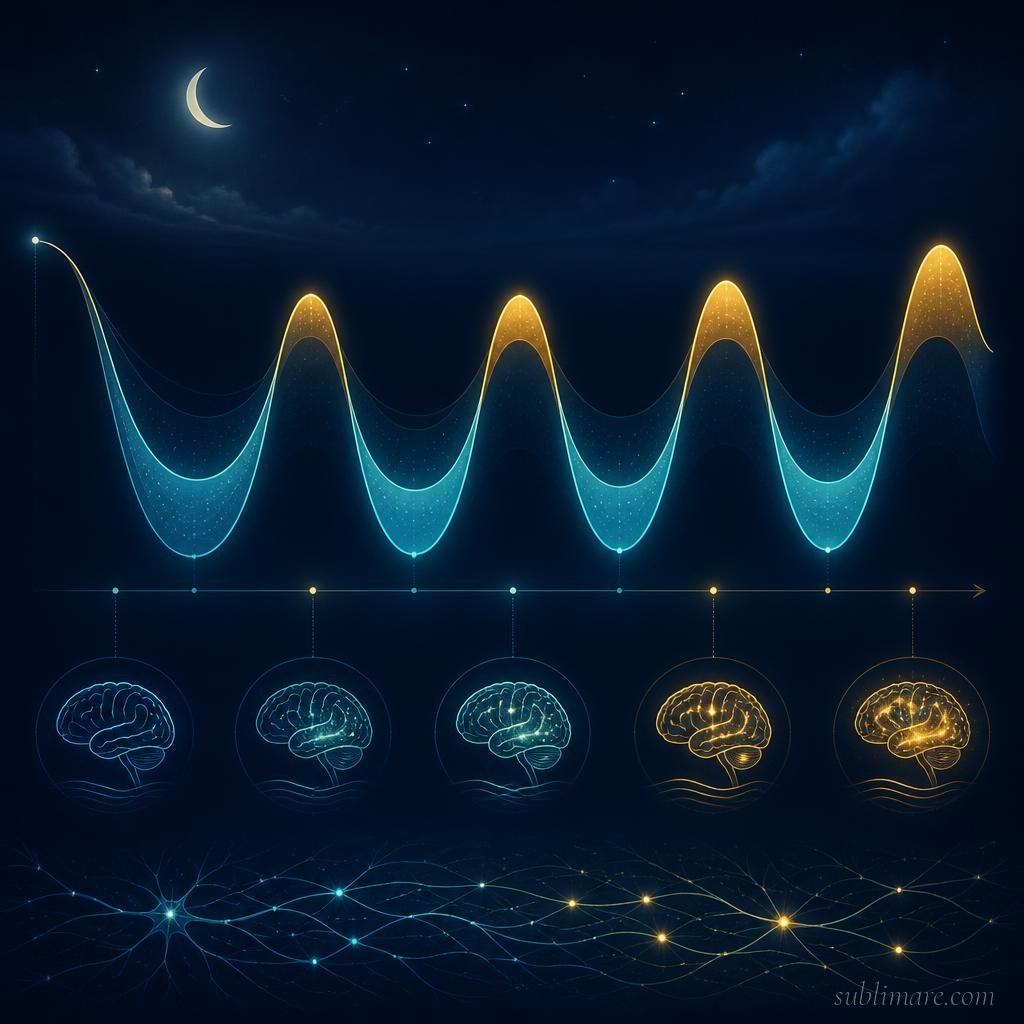
Sleep is divided into two fundamentally different categories: non-REM (NREM) sleep, itself divided into three progressively deeper stages, and REM (rapid eye movement) sleep, where most vivid dreaming occurs. Across a typical night, you cycle through these stages roughly every 90 minutes, four to six times, with the balance shifting as the night progresses — more deep NREM sleep concentrated in the first half of the night, more REM concentrated in the final hours before waking.
N1, the lightest stage, is the brief transition between wakefulness and sleep — typically lasting only a few minutes, characterized by slowing brain waves and, notably, the hypnagogic phenomena discussed below. N2 makes up the largest share of total sleep time and involves further slowing of brain activity along with brief bursts of activity called sleep spindles, thought to play a role in memory consolidation and sensory processing. N3, deep or slow-wave sleep, is the most physically restorative stage — this is when the body performs the bulk of tissue repair, immune system strengthening, and growth hormone release, and it’s the stage from which it’s hardest to wake someone.
REM sleep, by contrast, is where the brain becomes almost as electrically active as it is during waking, even though the body enters a state of near-total paralysis (a protective mechanism that prevents you from physically acting out dreams). This is the stage most associated with vivid, narrative dreaming, and — as covered in our earlier piece on dream journaling — it plays a documented role in emotional memory processing and regulation.
Recent research has added important nuance to the old idea that NREM sleep is “just” restorative while REM does the psychologically interesting work. A comprehensive review in a leading neuroscience journal found that memory consolidation during sleep is a more collaborative process than previously understood: slow-wave NREM sleep drives the replay of neuronal firing patterns from the day’s experiences, particularly involving the hippocampus, effectively re-running and strengthening memory traces, while REM sleep appears to help integrate and rebalance those changes across the broader network of the cortex. A related 2024 NIH-supported study found that NREM sleep functions as a kind of active reset for brain circuits — not simply “downtime,” but a distinct working mode with its own essential computational role.
What this establishes, at minimum, is that sleep is not the absence of meaningful brain activity. It’s a different mode of highly organized brain activity, doing work that waking consciousness cannot do — consolidating memory, regulating emotion, restoring the body, and, during REM, generating one of the most narratively rich and emotionally significant experiences human consciousness produces.
The Threshold State: Hypnagogia
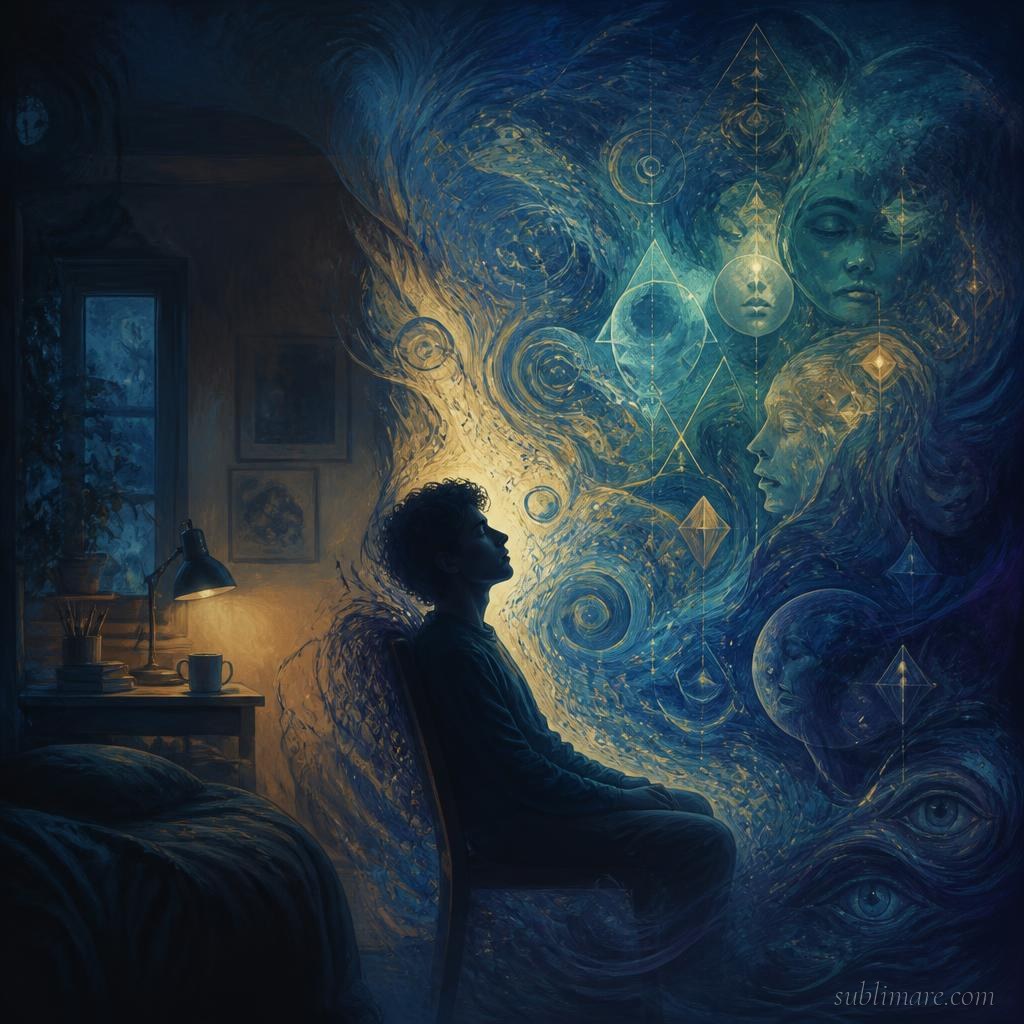
Between full waking and full sleep sits a genuinely strange transitional zone called hypnagogia (on the way into sleep) and its mirror state, hypnopompia (on the way out of sleep, upon waking). This is the territory of the N1 stage described above, but its phenomenology deserves attention on its own, because it’s unlike either ordinary waking thought or full dreaming.
During hypnagogia, people commonly experience vivid, unbidden visual imagery (geometric patterns, faces, brief scene fragments), auditory phenomena (hearing one’s name called, snippets of speech or music with no external source), the sensation of falling accompanied by an involuntary muscle jerk (the hypnic jerk), and a distinctive quality of thought that feels less directed and more associative than ordinary waking cognition — ideas arriving in loose, image-based, only semi-logical sequences.
A notable scholarly analysis published in the academic outlet The Polyphony examined historical religious and spiritual experience through exactly this lens, documenting how people across centuries — from historical Spiritualist mediums to contemporary members of mainstream religious congregations — have reported auditory and visionary experiences occurring in a state they describe as “neither awake nor asleep.” The author notes that the terminology people use to describe these experiences oscillates inconsistently between “dream” and “vision,” reflecting genuine ambiguity about how to classify an experience that doesn’t map cleanly onto either full sleep or full waking. What’s notable is that many of these historically reported “visions” and “visitations” — voices heard, presences sensed, meaningful imagery received — align closely with the well-documented phenomenology of hypnagogia as understood by contemporary sleep science, suggesting that a substantial portion of humanity’s reported visionary and mystical experience may have occurred, quite literally, in this specific liminal physiological window.
This isn’t necessarily a reductive claim that “it was all just hypnagogia, nothing more.” It’s a genuinely interesting convergence: a real, well-documented neurophysiological state that produces exactly the kind of experience — vivid, meaningful, ambiguous between inner and outer, occurring at the threshold of consciousness — that many traditions have described as spiritually significant. Whether the significance is purely psychological or points to something more, the physiological doorway through which these experiences most commonly arrive is well characterized.
Sleep Temples: When Civilizations Built Architecture Around Dreams
If the idea of sleep as sacred territory sounds like a modern wellness reframing, the historical record says otherwise — ancient civilizations built literal, dedicated architecture around the practice of sleeping in order to receive dreams, and treated the practice with the seriousness of formal medicine.
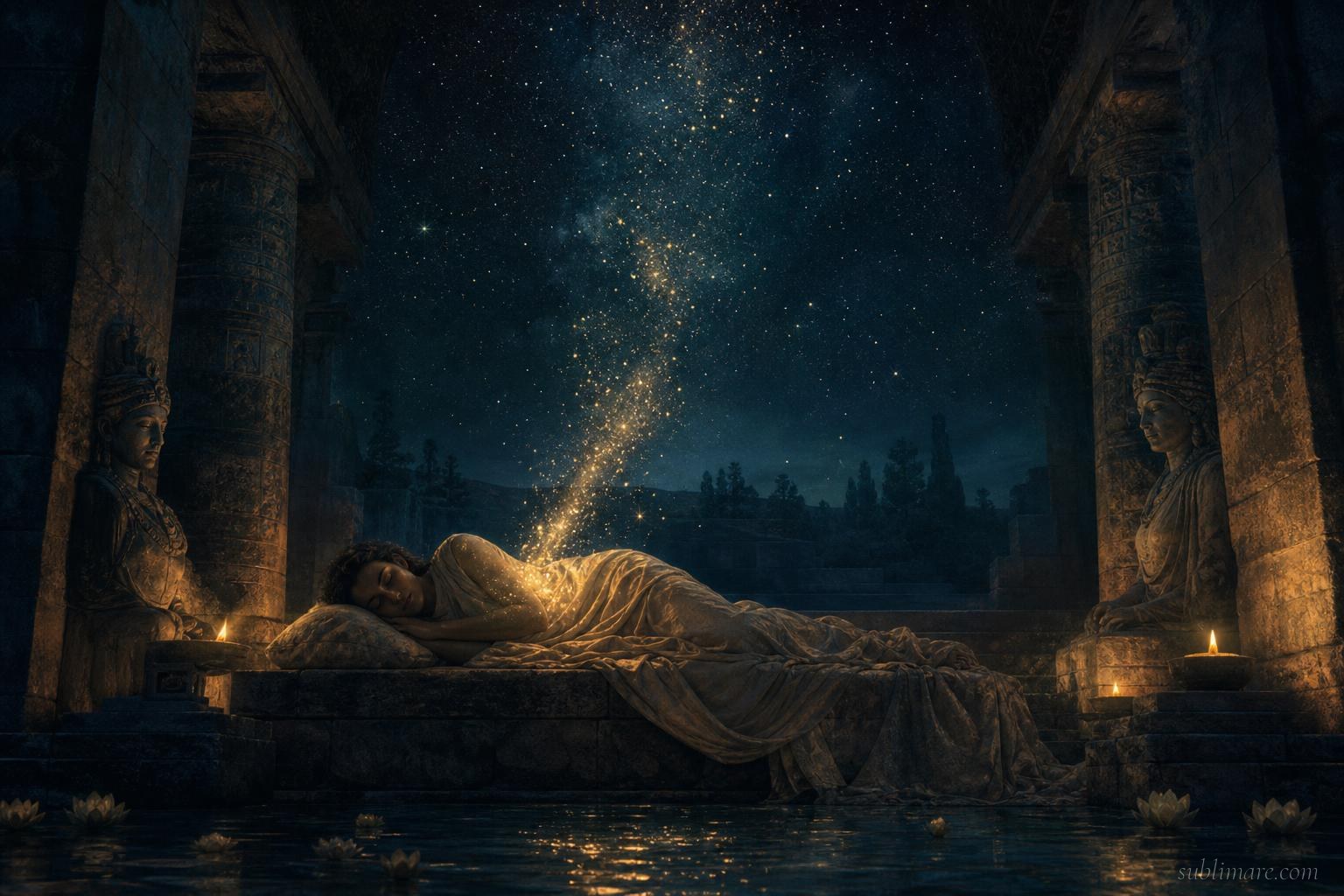
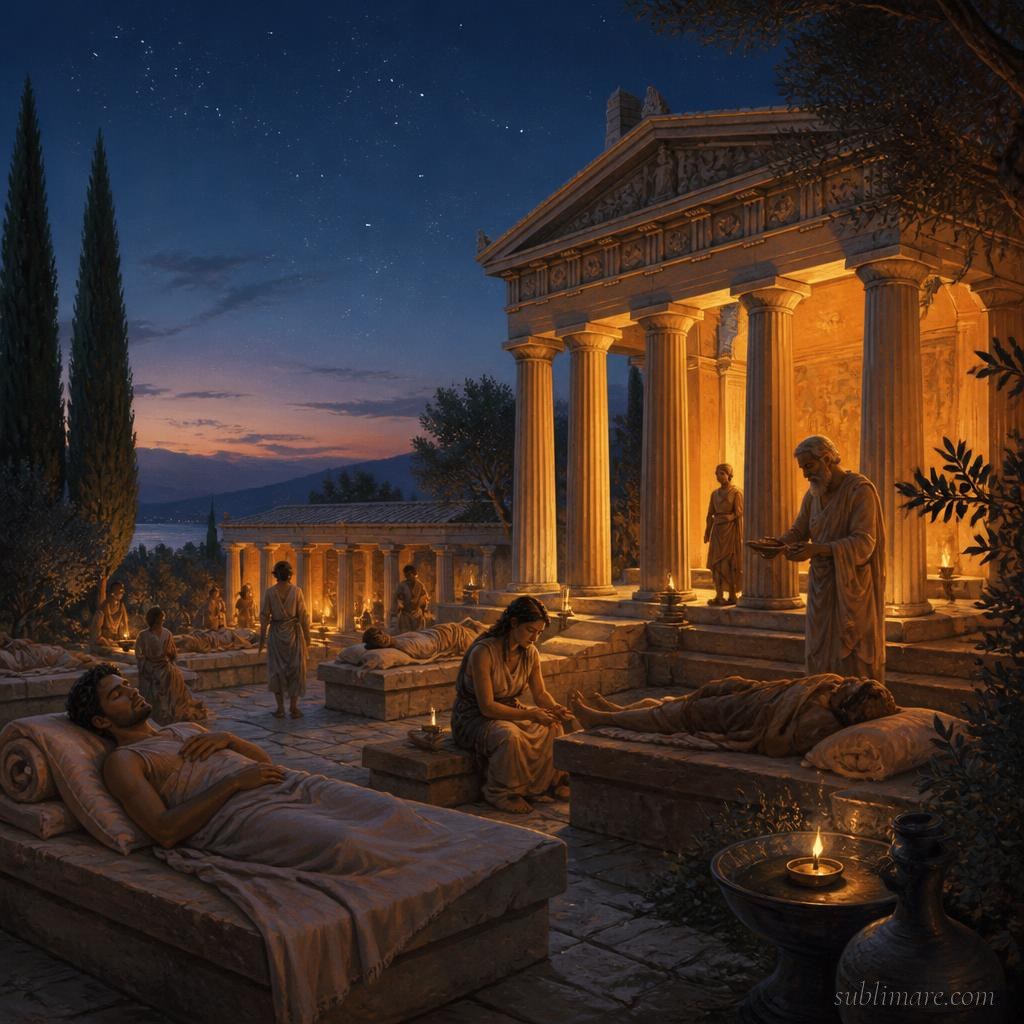
The practice, broadly called dream incubation (from the Latin incubare, to lie down upon), involved sleeping in a designated sacred space — often a temple — with the specific intention of receiving a dream that would provide healing, guidance, or prophecy. This wasn’t a fringe practice. It was a widespread, institutionalized feature of religious and medical life across multiple ancient civilizations.
In ancient Egypt, incubation rituals invoked deities including Imhotep (associated with healing and medicine) and Bes, with documented rituals recorded in surviving papyri describing the specific preparations undertaken before sleep. In Greece, the practice reached its most developed institutional form at the Asklepieion at Epidaurus and similar healing temples dedicated to Asklepios, the god of medicine — patients suffering from illness would travel to these sites, undergo purification rituals, and sleep within the temple grounds specifically to receive a healing dream, sometimes reporting the god appearing directly within the dream to perform a symbolic or literal cure. This practice functioned as a recognized form of ancient medical treatment, run by trained priests who interpreted and responded to the dreams reported. The Sumerian epic of Gilgamesh, among the oldest surviving works of literature, describes the king performing ritual preparations to receive guidance through dreams, indicating the practice’s antiquity predates even the Greek and Egyptian institutional forms by a significant margin.
Some historical accounts and recent popular scholarship have specifically highlighted the role these sleep sanctuaries played for women — offering a rare sanctioned space for rest, dream-based emotional processing, and consultation for conditions like grief and infertility, guided by priestesses trained in dream interpretation, at a time when women’s health concerns received little other institutional attention. Whatever one makes of the metaphysical claims behind the practice, the sociological function — a dedicated, ritually protected space for deep rest and psychological processing, staffed by trained interpreters — mirrors, in striking outline, functions we now associate with therapy and structured mental health support.
These practices didn’t disappear because they were disproven. They were largely suppressed through political and religious shifts, notably the closure of pagan temples following the Christianization of the late Roman Empire, which curtailed institutions like the Asklepieia even as some of their functions were later absorbed, in modified form, into Christian pilgrimage and healing shrine traditions.
What Sleep Deprivation Actually Costs You
The flip side of understanding sleep’s genuine complexity is understanding what’s lost when it’s chronically shortchanged — and the research on this is considerably more sobering than “you’ll feel tired.”
Johns Hopkins Medicine’s overview of sleep science notes that insufficient sleep measurably impairs brain function across multiple domains — attention, decision-making, emotional regulation — while also elevating risk for a wide range of physical health conditions, from cardiovascular disease to impaired immune function to metabolic dysfunction. Because slow-wave NREM sleep handles the bulk of physical restoration and REM sleep handles emotional processing and memory integration, chronic sleep restriction doesn’t just produce generic fatigue — it specifically degrades the functions tied to whichever stages get compressed most, and REM sleep in particular tends to be the first casualty of shortened sleep, since it’s concentrated in the final hours before waking that people most often sacrifice.
This has a specific, underappreciated spiritual and emotional cost. If REM sleep is where emotional memory gets processed and downregulated — the mechanism discussed at length in our earlier post on dream journaling — then chronically truncated sleep means chronically incomplete emotional processing. This may partly explain why sustained sleep deprivation correlates so strongly with anxiety, depression, and a generally reduced capacity for the kind of reflective, meaning-making thought that most contemplative practices depend on. It’s difficult to do the deep inner work that traditions from Stoicism to Buddhism to Christian contemplative prayer all describe when the biological substrate that processes emotional experience overnight isn’t getting adequate time to do its job.
Approaching Sleep as Sacred Territory, Practically
You don’t need a temple or a priestess to bring some of this historical seriousness back into your own relationship with sleep. A few practices, informed by both the ancient record and the modern science:
Treat the transition into sleep as a threshold, not a light switch. Ancient incubation rituals involved deliberate preparation — purification, quieting, setting an intention — before sleep, rather than sleep being an afterthought squeezed in after the last possible scroll through a phone. Even a simple version of this (dimming lights, a few minutes of stillness, setting an intention for rest or for a question you’d like clarity on) honors the transition rather than crashing through it.
Pay attention to the hypnagogic window, both entering and leaving sleep. This is a genuinely rich zone of experience that most people sleep through unconsciously or scroll through unconsciously, on either end. A few minutes of quiet attention as you’re drifting off, or immediately upon waking before reaching for a phone, gives this liminal state room to produce whatever it produces — imagery, insight, or simply a a felt sense of the threshold between two very different modes of consciousness.
Protect the full night, not just total hours. Since deep NREM sleep concentrates early in the night and REM concentrates late, a shortened night doesn’t lose sleep evenly across stages — it disproportionately cuts whichever stage falls at the end of your sleep window, most often REM. A night cut short at the back end costs you disproportionately more of the emotional processing stage than a full accounting of “hours slept” would suggest.
Consider sleep itself a form of practice, not merely a precondition for practice. Contemplative traditions have historically drawn a much thinner line between waking spiritual discipline and sleep than modern secular culture does. The Tibetan Buddhist tradition of dream yoga, explicit techniques for cultivating awareness within sleep and dream states, treats the entire sleep cycle as continuous ground for practice rather than a break from it. You don’t need to adopt that specific practice to take the underlying insight seriously: what happens overnight is not separate from your inner life during the day. It’s a direct continuation of it, processed through different, complementary machinery.
The Honest Bottom Line
Modern sleep science and ancient sleep temples were, in a real sense, both responding to the same underlying observation: something significant and specific happens during sleep that ordinary waking life cannot replicate or substitute for. The vocabulary differs enormously — hippocampal replay and slow-wave memory consolidation versus divine visitation and prophetic dream — but the underlying respect for sleep as a distinctive, valuable, and somewhat mysterious territory of human experience is shared across both.
You don’t need to resolve whether the healing dreams reported at Epidaurus were literally divine communication or a sophisticated placebo-and-ritual effect operating through the same neurobiological channels modern science now studies. What’s clear either way is that treating sleep — and the strange threshold states at its edges — with genuine attention rather than as dead time to be minimized is a very old and, it turns out, well-supported instinct. Something real happens there. Civilizations built temples around finding out what. The least you can do is stop reaching for your phone in the last conscious minutes before it happens.
Frequently Asked Questions
What are the stages of sleep and what does each one do?
Sleep alternates between non-REM (NREM) and REM sleep across the night. NREM has three stages: N1 (brief transition into sleep), N2 (the largest share of sleep, involved in memory processing), and N3 (deep slow-wave sleep, responsible for the bulk of physical restoration and immune function). REM sleep is when the most vivid dreaming occurs and plays a key role in emotional memory processing and integration. Deep NREM sleep concentrates earlier in the night, while REM sleep concentrates in the final hours before waking.
What is hypnagogia?
Hypnagogia is the transitional state between wakefulness and sleep, associated with the N1 sleep stage. It commonly produces vivid, unbidden imagery, auditory phenomena like hearing one’s name called, the sensation of falling accompanied by a hypnic jerk, and associative, image-based thought unlike ordinary waking cognition. Historical scholarship has connected this well-documented physiological state to many reported religious visions and visitations across history, since both share the quality of occurring in a state “neither awake nor asleep.”
What were ancient sleep temples used for?
Sleep temples, most notably the Asklepieia of ancient Greece dedicated to the healing god Asklepios, were sites where people practiced dream incubation — sleeping in a sacred space with the specific intention of receiving a healing or prophetic dream. This practice, documented across Sumerian, Egyptian, Greek, and Roman cultures, functioned as a recognized form of ancient medical and spiritual treatment, guided by trained priests or priestesses who interpreted the dreams reported by those seeking help.
How does sleep deprivation affect emotional and spiritual wellbeing?
Since REM sleep plays a documented role in processing and regulating emotional memory, chronic sleep restriction — which disproportionately cuts REM sleep, concentrated in the final hours of a sleep cycle — leaves emotional material less fully processed. This is linked to increased anxiety, depression, and reduced capacity for the kind of reflective, meaning-making thought that contemplative and spiritual practices typically depend on. Sleep deprivation isn’t just generic fatigue; it specifically undermines the biological processes most closely tied to emotional and psychological integration.
Is there a way to bring more spiritual attention to sleep without ancient rituals?
You can borrow the underlying principle without the specific historical form: treat the transition into sleep as a meaningful threshold rather than an afterthought, protect the full length of your sleep window (since shortening it disproportionately costs REM sleep), and pay quiet attention to the hypnagogic state entering and leaving sleep rather than immediately reaching for a phone. The Tibetan Buddhist practice of dream yoga offers a more developed formal tradition for those who want to treat sleep itself as continuous ground for contemplative practice.