
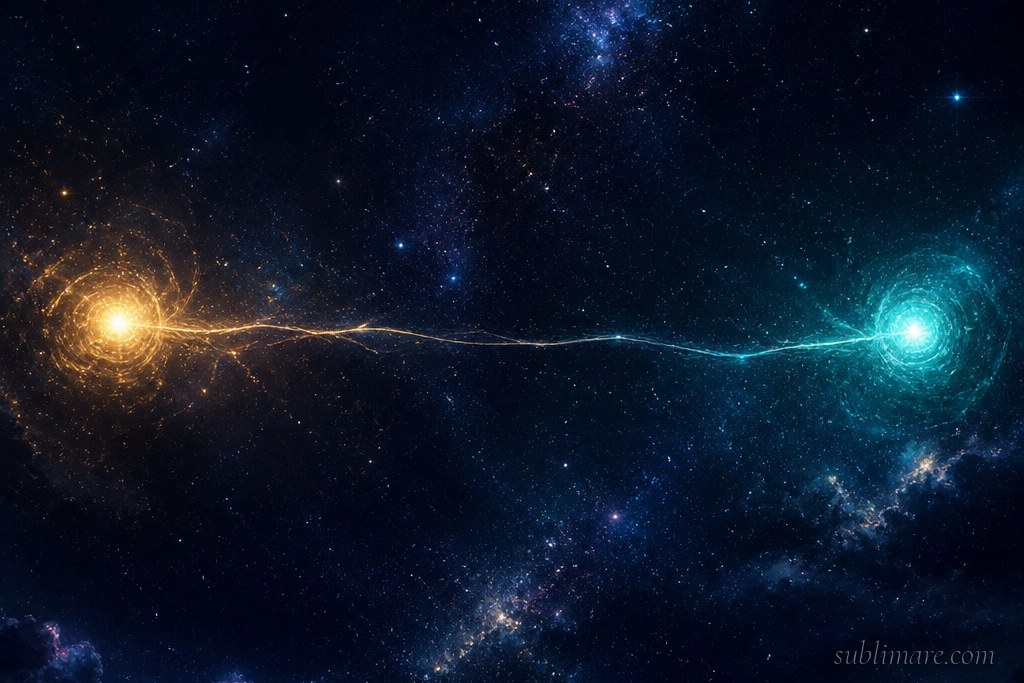
Picture two tiny particles born in the same instant, in the same flash of energy. Then they fly apart, one heading toward the edge of the galaxy, the other toward the far side of the cosmos. Light itself would need billions of years to cross the gap between them. And yet, when we measure one, the other responds as though they had never really parted. They behave like a single system stretched across the universe.
This is not science fiction. It is a real, repeatedly tested feature of nature, and physicists call it quantum entanglement. It is also one of the most borrowed ideas in spiritual and self-help writing, where it is often stretched far beyond what the physics supports.
This post is an attempt to separate the two. We’ll look at what entanglement actually is, why Einstein found it so uncomfortable, and how decades of experiments settled the argument. Then we’ll look at the ancient webs of meaning it’s so often compared to, from Indra’s Net to Carl Jung’s collective unconscious, and ask a simple question: where does the comparison inspire, and where does it overreach?
Entanglement in Plain English
What entanglement actually is
Entanglement happens when two or more particles share a single quantum state. Instead of each particle having its own separate description, the pair is described together, as one system. Measure one particle, and you learn something definite about the other, no matter how far apart they are.
Physicists typically create entangled pairs with photons, electrons or atoms, send them to separate detectors, and compare the results afterward. This has been done across laboratory benches, across cities, and in 2017 across more than 1,200 kilometers using a satellite.
A simple analogy, and where it breaks
Imagine a pair of gloves, each sealed in its own box. Ship one box to Tokyo and keep the other. When you open yours and find a left glove, you instantly know the other is a right. Nothing mysterious happened. The handedness of each glove was settled the moment it was packed.
Here is where the analogy breaks. In the quantum case, the outcome is not fixed in advance. A better picture is two coins that have no heads or tails until they are measured, yet whose results are always correlated. And the correlations are richer than a simple matching: they depend on how each side chooses to measure, and that is exactly what makes the glove explanation fail. The gloves can only explain so much. The experiments below show where they stop working.

It has been tested, and the result is not ambiguous
In 1964, physicist John Bell showed that experiments could tell the glove picture apart from the quantum one. Later, John Clauser, Alain Aspect and Anton Zeilinger ran increasingly careful versions of those tests, and nature sided with quantum mechanics. Their work earned the 2022 Nobel Prize in Physics.
One important catch: you cannot use entanglement to send messages faster than light. Each side’s results look completely random on their own, and the correlation only becomes visible when the two sides compare notes, which requires an ordinary signal traveling at ordinary speeds. Relativity stays safe.
Einstein and the “Spooky Action at a Distance”
Why Einstein objected
Einstein held a view called local realism, which sounds fancier than it is. “Realism” means objects have definite properties whether or not anyone looks. “Locality” means that what happens here can only influence what happens there by traveling through space, and nothing travels faster than light. Entanglement seemed to break one or both of these rules, and in a 1947 letter to Max Born he dismissed it as “spooky action at a distance.”
The EPR paper of 1935
Together with Boris Podolsky and Nathan Rosen, Einstein argued that quantum mechanics must be incomplete. If measuring one particle instantly tells you about its partner, they reasoned, the partner must have had that property all along. The theory simply wasn’t mentioning it. Those missing pieces became known as hidden variables, a kind of secret instruction sheet carried by each particle, like the sealed gloves.
How nature answered
Bell’s 1964 insight was that this question could be tested. Any theory built on local hidden variables must keep certain correlations below a mathematical limit, known as Bell’s inequality. Quantum mechanics predicts that limit can be exceeded.
The early experiments of the 1970s and 1980s, including Aspect’s, found the limit broken, but they left small technical gaps, or “loopholes,” that a determined skeptic could point to. Those gaps were closed one by one, and in 2015 several independent teams, in Delft, Vienna and at NIST in Colorado, reported “loophole-free” Bell tests. The result held: no theory of local hidden variables can reproduce what nature does.
It’s worth being precise about what that means. It rules out the specific picture Einstein hoped for. It does not settle what is going on underneath, and physicists still debate which interpretation of quantum mechanics is the right one, a question we touched on in our post on the observer effect.
Einstein lost this particular round, but he deserves real credit. His sharp critique turned a vague unease into a precise question, and that question led straight to the discoveries that answered it. Sometimes the best thing a great mind can do is ask the right question, even when the answer surprises them.
Classical Isolation vs. Quantum Interconnectedness
Before we go further, it helps to see the two pictures side by side. Classical physics, the science of falling apples and orbiting planets, treats the world as a collection of separate things. Quantum physics describes something more tangled.
| Classical physics | Quantum physics | |
|---|---|---|
| Objects and their properties | Separate objects with fixed properties | Systems described by shared states |
| Effect of distance | Influence fades as things move apart | Correlations that do not depend on distance |
| Role of measurement | Observing reveals what was already there | Measuring is part of how an outcome emerges |
| Whole and parts | Parts explain the whole | The whole state can say more than the parts |
None of this makes classical physics wrong. It remains excellent for everyday life, from building bridges to throwing a ball, and the quantum picture takes over at very small scales, where atoms and photons live.
You may wonder why we never see entanglement in daily life. The answer is that it is fragile. When a quantum system bumps into air molecules, light or heat, its delicate shared state leaks into the surroundings. This process is called decoherence, and it quickly washes out the quantum effects. That is why entanglement shows up in carefully shielded laboratories, not in your coffee cup. Researchers have managed to entangle surprisingly large objects, such as tiny vibrating mechanical devices, but only under extreme isolation.
Ancient Webs and Jung’s Collective Unconscious
Old images of a universal web
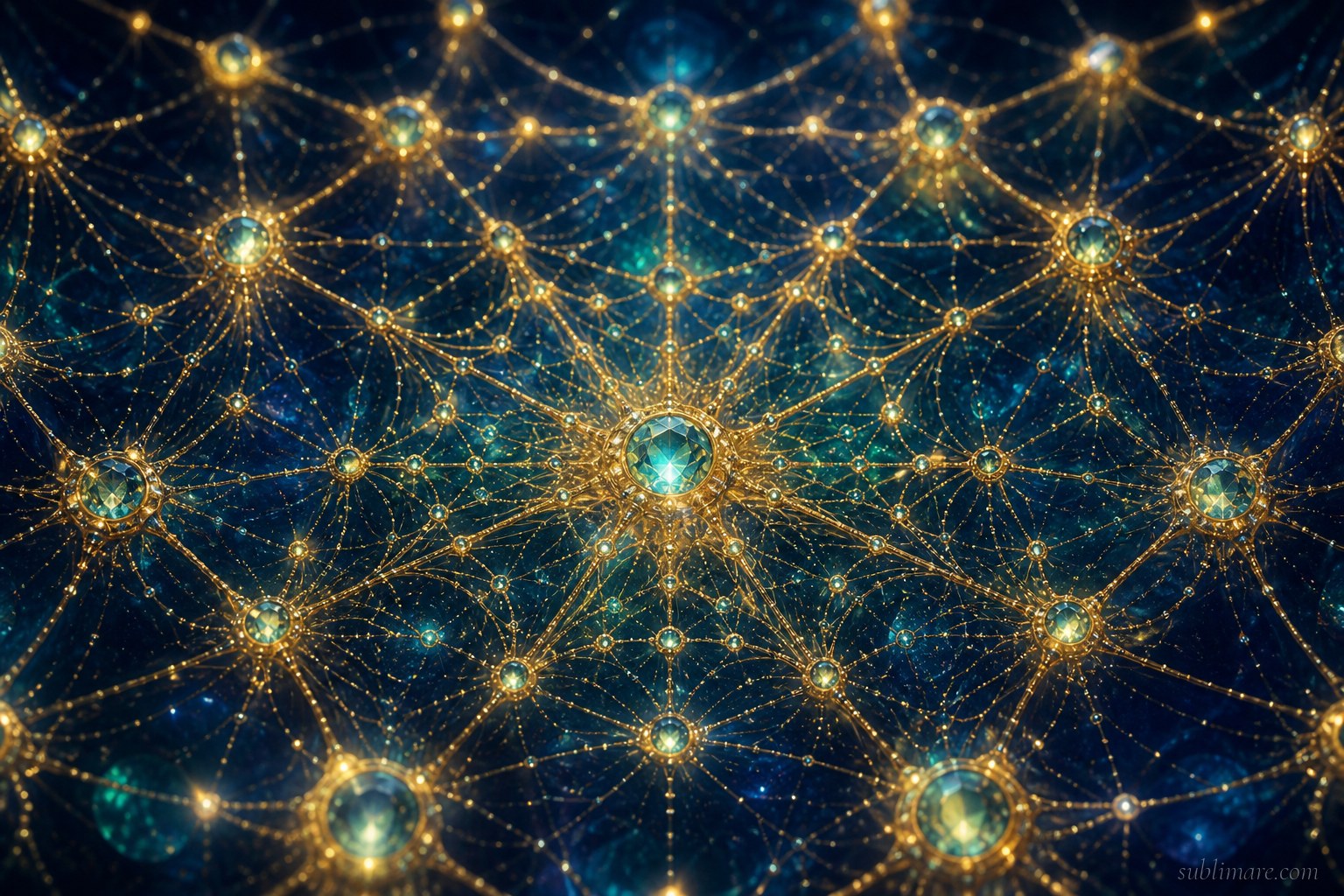
Long before physics labs, people were sketching webs of connection. The Buddhist Avatamsaka tradition, later developed in Chinese Huayan Buddhism, describes Indra’s Net, an endless web with a jewel at every knot. Each jewel reflects all the others, so the whole cosmos appears inside every single point. The Taoist tradition speaks of a unified flow, the Tao, in which things arise together and cannot be cleanly separated. Many Indigenous cultures hold a sense of kinship among all beings, from rivers to ravens to people.
In 1975, physicist Fritjof Capra popularized the comparison between modern physics and Eastern thought in The Tao of Physics. The book inspired many readers, and drew sharp criticism from many physicists, who felt it matched surface similarities while ignoring how different the two projects are.
Jung’s collective unconscious
Carl Jung proposed that beneath our personal memories lies a shared layer of the psyche, the collective unconscious. It holds archetypes, such as the hero or the mother, that appear across human cultures. Jung also worked with physicist Wolfgang Pauli, and together they explored synchronicity: meaningful coincidences that seem linked without a causal chain.
The resonance with entanglement is easy to feel. In each picture, parts cannot be fully understood alone, and a deeper layer links them. But Jung’s theory is a psychological hypothesis, not established physics, and many psychologists regard the collective unconscious as unproven. Pauli and Jung themselves treated their joint ideas as speculation.
What Entanglement Does Not Show
Because entanglement sounds so evocative, it’s routinely cited as evidence for claims it cannot support. Here are the most common ones.
It does not demonstrate telepathy or instant communication. As covered above, no information travels through an entangled pair. Without the ordinary comparison step, each side sees only random-looking results.
It does not give thoughts or intentions a way to shape distant events. Entanglement is a precisely defined relationship between quantum states, and it is wiped out quickly in warm, messy environments like brains and bodies. Nothing in the physics connects it to intention or manifestation, a theme we examined in the science of manifestation.
It does not show that consciousness creates reality. Entanglement and measurement are physical interactions, and as we saw in our look at the observer effect, nothing in the experiments requires a conscious observer.
It does not prove any particular spiritual tradition right. Analogies between Indra’s Net and entanglement are beautiful, but they are analogies. If a spiritual idea is true, it needs to stand on its own evidence, not on borrowed physics. That is a theme we return to often, including in why science and spirituality are not opposites.
“Quantum mysticism” goes astray exactly here, by treating a resemblance as a proof. The real value of the comparison is inspiration: old ideas and new physics can prompt fresh questions, as long as we keep each in its proper place.

What This Means for How We See Our Place in the World
Step back from the equations and the ancient stories, and a simple picture remains. At its foundation, nature seems to be relational. Particles are not always tidy, separate things with private properties, and sometimes the best description belongs to the pair rather than to either partner. Long before laboratories existed, philosophers in many traditions sensed a similar theme and put it in their own language: jewels reflecting jewels, a single flowing way, a family of all living things.
So what do we do with that? Stay curious. Enjoy the metaphor, but let the science stay honest. And look for the connections that are demonstrably real: the ecosystems that depend on every small creature, the communities that hold us up, and the atoms in our bodies that were forged in ancient stars.
A small practice to try
Tonight, pick one ordinary choice from your day, such as what you bought, said or shared, and trace how it might ripple outward to someone else. You don’t need quantum physics for this one. The ripples are real, and they travel through ordinary, well-understood channels: people, supply chains, conversations, kindness. You may be surprised how far it goes.
The Honest Bottom Line
Quantum entanglement is real, extensively tested, and one of the strangest and most important discoveries in the history of physics. It shows that nature does not always work the way our everyday intuition says it should, and that two particles can share a single description no matter how far apart they are. Its experimental confirmation was recognized with the 2022 Nobel Prize in Physics.
What it does not show is that everything is mystically linked, that thoughts travel through entangled channels, or that any spiritual tradition has been proven by physics. The sense of interconnectedness that so many traditions describe may well be worth taking seriously, but the evidence for it lies in ecology, psychology, and lived experience, not in a Bell test. Held honestly, the two can sit side by side: a physics that is already strange enough without embellishment, and a human longing for connection that doesn’t need physics to justify it.
Frequently Asked Questions
Does quantum entanglement prove that everything is connected?
No. Entanglement shows that certain particles can share a single quantum state and display correlations that no local hidden-variable theory can explain. It does not establish a universal, mystical connection between all things, and entanglement is typically destroyed quickly by interaction with the environment.
Can entanglement be used to communicate faster than light?
No. Each observer’s results look random on their own. The correlation only becomes visible when the two sides compare their results using an ordinary signal, which travels at or below the speed of light. This is why entanglement does not violate relativity.
Why did Einstein call it “spooky action at a distance”?
Einstein believed in local realism: objects have definite properties, and influences cannot travel faster than light. Entanglement appeared to contradict this, so he argued that quantum mechanics must be incomplete. Later experiments based on John Bell’s 1964 theorem showed that no local hidden-variable theory can match nature’s results.
Is Jung’s collective unconscious related to quantum entanglement?
Not in any scientifically established way. Jung and physicist Wolfgang Pauli explored the idea of synchronicity together, and the comparison between a shared psychological layer and shared quantum states is evocative. But it is an analogy, and the collective unconscious remains a psychological hypothesis rather than a physical theory.
Why don’t we see quantum entanglement in everyday life?
Entanglement is fragile. When a quantum system interacts with air molecules, light or heat, its shared state spreads into the environment, a process called decoherence. This quickly erases quantum effects in warm, everyday settings, which is why entanglement is observed mainly in carefully isolated laboratory experiments.
Sources
- The Nobel Prize in Physics 2022: press release, NobelPrize.org (Aspect, Clauser, Zeilinger).
- Yin et al., “Satellite-based entanglement distribution over 1200 kilometers” (2017), arXiv preprint.
- Hensen et al., “Loophole-free Bell inequality violation using electron spins separated by 1.3 kilometres”, Nature (2015), Delft.
- Giustina et al., “Significant-loophole-free test of Bell’s theorem with entangled photons” (2015), arXiv preprint, Vienna.
- Shalm et al., “A strong loophole-free test of local realism” (2015), arXiv preprint, NIST.
- Also in print (not linked): Einstein, Podolsky and Rosen, Physical Review 47, 777 (1935); J. S. Bell, Physics Physique Fizika 1, 195 (1964).
Related Posts