
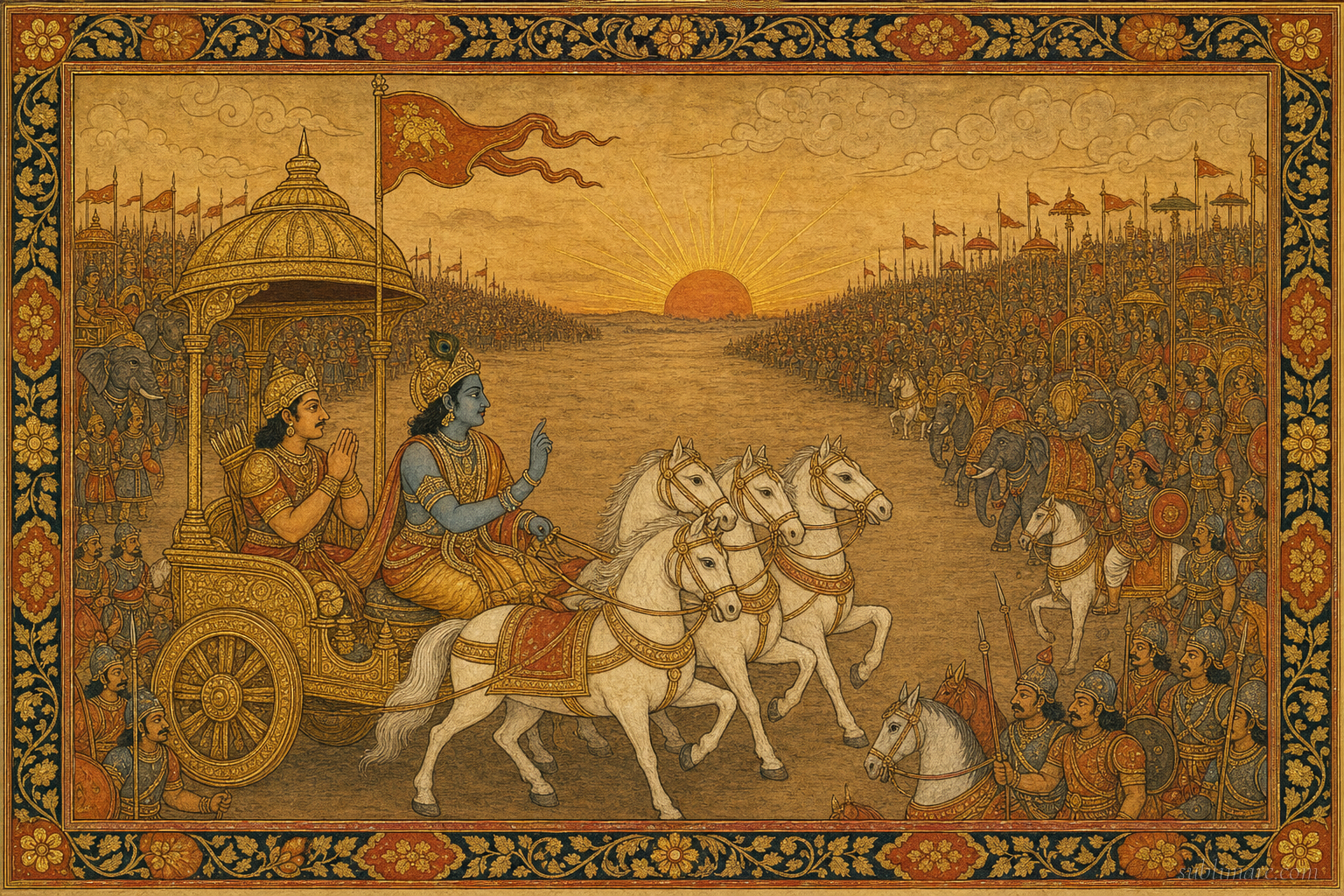
The Bhagavad Gita doesn’t start with a lecture. It starts with a crisis.
Arjuna is a warrior standing on a battlefield, about to fight a war that will require him to kill people he loves — cousins, teachers, mentors. He drops his bow. His hands shake. He tells Krishna he can’t do it. He doesn’t know what the right thing is anymore.
That’s where the Gita begins. In the middle of a decision that has no clean answer.
Why This Framing Matters
Most ancient wisdom texts start from a place of authority — here is the truth, follow it. The Gita is different. It starts from genuine doubt. From the most human possible feeling: I don’t know what to do and every option is going to cost me something.
That’s why it still speaks across 2,500 years. It’s not talking about easy choices. It’s talking about the ones that keep you awake at night.

The Core Teaching: Act Without Attachment to Results
What Krishna tells Arjuna is counterintuitive. He doesn’t say “here’s how to figure out the right choice.” He says: stop trying to control the outcome.
The concept is nishkama karma — desireless action. Do what your dharma (your duty, your nature, your deepest responsibility) calls you to do. Do it fully. And release the results.
This sounds passive. It’s not. It’s a profound shift in orientation. You’re still acting — decisively, fully — but you’re not holding your peace hostage to the outcome. The action is yours. The result isn’t.
Dharma: More Than Just “Duty”
Dharma gets translated as “duty” a lot, which makes it sound like a chore. It’s closer to your nature, your essential function, the particular way you’re meant to show up in the world.
When you’re considering a hard decision, the Gita would ask: what does your dharma point toward? Not what feels safest, not what gets you the best outcome, not what other people think you should do — but what you know, at the level of your deepest integrity, to be right?
There’s a simple test I find useful here, drawn from the Gita’s logic: if a decision requires constant justification, it’s probably coming from fear. If it’s steady even when challenged, even when costly, it’s probably closer to dharma.
Samatva: Equanimity as a Practice
Krishna also talks at length about samatva — equanimity. The ability to meet success and failure with the same quality of mind. Not indifference — he’s not saying don’t care. He’s saying don’t let the external result determine your internal state.
This is genuinely hard to embody. We’re wired to feel better when things go our way and worse when they don’t. But the capacity to stay centered regardless of results — to make decisions from a stable place rather than a reactive one — is exactly what the Gita is trying to cultivate.
It’s similar in some ways to the Stoic approach — which makes sense, given that Stoicism and the Gita were developing roughly around the same era, in different parts of the world, pointing at some of the same insights.
The Practical Version
When I’m stuck on a hard decision, I’ve found a few questions from the Gita’s framework useful:
What would I do if I knew the outcome didn’t depend on me? What does my clearest, most honest self think — not my anxious self, not my ego, not what I want other people to see me do?
And: can I do this fully, without holding back, and then let go of what happens next?
That last one is the hardest. It’s also the one the Gita keeps coming back to. Act from your deepest nature. Give it everything. Don’t make your peace conditional on the result.
That’s not a formula for getting what you want. It’s a formula for being able to live with yourself — which in the long run might be worth more.
Related Posts