

Crowded rooms exhaust you. Other people’s moods become your moods before you realize it. Here are 12 traits commonly associated with being an empath — and the real psychology and neuroscience behind why some people experience the world this way.

Every night you pass through a threshold state that ancient cultures built entire temples around — and modern neuroscience is only now starting to understand why. Here’s what actually happens during sleep, what the liminal zone at its edges was used for across history, and why treating sleep as sacred isn’t just poetic language.

Your gut has been wrong before — badly, memorably wrong. So how do you know when to trust it again? Psychology has a real answer: intuition isn’t one thing. It’s reliable in some conditions and actively misleading in others. Here’s how to tell the difference.
For decades psychedelic research was frozen by drug policy. Over the last twenty years it has quietly become one of the most rigorous fields in psychiatry — and the results consistently point to something unexpected: the mystical quality of the experience itself may be doing the therapeutic work. Here’s what the studies actually show.

Time disappears, self-consciousness vanishes, and a task that would normally feel effortful becomes effortless. Psychologists call this flow. Neuroscientists have spent 50 years trying to explain what’s actually happening in the brain when it occurs — and how to get there more reliably.

Manifestation has become a cultural phenomenon — vision boards, affirmations, the idea that focused intention can reshape reality. Strip away the marketing and the quantum-physics misuse, and there’s a real psychological mechanism underneath. Here’s what the research actually supports, and where it stops.

Most morning routine advice is either too complicated or too vague. The science, however, is surprisingly clear about which habits actually shift your mood, focus, and energy — and why the first 90 minutes after waking are the most powerful window in your day.
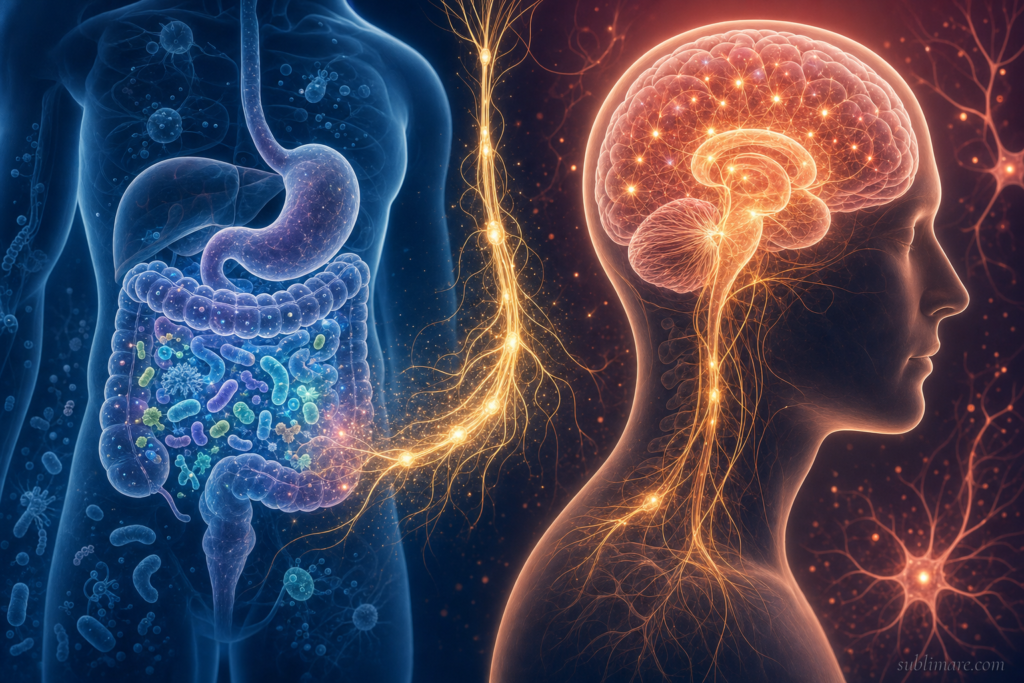
Your gut has its own nervous system, produces 95% of your serotonin, and talks to your brain far more than your brain talks back. Understanding this changes how you think about anxiety, mood, and mental health.

Millions of people have reported them. The experiences are strikingly similar across cultures and backgrounds. And science still doesn’t have a clean explanation. Here’s the honest state of the NDE research.
For most of history, we thought the adult brain was fixed. Neuroplasticity proved that wrong. Your brain changes every time you learn, practice, and yes — even when you think. Here’s what that means for you.