Ayurveda has had an unusual journey through modern wellness culture. It shows up as dosha quizzes on lifestyle blogs, as a marketing term on supplement bottles, and occasionally as a genuinely serious clinical framework studied at research universities. These are wildly different levels of engagement with the same underlying tradition, and most people encounter only the first — the simplified, quiz-friendly version — without ever meeting the actual system it’s drawn from.
Ayurveda, whose name derives from Sanskrit and translates roughly to “the science of life,” is one of the oldest continuously practiced medical systems in the world, with roots extending back more than 5,000 years into Vedic culture in India — predating written Greek medicine by a significant margin. It’s also, today, formally recognized by the World Health Organization as a traditional medicine system, actively integrated into India’s national healthcare framework, and the subject of a growing body of peer-reviewed research examining both its individual components and its broader theoretical framework.
This is an honest introduction to what Ayurveda actually claims, how its core framework works, what the scientific evidence does and doesn’t support, and what’s genuinely useful to take from it if you’re building any kind of personal wellness practice today.

The Core Framework: Doshas
At the center of Ayurvedic theory sits the concept of three doshas — Vata, Pitta, and Kapha — dynamic principles believed to govern all physiological and psychological function. Each dosha is understood as a combination of two of the five classical elements (space, air, fire, water, earth) that Ayurvedic theory considers the fundamental building blocks of the physical universe.
Vata (composed of space and air) governs movement — nerve impulses, circulation, breathing, elimination, and the general quality of dynamism in body and mind. People with a Vata-dominant constitution are traditionally described as quick-thinking, creative, and easily excitable, but also prone to anxiety, irregular digestion, and difficulty settling when out of balance.
Pitta (composed of fire and water) governs transformation — digestion, metabolism, and the processing of both food and ideas. Pitta-dominant individuals are traditionally described as focused, driven, and intelligent, with a tendency toward irritability, inflammation, and perfectionism when imbalanced.
Kapha (composed of earth and water) governs structure and stability — the body’s physical form, immune resilience, and emotional steadiness. Kapha-dominant people are traditionally described as calm, grounded, and nurturing, with a tendency toward sluggishness, weight gain, and emotional stagnation when out of balance.
Every person, in this framework, has a unique baseline constitution (prakriti) established at conception — typically a combination of all three doshas in individual proportions, with one or two usually dominant. Health is understood as maintaining this individual baseline in balance; illness arises from disturbances that push one or more doshas out of their natural proportion, whether from diet, season, stress, or lifestyle. This is a fundamentally personalized medical model: rather than treating a diagnosed condition the same way in every patient, classical Ayurvedic practice asks what treatment restores balance for this specific person’s particular constitution.
A More Sophisticated System Than the Quiz Version Suggests
What tends to get lost in the popular “which dosha are you” framing is that classical Ayurveda is a genuinely comprehensive medical and philosophical system, not simply a personality typology. It includes detailed anatomical and physiological theory, a pharmacology of thousands of herbal and mineral substances, surgical techniques described in ancient texts like the Sushruta Samhita (which includes procedures for cataract surgery and reconstructive rhinoplasty that predate comparable Western techniques by over a thousand years), a theory of digestion and metabolism (agni) considered central to nearly all disease processes, and detailed guidance on diet, daily routine, seasonal adjustment, and mental health that integrates far more subtlety than a three-category personality system implies.
Ayurveda also doesn’t separate physical and mental health the way modern Western medicine historically has. The system treats body, mind, and what it calls consciousness as fundamentally interconnected, with mental and emotional states considered direct contributors to physical disease processes and vice versa — a holistic framing that mainstream Western medicine has, notably, been moving toward more explicitly in recent decades through fields like psychoneuroimmunology, even without adopting Ayurvedic vocabulary.
What the Scientific Evidence Actually Shows
This is where an honest treatment of Ayurveda needs to be genuinely careful, because the evidence picture is real but mixed, and different components of the system have very different evidentiary status.
The dosha theory itself lacks direct scientific validation. A widely cited review notes plainly that there is currently no scientific evidence confirming the existence of doshas as biologically distinct categories, nor validated methods for objectively measuring them. This doesn’t mean the framework is useless as a heuristic — many personality and constitutional frameworks (including some used in mainstream psychology) function as useful organizing tools without being literally, biologically “real” in a strict reductionist sense — but it does mean the doshas shouldn’t be presented or understood as an established biological classification system in the way, say, blood types are.
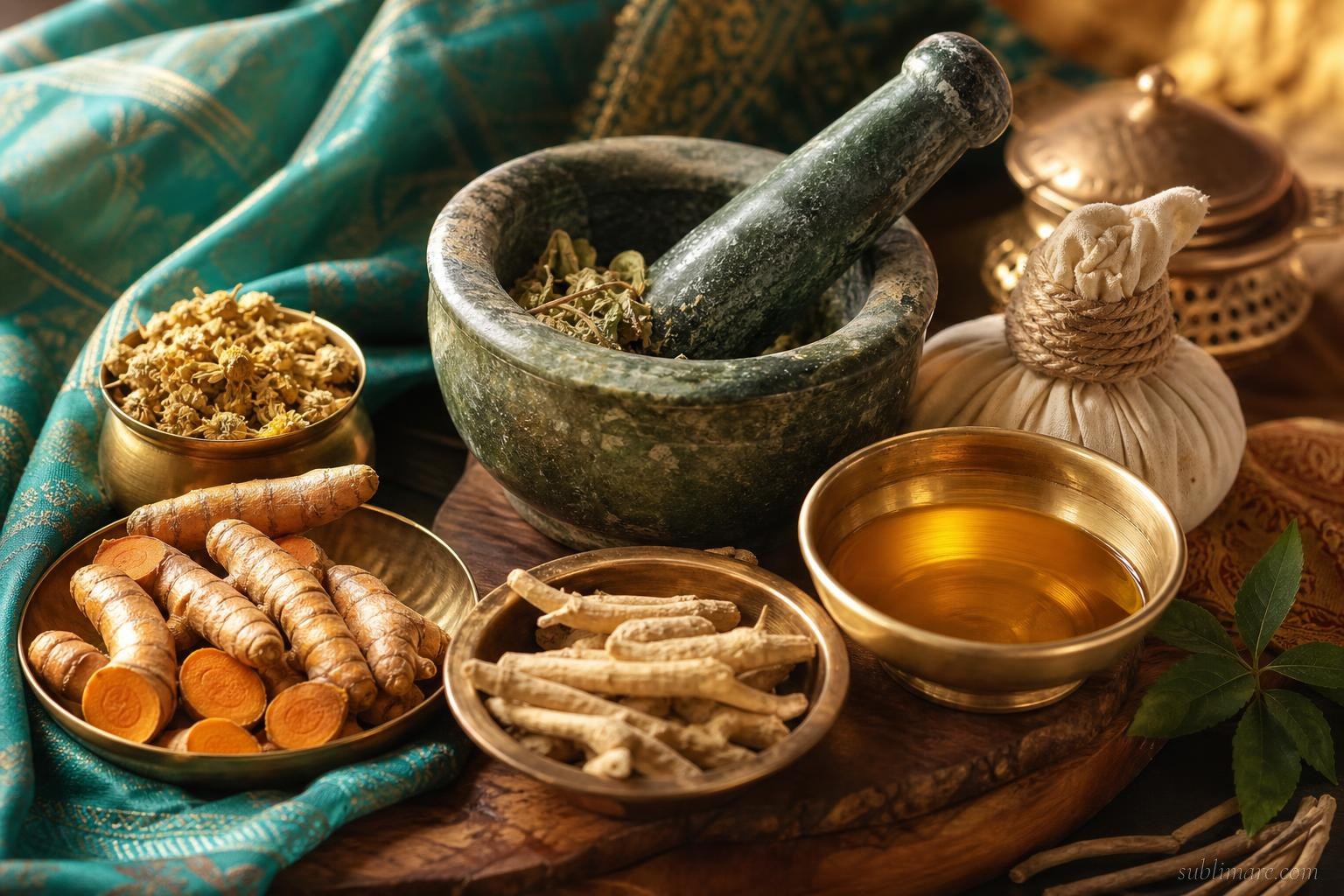
Individual Ayurvedic herbs have a considerably stronger and more specific evidence base. Research highlighted by institutions including Thermo Fisher Scientific has examined specific compounds used in traditional Ayurvedic pharmacology — turmeric (and its active compound curcumin) for anti-inflammatory effects, ashwagandha for stress reduction and cortisol regulation, and others — with a growing number of studies finding measurable biological activity consistent with traditional therapeutic claims. This is a meaningfully different evidentiary category than the doshas: individual compounds can be isolated, dosed, and tested using standard pharmacological methods, and several have shown genuine promise in peer-reviewed research, though the overall body of evidence for most is still described by researchers as preliminary and in need of larger, more rigorous clinical trials.
Lifestyle and dietary recommendations often align with independently established health science, even when the underlying dosha rationale isn’t itself validated. Ayurvedic emphasis on regular meal timing, seasonal dietary adjustment, adequate sleep, stress management, and mindful eating overlaps substantially with recommendations from mainstream nutrition and lifestyle medicine — not because the dosha theory was empirically derived the way modern nutritional science was, but because careful, centuries-long observation of how diet and routine affect wellbeing likely converged on genuinely useful practices, even without a modern mechanistic explanation attached.
Safety is a genuine and specific concern that deserves direct attention. A notable caution raised in medical literature, including coverage from News-Medical, involves documented cases of heavy metal contamination (lead, mercury, arsenic) in certain traditionally prepared Ayurvedic formulations, particularly those involving rasashastra preparations that intentionally incorporate metals and minerals as part of classical pharmacology. This is a real, documented risk — not a fringe concern — and it means Ayurvedic herbal products, especially those imported without third-party quality testing, should be treated with the same scrutiny as any unregulated supplement, and ideally sourced only through practitioners or brands that provide independent contaminant testing.

What Modern Integrative Medicine Is Actually Doing With It
Rather than either wholesale adoption or wholesale dismissal, the more serious contemporary engagement with Ayurveda — reflected in academic reviews and integrative medicine programs — is a selective, evidence-informed integration. A 2024 academic review on bridging Ayurveda with modern medicine specifically frames the goal as identifying which elements of the system have testable, verifiable mechanisms and outcomes, and incorporating those into complementary care, while treating the broader metaphysical framework (the doshas, the elemental theory) as a traditional interpretive lens rather than a literal biological model requiring empirical proof on its own terms.
This mirrors a pattern we’ve seen elsewhere on this blog — with the chakra system, for instance, where an ancient framework doesn’t need to be literally, mechanistically true in every claim to still offer a genuinely useful map for organizing attention, self-observation, and lifestyle choices. The most intellectually honest position on Ayurveda, and traditions like it, isn’t “ancient wisdom the establishment suppressed” or “primitive superstition science has fully debunked.” It’s closer to: a sophisticated pre-modern system of accumulated observation, some of which anticipates or aligns with what later science independently confirmed, some of which reflects the specific cosmological assumptions of its era and hasn’t held up, and some of which — particularly around individual herbal compounds — is still an active area of legitimate ongoing research.
Practical Ayurvedic Principles Worth Trying
Setting aside the dosha typology as a strict diagnostic system, several core Ayurvedic lifestyle principles are worth genuine consideration, either because they have independent supporting evidence or because they represent low-risk, potentially valuable additions to daily life.
Eating your largest meal at midday. Ayurvedic theory holds that digestive fire (agni) is strongest around midday, mirroring the sun’s peak, and recommends the day’s largest meal accordingly, with lighter meals in the morning and evening. This aligns notably well with independent chronobiology research on circadian rhythms and metabolism, which has found that insulin sensitivity and digestive efficiency tend to be higher earlier in the day, making earlier, larger meals metabolically favorable compared to large meals eaten late at night.
A consistent daily routine (dinacharya). Ayurveda places significant emphasis on regularity — consistent wake times, consistent meal times, consistent sleep times — as foundational to health, treating irregularity itself as a disease-generating factor regardless of the specific activities involved. This aligns closely with modern circadian rhythm research, covered in our earlier piece on morning routines, which consistently finds that regularity in daily timing supports better sleep, mood, and metabolic health, independent of what specific activities fill that schedule.
Seasonal adjustment of diet and activity. Ayurvedic practice traditionally recommends adjusting diet, exercise intensity, and daily rhythm according to season — warming, heavier foods in cold months, lighter and more cooling choices in hot months. This is a genuinely reasonable, low-risk practice that mirrors what many traditional food cultures worldwide independently arrived at through seasonal eating, well before industrialized food systems made identical foods available year-round regardless of climate or season.
Attention to your own constitutional tendencies, used descriptively rather than diagnostically. Even without accepting doshas as a literal biological category, using the Vata/Pitta/Kapha language as a loose descriptive vocabulary for noticing your own patterns — do I tend toward anxious, scattered energy; toward driven, irritable intensity; toward steady, sometimes sluggish groundedness — can be a genuinely useful self-observation tool, in the same spirit as using any personality framework (Enneagram, Myers-Briggs, or otherwise) as a starting point for reflection rather than a fixed scientific verdict on who you are.

Approaching Ayurveda Responsibly
If you’re interested in exploring Ayurveda more seriously than a quiz-based dabbling, a few practical guidelines worth keeping in mind:
Treat it as complementary, not a replacement for conventional medical care, particularly for diagnosed conditions with established treatments. This is the position most seriously engaged integrative medicine researchers and even Ayurvedic institutions themselves recommend — using traditional and modern approaches together rather than choosing one exclusively.
Source herbal products carefully, given the documented heavy-metal contamination risk in some traditionally prepared formulations. Look specifically for third-party testing and reputable sourcing, and be especially cautious with products imported without regulatory oversight.
Consult a qualified practitioner for anything beyond basic lifestyle adjustments — proper Ayurvedic training involves years of study, and self-diagnosing based on an online quiz and then self-prescribing herbal treatments carries real risk, particularly around herb-drug interactions if you’re taking other medications.
Hold the framework with genuine curiosity rather than either credulity or dismissal. Ayurveda represents thousands of years of careful, systematic observation by a sophisticated intellectual tradition. It also emerged from and reflects the cosmological assumptions of its era, the way every medical system, including the history of Western medicine, has. Neither fact cancels the other out.
The Honest Bottom Line
Ayurveda is neither the ancient cure-all sometimes claimed by uncritical wellness marketing, nor the pure superstition sometimes dismissed by uncritical skepticism. It’s a genuinely sophisticated, millennia-old medical and philosophical system with real intellectual depth, a mixed but real evidence base that varies significantly depending on which specific component you’re examining, documented safety concerns that deserve serious attention, and a set of lifestyle principles — regularity, seasonal attunement, mindful eating, attention to individual constitution — that hold up well even independent of the elemental theory used to originally justify them.
The most useful way to engage with it today is probably the same way this blog has approached most ancient frameworks: with genuine respect for the accumulated observation behind it, genuine honesty about what current science has and hasn’t confirmed, and a practical willingness to extract what’s useful without needing every claim to be literally, mechanistically true to justify the extraction.
Frequently Asked Questions
What are the three doshas in Ayurveda?
The three doshas are Vata (governing movement, composed of space and air), Pitta (governing transformation and digestion, composed of fire and water), and Kapha (governing structure and stability, composed of earth and water). Ayurvedic theory holds that every person has a unique baseline combination of all three, with one or two typically dominant, and that health depends on keeping this individual balance intact.
Is there scientific evidence for Ayurveda?
The evidence is mixed and varies by component. There’s no direct scientific validation for the doshas as biologically distinct, measurable categories. However, individual Ayurvedic herbs like turmeric and ashwagandha have a growing, though still developing, evidence base for specific biological effects like anti-inflammatory activity and stress reduction. Many Ayurvedic lifestyle recommendations, such as regular routines and seasonal eating, align well with independently established findings in nutrition and circadian rhythm science.
Is Ayurveda safe?
Many Ayurvedic lifestyle practices (diet timing, routine, seasonal adjustment) carry minimal risk. However, some traditionally prepared herbal formulations, particularly certain rasashastra preparations that intentionally include metals and minerals, have been documented in medical literature to contain concerning levels of heavy metals like lead, mercury, and arsenic. Sourcing herbal products from reputable, third-party-tested sources and consulting a qualified practitioner, especially if taking other medications, are important safety measures.
How old is Ayurveda?
Ayurveda’s roots extend back more than 5,000 years into Vedic culture in ancient India, making it one of the oldest continuously practiced medical systems in the world — predating written Greek medicine by a significant margin. Classical texts like the Charaka Samhita and Sushruta Samhita, which detail its theoretical framework and surgical techniques respectively, date back roughly 2,000 to 2,500 years, though the oral tradition behind them is considerably older.
Should Ayurveda replace conventional medical treatment?
No. The most responsible and widely recommended approach, supported by both integrative medicine researchers and many Ayurvedic institutions themselves, treats Ayurveda as a complementary framework alongside conventional medical care, particularly for diagnosed conditions with established treatments — not as a replacement for evidence-based medical treatment.